Showing posts with label Books and Authors. Show all posts

Wednesday, December 14, 2016

These Books We Love

My son began pulling out books from the bookshelf just about when he started crawling, and there has been no looking back since.  The lowest two shelves of our bookshelf are filled with his books; he reads them as well as many of ours which fill the other shelves (now he can stand on his toes and pull them out!).
If you need to buy books for children between two and four years of age (though I think we started reading earlier), here are some of our favourites apart from the old classics (which I also mention below) -

Old favourites are- Michael Bond ('Paddington', stories about a bear from darkest Peru, who my son loves to emulate!), A. A. Milne and E. H. Shepard (Winnie-the-Pooh) - we began with all of Pooh's songs (The more it snows/Tiddley Pom/ The more it goes/ Tiddley Pom/ The more it goes/ Tiddley Pom/ On snowing..).  Margaret Rey and H. A. Rey (Curious George ("This is Nayan.  He lived in Bangalore.  He was a good little monkey and always very curious...").  Dr. Seuss (The Cat In The Hat is truly a classic that no child or parent perhaps gets tired of.  For younger readers, I recommend Fox in Socks and for the in between ages, Green Eggs And Ham).  

My friend Nora introduced us to two authors that Nayan likes enormously- Richard Scarry (What Do People Do All Day) - "Hello tanker, are you lost?  No Nayan, I'm just filling some petrol in the underground tank of the petrol pump."  Lauren Child (the Charlie and Lola series)- "I completely love winter - can I go skiing, Mummy?" or "Can I have some orange twiglets from Jupiter (carrots)?"

If there is any one publisher I can mention (based on the number of books we buy from each publisher), it would be Walker Books, but of course, there are many, many others in the market.

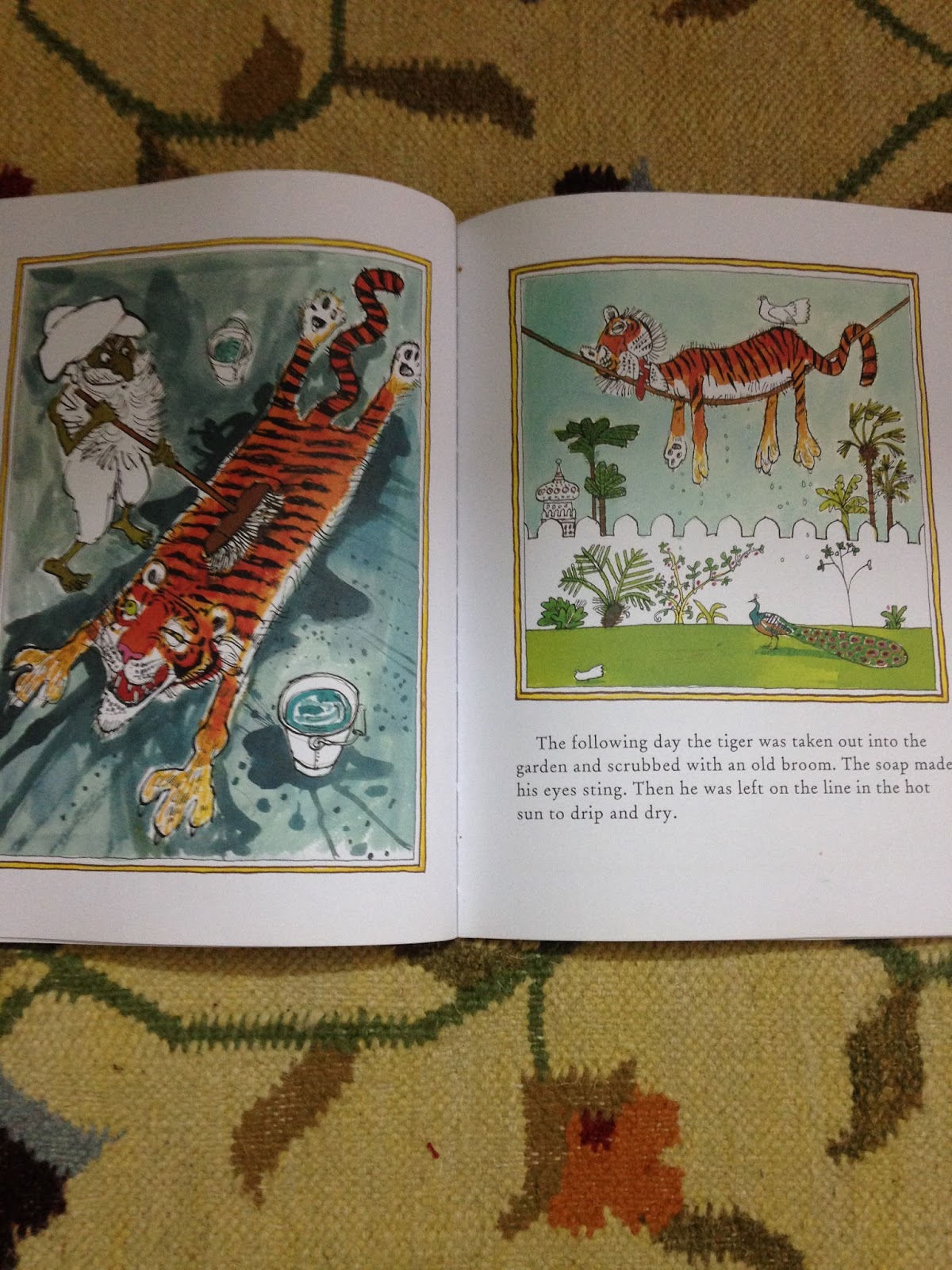
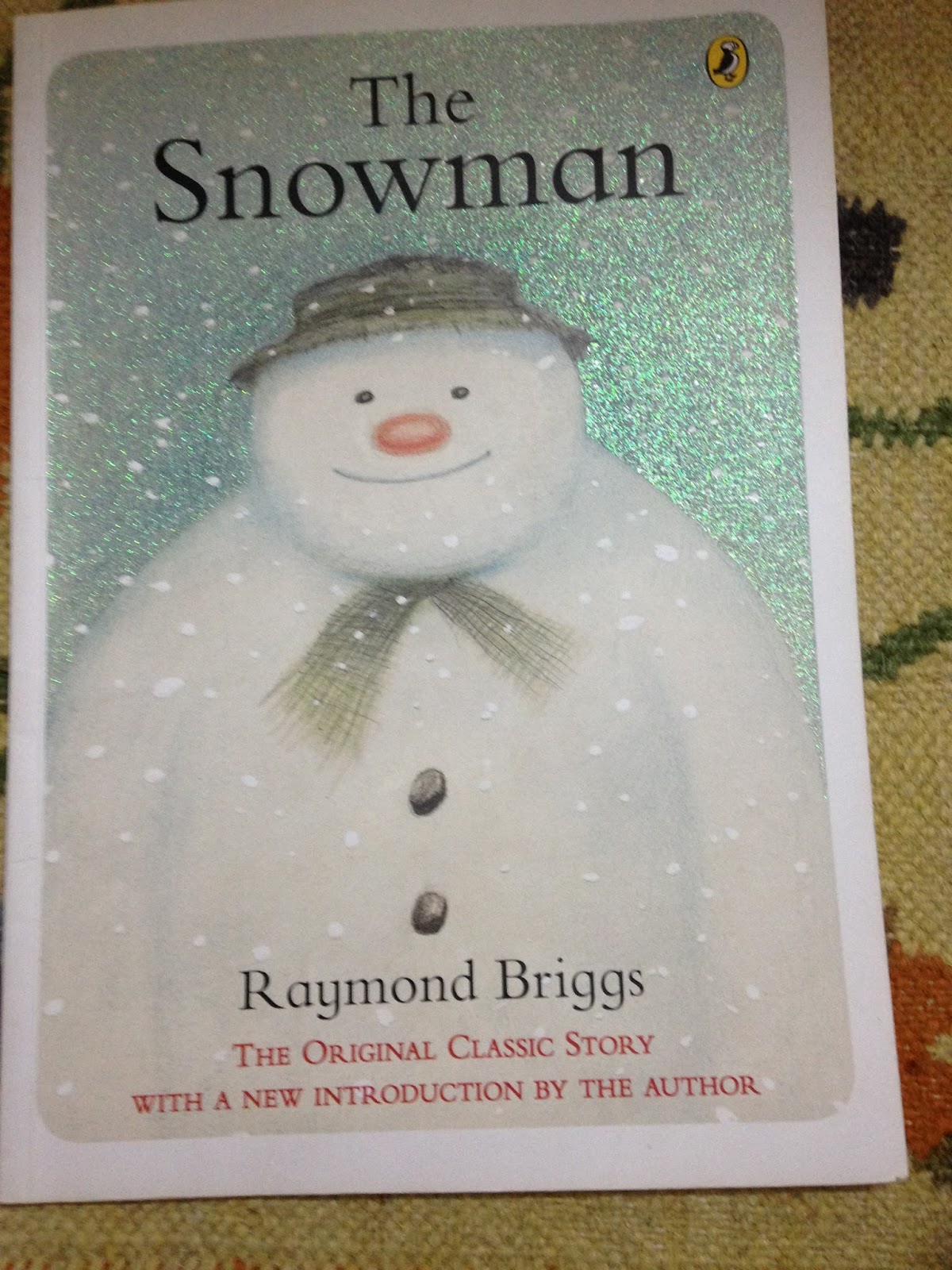
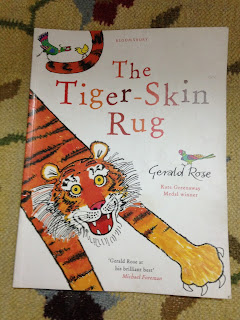
Apart from this list, here are some less known books that you may like to explore; I am pasting two pictures from each book (the cover and one inside page).

1) The Tiger Skin Rug - one of our utmost favourites.  Written and illustrated by an award winning British author, it is reminiscent of old Indian folk tales that were written in the sixties and seventies, and has wonderful illustrations to match.


2) Cloud Tea Monkeys - written and published in England, set in the tea plantations of East India at a time when Queens and Royal Tea Tasters abounded.  Magically illustrated..


 3) Library Lion - Set in days when libraries were wondrous places (in India, most aren't any more), this is a lovely way to remind children that sometimes there is a good reason to break rules.


4) 10 Minutes till Bedtime - A book without words, from a fun author and illustrator about a subject all children (and parents) can relate to!  (Another of Peggy Rathmann's books, Goodnight Gorilla, again without words, is a terrific way to introduce babies to books).


5) The Rainbow Bear - A lyrical story about a bear who chases rainbows, with lots of Native American wisdom thrown in (beauty can sometimes be dangerous) and wondrous pictures.  I'm amazed my son likes it so much at this age, but he does.


6) Cheer Up Your Teddy Bear, EMILY BROWN!  Whacky and wonderfully flowing, my son loves to chant out aloud from this book - "Pooooor me, Poooor me, poor little sad little wet little me!  I'm a lonely only bear and I'm feeling very blue..."  After reading this, he also wants to visit the Outback in Australia...


 7) The Snowman - A timeless classic, but one that's oft forgotten.  Raymond Briggs apparently wanted to convey the essence of life and death through this picture-based story.  My son accepts death and the melting away of magical moments in a matter of fact way while reading this book and re-lives the excitement of flying with the snowman at night just before he drops off to sleep ("I can fly...?")


Tuesday, May 26, 2015

Two Tales On Reincarnation

Reincarnation is a theme rich with possibilities for mystery writers, and there have been several well known novels and hauntingly eerie films on this subject.  Murder mysteries wherein the victim returns (often in human form, sometimes not!) to identify the killer are particularly common.

However, the gentler kind of stories are rare- those that deal more with the confusion that can arise when people are confronted with the possibility of reincarnation, rather than actual details or gory incidents.

I don't personally have any views on reincarnation as the world contains many things beyond my sphere of knowledge.  It is not a subject I find important enough to dwell on; my present life is demanding enough of my time and thoughts!  Having said that, I found two nice stories that use this theme.  I recently finished reading one of them and the other has been a favourite for many years.

Alexander McCall Smith has written a novel, 'The Novel Habits of Happiness', set in Scotland, which  (in his usual style) is about many things, including a little boy who feels he lived elsewhere, in another life, and all the events that follow.  The tale is interesting because though clearly fiction, something like this could easily (or unexpectedly) happen to anyone, I feel.  Coincidence?   Fate?  Churning of our incredibly complex (and often undecipherable) mental mechanisms?  The line between fantasy and reality can get blurred depending on people's interpretation of facts or their perception of their environment and themselves.

The older book I referred to is 'The Golden Fortress' (Sonar Kella) by Satyajit Ray (which he subsequently made into a wonderful film, now available on DVD).  This is a part of the Feluda detective series (written for children or more specifically, 'young adults' as people now like to say).  It begins with a child's recreation of a world very different from what he has ever been in.  The trail leads the characters all the way up to north India and provides an interesting glimpse of life and travel in a pre-cell phone, pre- fast car, pre- fast plane age (the sweet seventies).

For those who like gentle, meandering stories that deal with people's thoughts and emotions, a little travel and a hint of humour, both these books are recommended.

Sunday, October 19, 2014

The Magic Of Never-Never

I read 'We of the Never-Never' twenty years ago, and on re-reading this book, find the magic as strong as ever.  It reminds me of all that we must be thankful for in our lives : love, true friends and the sometimes harsh but bewitching beauty of the natural world.  As I read, the rain pelts outside; inside the electricity flickers, candles come on and off  at the whim of the power supply.  Flying ants fill the rooms, little white ants crawl on our tables and mud is splattered all over the floor.  But I remain caught in the spell of the book and these things don't seem like annoyances any more.

Written by Jeannie Gunn in 1908, this is the story of her adventures in the Australian bush as she accompanied her husband, Aeneas Gunn, who had been appointed manager of a large cattle station in 1902.

Her arrival in the bush was unexpected, and unwanted, for this was a land which white women did not inhabit, but once there, she was gradually accepted and eventually befriended.  Her story is eloquently narrated and the charm of her personality, tales of the brave and true bushmen and the pristine beauty of the land come alive through her words.  I quote a few paragraphs from her book, just to give you an idea of its timeless charm.

"And All of Us, and many of this company, shared each other's lives for one bright, sunny year, away Behind the Back of Beyond, in the Land of the Never-Never; in that elusive land with an elusive name - a land of dangers and hardships and privations yet loved as few lands are loved - a land that bewitches her people with strange spells and mysteries, until they call sweet bitter and bitter sweet.  Called the Never-Never, the Maluka (her husband) loved to say, because they who have lived in it and loved it, Never-Never voluntarily leave it."

In the beginning, when the men at the station learned that their boss had gone and got married, and, moreover the Missus was to accompany him, this is what one of them (the Sanguine Scot) said:

"I'll block her yet; see if I don't," he said confidently.  "After all these years on their own, the boys don't want a woman messing round the place."  And when he set out for the railway along the north track, to face the "escorting trick", he repeated his assurances.  "I'll block her chaps, never fear," he said; and glowering at a "quiet" horse that had been sent by the lady at the Telegraph, added savagely, "and I'll begin by losing that brute first turn out."

The Maluka and his Missus, meanwhile, having no inkling of this, were on their way to the end of civilization in a Territorial train:

"It was a delightful train - just a simple-hearted, chivalrous, weather beaten old bush whacker, at the service of the entire Territory.  "There's nothing the least bit officious or stand-offish about it," I was saying, when the Man-in-Charge came in with the first billy of tea.
  "Of course not!" he said, unhooking cups from various crooked-up fingers.  "It's a Territorian, you see."
  "And had all the false veneer of civilization peeled off long ago," the Maluka said, adding, with a sly look at my discarded gloves and gossamer, "It's wonderful how quietly the Territory does its work."...

They left behind the city and town dwellers, all of whom were horrified at the idea of Jeannie going into the bush.  This is what she says, later on, while shuttling from camp to camp:

"Whatever do you do with your time?" asked the townsfolk, sure that life out-bush is stagnation, but forgetting that life is life wherever it may be lived.

Sunday, May 26, 2013

Foods (And Food Writers) Of The World

My attempt to learn more geography and history (subjects which never interested me in school) has somehow got entangled with my culinary interests.  The result is a growing collection of books on food from different parts of the world!  Not mere cookbooks, for I initially selected them because they served as guides to various countries' geography, history, political past and culture.

I began with some of 'The Beautiful' series quite by chance - Mexico The Beautiful was the first, a gift from an old Mexican friend.  These books are a cross between a small encyclopedia and a large coffee table book, with lots of recipes thrown in.  An interesting and informative combination.  What got me thinking a little more about them was when I read 'China The Beautiful' by Kevin Sinclair.  This was so well written that I wondered if the author was not merely a cook or gourmet traveller in the country.  After a little search, I discovered that he had been a veteran and irrepressible journalist, who  spent forty years reporting on Hong Kong.  This led me to thinking about the universal appeal of thoughtful and well written books.

The next step in my search came when I looked at some Time Life volumes which were part of the 'Foods of the World' series.  These were lying at the very bottom of a large bookshelf, almost concealed, in a second hand bookstore.  They had been lying there for some time and I had seen them earlier but had never bothered to give them a second glance.  I was usually searching for more modern and relevant cookbooks.  This time, I thought of Kevin Sinclair and Time Life's reputation for serious, high quality writing and opened these books.  They seemed filled with quaint pictures, interesting-sounding recipes and very personal interpretations of food.  The Time Life teams appeared unusual - some were writers, some journalists, editors and professional photographers.  I bought the few books that were stocked in the bookstore and am slowly going through them.

I find them quite fascinating, not just because of what I learn about the country they deal with but because of their intrinsic subjectivity.  The mind of the author comes through distinctly, lending a particular style to each volume that sets it apart from the others (though I sense that some volumes have been over-zealously edited).  Equally interesting are the reasons given for creating these books; these shed light on the authors and their regions of interest.

I quote below, from various authors, their reasons for writing about food.  (My main reason for writing about food is that it satisfies me from within.  But others have put it far more eloquently and movingly than I can ever hope to):

One of the nicest descriptions that I have come across in general is that by M.F. K. Fisher, (one of America's earliest food writers), when asked why she chose to write about food and hunger :  

'When I write about hunger, I am really writing about love and the hunger for it, and warmth, and the love of it . . . and then the warmth and richness and fine reality of hunger satisfied.'

Certainly the last century was filled with horrors of war and its aftermath in many parts of the West, where most of these food writers lived.  Elizabeth David, in the preface to the second edition of her book 'Mediterranean Food' writes:

'This book first appeared in 1950, when almost every essential ingredient of good cooking was either rationed or unobtainable.  To produce the simplest meal consisting of even two or three genuine dishes required the utmost ingenuity and devotion.  But even if people could not very often make the dishes here described, it was stimulating to think about them; to escape from the deadly boredom of queueing and the frustration of buying weekly rations; to read about real food cooked with wine and olive oil, eggs and butter and cream, and dishes richly flavoured with onions, garlic, herbs and brightly coloured Southern vegetables.'

For many authors of the Time Life series, the assignment began as a personal quest that shaped the style and manner of presentation of each volume.  The quest varied in nature depending on the person and their circumstances.  Dale Brown, writer of 'American Cooking' travelled within America at a time when there was no scarcity or rationing and these were his main concerns :

'New York, New England, the middle Atlantic States and the Mid-West - have long been familiar to me.  But until recently I had not had an opportunity to acquaint myself with the food in other parts of the country and to study the influences that have affected it.  And so, my wife and I, with our two year old daughter, embarked on an extended gastronomic tour of the country.  Before our journey was over, we would have tasted everything from Florida's Key lime pie and South Carolina's wild orange marmalade (a real rarity) to Louisiana's mirliton, or vegetable pear, stuffed with Gulf shrimp, and Oregon's kippered salmon.  I welcomed so unique an opportunity to show my Dutch wife this beautiful country and to introduce her to its regional cooking - but I was also, to tell the truth, a little worried.  I felt that mass communication and mass travel might have succeeded in throwing a net of conformity over many formerly colorful areas.  How wrong I was, only the trip could tell.'

For some, moving to a new country (especially from the West to the East) was a eye-opener of sort.  Emily Hahn began 'The Cooking of China' with her description of the first meal in a Shanghai restaurant, where she was a guest of some Chinese friends:

'For one thing I was exasperated by the behavior of my host, who made what seemed to me a ridiculous fuss about giving the order.  After all, I said to myself, we weren't celebrating anything, but simply going to eat.  Yet the host went into a long, incomprehensible (to me) discussion about the menu with the proprieter.  With every minute that passed I grew more bored and hungry, wondering how people could possibly find so much to say about food.  Long after the proprieter had gone away with the order, I continued to feel indignant.
   Then the first dish arrived - soup with sliced pork and Chinese vegetables - I tasted it.  I looked up in amazement, waiting for someone else to comment on its excellence, but nobody did.  They spooned it up busily, and after a moment I followed their example.  I was considering a second bowl when the waiter brought in a number of dishes that he put on the table in a haphazard way, all together.  One was steamed fish in black bean sauce, tender and juicy, full of different tastes of spice, and enriched by the sauce.  There were spareribs of just the right crispness, and a dish of vegetables that I did not recognize, crunchy and as fresh-colored as if they had not been cooked.  I asked how this effect was attained, and was told that they had been "stir-fried", or cooked quickly in very hot oil.  There was also chicken cooked in soya sauce, and that completed what my host called a plain, simple little meal.  It certainly showed me how much I did not know about Chinese food.  I had come late to the realization, but I determined to make up for lost time.'

Her determination resulted in a book explaining the food and cooking of different parts of China!

Rafael Steinberg, a correspondent during the Korean war and later Tokyo's bureau chief, was married to a Japanese and was introduced in some detail to Japanese food through her and her family.  (This book is also filled with beautiful photographs taken by Eliot Eliofson, a painter and photographer.)

In the prelude to his book 'The Cooking of Japan' Rafael Steinberg quotes from the writings of Faubion Bowers, author, world traveller and aide-de-camp to General Douglas Mac Arthur during the early years of the post-war occupation of Japan:

'The time finally came for me to visit my dream of Japan, and as soon as I set foot on the good ship Hikawa-maru in Seattle - oh yes, aircrafts were invented but they weren't flying the Pacific - I was confronted with what the passengers called "The Choice".  You could have either a full Western meal or a full Japanese one.  I asked for Japanese food, got it three times a day and stuck to it for the whole 21 days of the voyage to Yokohama.  My motives were mostly brummagem, but partly too, I like to imagine, good sense.  I was determined to learn Japanese for, as I now tell the story, I knew war was coming.  I have never believed that "you are what you eat" (in Japanese they drink snake's blood for longevity), however I am convinced that you can't learn a language without enjoying the food of the nation.  Just think of the loss of idiom an English-speaking Japanese might feel if he didn't understand things like a lover being the "cream in his coffee", or something being "as English as roast beef".
   Now, in retrospect, I must admit I explored Japan's gustatory and culinary arts the hard way.  I tortured myself with umeboshi, ultra-sour plums, on deck while watching the sun rise.  I snacked on odorous, fermented soya beans, called natto, at night before retiring .  I even tried again and again those little cakes printed in the shapes of flat flowers, which taste dry as chalk and crumble into sandy powder with every bite.  But along the way I encountered myriads of delight and miracles of surprising pleasures.  Sukiyaki and tempura, as it goes without saying, and noodles too, and tonkatsu, which loses totally in translation if you say "pork cutlet".  The warmth of bean soup, the dew-like freshness of thin soup, the brilliant clarity of good, first-quality soya sauce, and thousands of other sauces, each bound, as in a marriage, to its own particular mate.  Where else in the cooking world can you have so light, so greaseless, so sparkling a set of flavours and textures that turn into aromas or melt as soon as they reach your mouth?
   The day soon came when raw fish was on the ship's table d'hote, and I discovered that it didn't taste raw, or even like fish.  And with this conclusion I joined the ranks of astonished foreigners whose numbers increase, like school children and textbooks, year by year.  By now the last threshold was crossed, and I was enslaved to Japanese cooking...
   ...Today I often find myself "hungry" for Japan, and once it got so bad I cooked up an excuse for a quick trip back just because I was hungry.  So, there are dangers in becoming habituated to this great cuisine.  However, a book such as this one at last makes possible the impossible: You can now do it yourself in your own home.  Here, too, be careful.  My own son said to me recently, "Please, Dad.  Not tofu again!"  But just wait until he grows up.'

And finally, a book on African food by a very interesting author, Laurens van der Post.  I couldn't believe that such a book might actually exist!  I was curious about the food of Africa - a whole mysterious continent that one knows little of, and that too seen through the eyes of one who was born there and had extensively explored and written about it.  He drifted between Africa and England and finally settled in England; his biographical claims and descriptions were mired in controversy after he died, but some of his words remain haunting and evocative.

In his book 'African Cooking', he says:

'My earliest memories of Africa, and of my life there, center around the large dining table in the home of my Boer grandfather, in the Orange Free State, deep in the interior of south Africa.  And almost invariably the scene in this theater of my past is the evening meal.  I used to wait for this meal, six decades ago, with the same kind of excitement that I was to experience much later as a drama critic in London, before the curtains rose on the first night of a new work by a friend from whom I expected much.  As in a darkened playhouse, the excitement would start when the maids began to light the heavy oil lamps in the long passage that led from the front door on the veranda surrounding the house.  At last they came to the dining room, and the biggest lamp of all.  In the center of that room was a great table made of an African wood so hard and dense that a piece of it would sink like iron if it was thrown into water; and over the center of the table, suspended in massive chains, hung an immense oil lamp made of brass  that glowed and shone like gold...
   The sense of smell is surely the most evocative of all our senses.  It goes deeper than conscious thought or organized memory and has a will of its own that the mind is compelled to heed.  Since the scent of cinnamon is the first to present itself to my memory of the moment when the great lamp was lit and the great table set and ready, I must accept the fact that my first coherent recollection of the drama of our evening meal begins with the serving of a typical milk soup of the South African interior...
   The fragrance of cinnamon would still be adrift in the room when the more acute sense of cloves announced that the main course was on its way.  This would be a superbly pot-roasted leg of lamb, a standard dish of the interior.  Studded with cloves from Zanzibar, less than 2,000 miles from us as the crow flies, the lamb - itself a product of our farm- was so tender that it seemed to flake rather than cut at the touch of my grandfather's carving knife.
   Mixed with the smell of cloves was that of saffron rice and raisins - a dish that was not typical of the interior, but one that had been introduced to my family by my French grandmother.  My grandfather served it more as apart of a ritual remembrance of all she had meant in his life than as mere gratification of his own liking for it.
   With these varied scents, there came the sharp fragrance of quince jelly, which was always served with our roasts, burning like a maharaja's ruby in its own crystal bowl, and tasting as brilliant as it looked.  Then, since this was winter, came a dish of dried spotted beans, which we know as governor's beans; centuries ago , presumably, some forgotten governor had first planted them in the vast kitchen garden that his masters, the Dutch East India Company, had made of the Cape of Good Hope.  (Their purpose was to provide fresh foods to forestall scurvy among Dutch sailors in the spice trade.)  At grandfather's house the beans were cooked in mutton stock and pureed tomatoes and were accompanied by baked pumpkin flavoured with nutmeg.
   Last of all came a bowl piled high with yellow peaches, turned to burnished gold by the alchemy of the great lamp overhead.  These peaches still glow in my memory like an offering of fruit from some sheltered grove of Hesperides.  Like everything else we ate they were the product of our completely self-sufficient farm.  They were preserved whole in glass jars in the summer, so skillfully that much of their original savor remained.  I have yet to discover, in this technological age of ours, any preserved fruit that could rival those peaches.  They brought into the winter night the fullness of the summer gone by and the promise of its return...

...Some months ago I badly injured my right arm and was told by doctors that, if I ever meant to use it for writing again, it would have to be rested for many months.  This enforced ease seemed a wonderful opportunity to revisit the whole of Africa.  I would see again the lands I had explored for 40 years of my life; I would see what Africa was achieving now that so many influences of European colonialism were vanishing.  I intended, once I could write again, to set down my appraisal of this new emergent Africa.  But everywhere I went I found myself too profoundly depressed by what I saw to write dispassionately about it.  In an Africa that is so much at one in its deepest nature, millions of human beings are involved in divisive conflicts, killing one another from Mali to Zanzibar and The Congo on a scale that even the reviled former imperialists would never have permitted.  The political and social scene in Africa seemed to me eroded and bankrupt, and I instinctively rebelled against joining in any form of activity so negative and destructive.
   All this may be part of the price Africa must pay before it can enjoy ultimate unity.  But I was certain that I could not further this unity by entering into the ideological conflicts and rivalries that are tearing the continent apart.  I came to believe that embattled Africa could best be regenerated by a profoundly nonpolitical reassessment of common aims and ideals - a rediscovery of the overriding values of the dignity of man and the reverence for life.
   Then I wondered, often in desperation, what in the world all the warring systems, countries, tribes and races still had indisputably in common.  Oversimple and childlike as it may seem, one answer that popped up from my imagination was food.  If I did what has never been done before - if I wrote about the food of Africa as a whole, about African man and his ways of eating and cooking from the Stone Age Bushman to the sophisticated gourmet in Addis Ababa or Capetown - perhaps I could render some service and at least pay homage to my troubled continent.  In a way, I would be doing what my grandfather did at those meals at his homestead, when he assembled all the races around his table every night.  In a small way, too, I could recall for my readers the fact that all men are one in their needs and searchings, that whatever set them apart is evil and whatever brings them peacefully together is good.  This is what I have tried to do in the chapters that follow.'

The down side of so much subjectivity is that one depends heavily on the writer for accuracy of reporting, but these books (mostly published in the early seventies) are an incredible read.  So here  begins a culinary adventure of a different kind for me - one that starts in the mind and that can be converted into things one can smell and taste (the books come with recipes) - more exciting than reading mere geography or history!

Saturday, March 23, 2013

A Bevy Of Books

It's summer and a bevy of books has come a visitin'.  They entered without asking and piled themselves up in all the nooks and crannies they could find, waiting for me to pick them up, dust off their travelly cloaks and find suitable places for them! Darn cheek, if you ask me.

The strange thing about books is how they worm themselves into your life and once there, sit and silently multiply.  They don't hesitate to locate the comfiest spot on your bed, they are seen sloppily snoozling in your best chair when guests drop in and horror of horrors- there they are, sloshing about amongst your pots and pans, getting thoroughly splashed and dishevelled when they think you are not looking.

It's stealth they use - one book muttering names of others under its breath (making sure you're around when it does so), another sighing wistfully and saying, "How nice it would be if I had my companion volume next to me," and so on.  They don't care if their sizes and shapes drive you up the wall (literally).  There they lie, looking expectantly, asking to be opened up ("Just a little stretch for my spine, dearie," the older ones cackle).

This summer's stack arrives as a motley collection - associates of old and loved books and some strangers that have drifted in by way of bookstores.  (March brings an excessive number of birthdays and while selecting books for others, I end up buying many more for myself).

By way of Amazon, I have received huge colour cookbooks - China The Beautiful Cookbook (lyrical and truly beautiful) and Mediterranean The Beautiful Cookbook (erudite though very approachable).

I have also received 'The 13 Clocks' (an old fairy tale by James Thurber - about an aggressive Duke who was always cold.  "He wore gloves when he was asleep, and he wore gloves when he was awake, which made it difficult for him to pick up pins or coins or tear the wings from nightingales.  He was six feet four and forty-six, and even colder than he thought he was.  One eye wore a velvet patch; the other glittered through a monocle, which made half his body seem closer to you than the other half."

Finally, and best of all, I have received through Amazon, 'The Midnight Folk' by John Masefield.  This is a magical way to learn about treasures and cats, owls and witches (and other midnight folk), adventurous great grandfathers - and also to brush up on your French:

..."You learn your lessons," she said.  "Never mind about what I think it was."

She left him with "pouvoir".  Kay had a special prejudice against "pouvoir".  It wasn't a good, straightforward word like "aimer."  It was a mean and ugly word, which went into "peux" and "pu."  It didn't seem to have any sense in it.  He wrestled with it with each boot twisted round a leg of his chair, scraping up and down.  Then, looking up, he saw great-grandpapa Harker looking down at him from his portrait over the mantelpiece.

The portrait was one that he had looked at during lessons ever since lessons began.  It was just "great-grandpapa Harker's portrait," though it was labelled Baxter.  When people were shown the schoolroom, the governess always said "That is a Baxter," and then people said, "Really" or "Fancy that" or "How interesting".  It was the full length of a man in old fashioned clothes.  There was a sort of shrubbery behind him and a sort of blueness behind the shrubbery.  It was said to be the only full length Baxter as Baxter only did down to the knees.  But now, as Kay looked, great-grandpapa Harker took a step forward, and as he did so, the wind ruffled the skirt of his coat and shook the shrubs behind him.  A couple of blue butterflies which had been upon the shrubs for seventy odd years, flew out into the room.  Great-grandpapa Harker  took another step forward and smiled.  Now Kay could see into the shrubbery: it was just where Kay's fort now was, but the box trees had grown enormously since then although the bull finches were already there.  Great-grandpapa Harker held out his hand and smiled again.  His face, which had seemed such an old-portrait kind of a face, became alive and full of welcome.  He seemed a fine fellow, not at all old, and very kind and good.

"Well, great-grandson Kay," he said, "ne pouvez vous pas come into the jardin avec moi?"

Kay thought it odd, but it was a perfect excuse for not doing "pouvoir" : "I would have learned it, but great-grandpapa Harker asked me to come into the jardin avec him, so of course I thought you wouldn't mind."  He smiled back at great-grandpapa Harker and said, "Oui, grand-grand pere, thank you; je serai very glad."

Great-grandpapa held out both hands, and Kay jumped onto the table; from there, with a step of run, he leaped onto the top of the fender and caught the mantelpiece.  Great-grandpapa Harker caught him and helped him up into the picture.  Instantly the schoolroom disappeared.  Kay was out of doors, standing beside his great-grandfather, looking at the house as it was in the pencil drawing in the study, with cows in the field close to the house on what was now the lawn, the church, unchanged, beyond, and nearby some standard yellow roses, long since vanished, but now seemingly in full bloom...

Getting back to those books of the present, the ones I bought while searching for gifts are: 'I dreamed of Africa' by Kuki Gallmann (a memoir of bringing up a family in Kenya), 'The Guernsey Literary and Potato Peel Pie Society' by Mary Ann Shaffer and Annie Barrows (a story set in the Channel Isles just after the second world war) and 'Ten Thousand Miles Without A Cloud' by Sun Shuyun (a travelogue and more, of the author's journey from China to India, in search of her beliefs).  Some not complete strangers are 'The Uncommon Appeal of Clouds' by Alexander McCall Smith (a gentle Scottish story about life - and detection) and 'The Winter Queen' by Boris Akunin (beckoning me with its spirited though slightly sad smile, in the way that these Russian tomes do, and featuring the extraordinary detective, Fandorin).

This is my summer reading (and I have already gone through some of it).  Please don't think I am writing out these long lists of my own volition - it's these critters that are askin' me, in fact nudging me to do so, in the hope that they may slip into your rooms as well.  All I can say is - good luck with your summer visitors, they will come a knockin' soon...

Monday, February 11, 2013

Moving to the Earth's Beat - and One's Own


I recently finished reading a book by A. J. Chopra, called 'Moving to the Earth's Beat, the road back from eco-despair'.  It has just been published in paperback and Kindle versions.  It describes Chopra's challenging and intriguing journey that began when he realized he was depressed but couldn't exactly figure out why and what to do about it.

There may come times in one's life when, despite everything being stable and chugging along pleasantly, one feels unaccountably gloomy.  Almost always, such times of depression are accompanied by a feeling of isolation, which cut one off from a sense of perspective or purpose.  This prevents one from reaching out to the world that one cares ('used to care') about, further deepening the negativity and sense of fragmentation.  A nasty feedback loop.

A.J. Chopra discovered that his sense of gloom arose from a concern about the earth and a feeling that it was too late to prevent destruction of the natural world as we know it.  He calls it 'eco-despair'.  Being an engineer, a 'problem solver', a reader, thinker (and agnostic), he took the help of books (and a few people) to work his way, step by step out of this impasse.  The way led not to formal and classic treatments for depression, but to a change in his way of approaching life.  He decided to adopt a belief in something larger than himself, something that was consistent with his thoughts and training and something that was essentially 'good' and 'meaningful' to him.  In his life, this came in the form of viewing the world the way (certain) Native Americans do and feeling one's connectedness with the earth (a sacred being) and everything upon it.  His path was long and tenuous; one reason for writing the book (apart from allowing himself a means of self expression) was to reach out to other people who may feel this form of despair consciously or unconsciously.  The other reason is to try and make a difference (by spreading the word) about the importance of caring for the earth and fragile ecosystems that exist all over the world.

His story is steeped in analysis - of different schools of pyschology, physics, ecology, philosophy and more - a rational, step by step breakdown of thoughts and experiences.  The story is clearly written and the style of narration is engaging - one chapter leads you on to the next.  It is evident that deep thought and research has gone into the making of the book.  I perceive a few gaps though.  While each step along the path is clearly discussed, corresponding changes in Chopra's own inner state are not described in tremendous detail.  One wonders about his inner feelings (not just his thoughts) as he proceeds to align himself with his intuition - moving from his zone of safety to exploring a different way of thinking about the world, leading ultimately to his personal experience with Native American healers.  Perhaps this is because the results of his choice are illustrative enough that this belief system works for him and his changing feelings need not be dissected in exacting detail.  (His is a belief in the interconnectedness of all who inhabit this planet, of living with the rhythm of nature, of interacting directly and simply with nature and other creatures and honouring the reciprocity of gifts given and received.)  Perhaps it is also because the ultimate story is one that continues beyond him - to the state of the earth and ways to help nurture the earth and all that it sustains.

Interestingly, when I began reading this book, I was also reading a text on some of the Upanishads.  I was struck at the time between the similarity between certain thoughts reflected in this newly written American book and those found in ancient Eastern philosophy.  For this reason alone, I describe below the first five shlokas (verses) of Ishavasya Upanishad (with explanations based on Sri M's commentary and my own interpretation of these) :

Shloka 1 :

ishavasyam idam sarvam yat kincha jagatyaam jagat
tena tyaktena bhunjitha ma gridhah kasya svid dhanam

That Supreme Being pervades everything here (and now).
It pervades all that moves, and also all that does not move.
Whose wealth is all this? (Who does all this belong to?  When the essence of life is everywhere, who is deprived and who can stash it?)
Therefore, let go and rejoice!  (When the reason for one's being alive and spirited is everywhere, including within oneself, one cannot lose it - one need not feel threatened or vulnerable, neither need one fear for the loss of one's self, so one can just give up worrying about mind-created problems or requirements).

Shloka 2 :

kurvann eveha karmani jijivishet shatam samaah
evam tvayi nanyatheto asti na karma lipyate nare

If one understands (even theoretically) what has been proposed in the first shloka, then one can live, performing karmas for a hundred years.  (There is no reason to renounce the world or any of one's worldly activities).
That is the only way by which you can live a full life, performing all the karmas (tasks to be done) on this earth and yet not be affected by (not be emotionally dependent on) the results of these karmas.

Shloka 3 :

asurya nama te loka andhena tamasavrutah
tams te pretyabhigacchanti ye ke cha atma hano janah

There are some worlds which are enveloped in darkness to which those of demonic nature go.  People who are slayers of their own Self (who consciously or unconsciously deny their inner self) enter this dark world.

Shloka 4 :

anejad ekam manaso javiyo nainad deva apnuvan purvam arshat
tad dhavato nyan atyeti tishthat tasminn apo matarishva dadhati

(Attempts to explain the Supreme Being, that comprises the essence of everything and is something that cannot really be described) :
It is that which does not move.
It is one.
It is even swifter than the mind (i.e. the way to reach it is not through the mind or senses).
By itself it stands still.  It outstrips those who reach out for it.
In it, the all pervading prana (air or energy that sustains life) supports the activities of all beings.

Shloka 5 :

tad ejati tan naijati tad dure tad vadantike
tad antarasya sarvasya tad u sarvasyasya baahyatah

It moves, yet it moves not.
It is far and yet it is near.
It is within all this.
It is outside all this.
(If we think we are different and separate from our inner essence, it appears unreachable but if we understand that it is a part of our inner self or driving force, we are very close to it.  It is everywhere, whether we see it as being a part of us or see ourselves as being contained within it).

Sunday, October 28, 2012

Mexican Food For The Soul And Stomach

Some time ago, I received by registered mail, all the way from Mexico, a giant pictorial cookbook called 'Mexico The Beautiful Cookbook' (recipes by Susanna Palazuelos).  It was sent by a family friend who had visited India and with whom I had several enjoyable conversations on food.  This book is part of a series of 'The Beautiful Cookbooks' that run along the lines of the Time Life food books but they are less academic, more glossy and picture-filled.  This does not mean that they lack content - they are replete with information on the geography and history of a country and how these relate to its culinary trends.

This book contains a range of recipes, classic and contemporary.  It makes for good reading and even better experimenting (inevitably I cannot find several of the ingredients mentioned so I need to periodically substitute or delete some).  The style of narration is relaxed, lively with a touch of humour and the pages are filled with the colours of Mexico - vivid blues, greens, whites, yellows, browns - as much a feast for the eyes and mind as for the stomach!

I quote below some descriptions of Mexican food and drink that are mentioned in the book:

"Atole made from the treasured cacao bean was reserved only for the noblemen of Moctezuma's court, who drank it from special gold ceremonial cups.  The women  were served their atole flavoured with chia and a topping of chile.  Oaxaca is especially famed for its chocolate, which is sold in all of its markets.  It does good to pay heed to the time-proven advice "Ni amor recomenzado ni chocolate recalentado" ("Neither rekindle a love affair nor reheat chocolate")."

"Horchata is another culinary adventure, having its roots in the Arab world, where it was first made from the ground tiger nut.  Brought to the New World by the Spanish, horchata first appeared as a popular drink on the Yucatan  peninsula.  This Oxacan version uses milk instead of water and sometimes includes fruit of a local cactus for a pink colouring or a few almonds for flavour."

"The term "cocktail" is said to have originated in Mexico.  According to a widely accepted story, British naval crew used to gather to fortify themselves at a favourite tavern in Campeche.  While most liquors were drunk straight, at times, the English preferred their tot of rum mixed with other ingredients, which were then stirred with a small wooden spoon.  One day an enterprising waiter, being out of these spoons, used pieces of thin, smooth roots of a plant known as "tail of the cock" because of its peculiar shape.  The name "cock's tail" caught on and by the end of World War I these drinks were the rage of England, Europe and the U.S. nightclub set.  The best known in Mexico is the margarita, first made in a Chihuahua bar."

"Huevos "Rabo de Mestiza" - No one seems to know how it got its name, but "in rags and tatters of the daughter of a Spaniard and an Indian" is the very loose, unliteral meaning given to this hearty dish of poached eggs that dates back to the early days of the Spanish conquest."

"Jicama con Pina - This botana (snack) is a refreshing variation of the traditional Jaliscan pico de gallo ("rooster's beak") made with jicama (yam bean), oranges and chile piquin.  Since jicamas are available in the wintertime, they are a harbinger of the Christmas season.  The smallest, crispest ones are combined with candies, peanuts, tangerines, sugar cane and small toys and stuffed into pinatas."  (A pinata is a jar or pot suspended from the ceiling at festive occasions.  People take turns at being blindfolded and trying to break the pot using a stick).

Wednesday, October 17, 2012

Inspector Ghote Goes To London

Quite by chance, I was reading H.R.F. Keating's 'Inspector Ghote Hunts The Peacock' last week (when I saw the film 'English Vinglish').  In this book (published in 1968), Keating looks deep into the heart and mind of Inspector Ghote during Ghote's first visit to London.  And this is what he discovers:

"...Cautiously he (Inspector Ghote) made his way down to the Tube platform.  The train, when he got into it, was immensely crowded, but the mass of people seemed infinitely more orderly than those of the similar morning rush in Bombay.  Even in the very closest proximity they contrived to ignore each other with magnificent calm.  He felt proud of them.
   It was at about this time that he became fully aware of his first live mini-skirt.  In the preoccupation of making sure he got on the right train going in the right direction he had had eyes for nothing but illuminated notices.  Then he had been too jammed tight to see anything.  But now as the train cleared a little, he found himself looking straight down the long carriage at two girls with skirts showing four long plump stretches of nylon-covered leg above four soft rounded knees.
   For perhaps two minutes he regarded the phenomenon earnestly.  Then he found that his mind was made up.  He did not approve.
   But already the station names were getting dangerously near to the ones immediately before the Bank, where his briefing had told him to alight.  He concentrated his fullest attention on being absolutely ready to jump from the train the moment it reached his destination.
   He made it with colours flying.
   He negotiated the tricky circular exit from the station without a hitch.  Out in the street, he paused long enough to be absolutely sure he had got his bearings and then set off following the directions in his briefing, happily confident that he was not putting a single foot wrong.
   He found each turning exactly where he expected it to appear.  He noted with a comforting feeling that the walk from the Tube to Wood Street was taking not a moment longer than he had thought likely.  He spotted a tall, strikingly modern building that he guessed would be the newly built police station which the briefing had described well before he got to it.  And when he arrived at the broad flight of entrance steps, sure enough they proved to be those of the building itself.
   The only trouble was that he had arrived one hour and twenty seven minutes too early.

Ghote walked hastily round the corner so that no one coming out of the building should spot him as a conference delegate who had made the mistake of turning up so ridiculously long before necessary.  And there he stood and considered.
   For a minute or two he pored over the pages of his newspaper-covered guide.  And, yes, he should be able to do it.  From where he was standing it could not be more than fifteen minutes' walk to the Tower of London...

...The huge black and grey walls rose up massively in front of him.  Beyond them the pinnacled inner towers stood out  against the softly grey sky.  Which one of them was the Bloody Tower, he wondered.  Never mind.  When he made his proper visit he would find out for certain and savour its rich associations to the utmost.
   For a brief moment he caught a glimpse on a high inner gallery of a Beefeater, a sudden richly coloured figure lighting up the sombreness all around.  And, he thought, in due time he would see such figures by the dozen.  And the ancient ravens that haunted the place.  And the very axe under which Queens had bowed their necks.  And the glowing splendour of the Crown Jewels, symbols of the proud and ancient monarchy of this proud and ancient land.
   He gazed and gazed.
   Yet, oddly enough, at the very moment when he got up to go back to Wood Street police-station, leaving himself a decently reasonable time for the return walk, he found suddenly that he was overwhelmed almost to drowning point, it seemed, by a totally unexpected and desperately acute attack of home-sickness.
   It was stupid, but abruptly he wanted to be back in India.  He wanted the brightness, the noise, the easy-goingness.  He wanted, he found to his simple astonishment, to be standing looking at peacocks.
   Peacocks.  Nothing else.  He wanted to see the gaudy plumage, the bright, light-reflecting jewel colours of the proud birds.
   He shook his head angrily.
   What nonsense was this?"

Saturday, June 23, 2012

A Book Hunt In Delhi

As I approached the corner of another birthday, this time spent in Delhi, my family asked me to choose my own present.  And I decided it would be books - a delightful indulgence as it involves long, guilt free hours spent browsing in bookshops. 

Much as I appreciate the ease, accessibility and affordability of online shopping, this also tends to narrow one's range to things that one already knows about or that are prominently advertised.  Besides, I like to feel that my selecting and buying things from personal bookstores might help in a small way to keep them afloat.  I particularly dislike the convenient modern appliances that scan books in stores and tell you cheaper places to buy them from (not yet possible in India but quite prevalent in  the US).

So, braving the furnace like Delhi heat, we went book-hunting (it was more purposeful than a casual browse)!  The bookshops I like in Delhi are the smaller, individualized ones, with distinct personalities of owners and their sometimes idiosyncratic staff.  We began at The Bookshop (Jorbagh Market).  They have a small but unusual selection of bestsellers, translations of well known European authors, new editions of Penguin classics and an eclectic mix of detective novels (something I have a weakness for).  Here one will find Raymond Chandler, Eric Ambler and Boris Akunin reposing peacefully beside H.R.F. Keating, Alexander McCall Smith and Agatha Christie.  An elderly, pleasant (and hawk eyed!) Punjabi couple run this little shop in a determined way.

The next halt was Khan Market, partly because it lies close to Jorbagh.  I often pop into Bahrisons just to see if they have anything new on existing authors that I read.  They usually get new releases soon after they are in print and have a steady supply of older and popular books. They also have a slightly different collection of hardbound cookbooks on one shelf in the midst of their regular cookery section.  Just for information, they have now opened a new shop for children's books, located in the same market.

In Khan Market is also to be found the Full Circle Bookstore.  They also publish their own books, focussing on spirituality, philosophy, religion etc.  They are one of the better stocked bookstores for books in regional Indian languages, in particular Hindi.  One climbs up a steep flight of stairs, past walls lined with Tibetan tangkas to reach a section of this store.  Above this is Cafe Turtle, a popular little eating place.  As a rule, though, I avoid eating in bookstores; I feel somehow that the business of book selecting and eating don't quite mix!  I have also often observed that eating spaces have an unfortunate way of expanding and overshadowing the rest of the environment around them (particularly evident this time when I visited one of my favourite alternative bookstores- 'Trident' in Boston.  They originally served home made fruit pies and fresh juices in a small, snug corner, but now a new cafe space has been constructed, pushing out several shelves of books).

Last but not the least - a bookshop that I have recently begun visiting is Midland Books (Aurobindo Place Market).  It stands opposite a little shop that sells excellent mushrooms, sprouts and different kinds of paneer.  My family stopped here to drink some cold almond milk while I rushed in to the shop, for fear that it might close.  But it seems to remain open well after 8 pm.  It was here that I chanced upon a cookbook I had not seen before and that looked particularly interesting - Perfect Cakes by Nick Malgieri.  It is hard to get a good cake book - one that has a range of cakes listed by technique, where the simple ones are not just plain vanilla and the fancy ones are not wildly extravagant, just elegant, interesting and do-able affairs.  This book perfectly complemented my blood curdling detective purchases!

Midland Books has a diverse collection (often just one copy of a particular book) especially of Western fiction and cookbooks.  They also give a hefty discount (20% on average).  This particular book's original price was about $40 (over Rs. 2000) but after the mark down and  final discount, I could get it for a little over Rs. 800 (about $16).  Even the internet would not be able to give a better deal!  It's probably because no one else wanted the book but that's the nice thing about real browsing as opposed to the virtual kind, I think.

Thursday, November 3, 2011

A Dabbawala's Diary

The famous Mumbai Dabbawalas, who deliver over two lakh (0.2 million) tiffin boxes each day from people's houses to their offices, with a success rate of 99.99%, are now being invited to various management institutes to talk about how their system works. Yesterday they were in Bangalore, to share their 'management module' with students of a local college.

Founded in 1890, the Dabbawala Association has apparently never gone on strike nor been involved in any police case. Literacy is not a requisite but the ability to carry 70 kgs of weight is essential! It is truly an amazing organization, one that takes pride in its roots and the unique and dependable service that it provides to Mumbaikars.

I quote below an excerpt from the visit of two Dabbawalas to London (to attend the wedding of Prince Charles and Camilla), written originally in Marathi (the speaker is Raghunath Medge) and translated into English by Shalaka Walimbe (The Mumbai Dabbawala: The Uncommon Story of the Common Man) that I read in part in the IIC Quarterly newsletter. Raghunath Medge and Sopanrao Mare represented the association at the royal wedding.

" From that moment onward we had loads to do. We got busier than the bridegroom himself! We had received the invitation on the 1st and the marriage ceremony was scheduled for the 8th of April. That in effect gave us only six days in hand for preparation. We were worried whether we would be able to manage to put everything together in time.
Our daily routine was already a packed one. My day starts very early in the morning. From home, I head straight to our office in Dadar, then to the Grant Road office, followed by a quick visit to Churchgate station and then off to our cooperative credit society office in Andheri. To add to this hectic schedule , there were now visits to the British Deputy High Commission, the Air India office, Hotel Taj Mahal and several other such places.
We are simple, traditioinal and superstitious people. Earlier, well before we got the invitation, when we had leart that Price Charles would be taking his wedding vows on 8th April, a 'no moon' day, we were quite perturbed. It is considered an inauspicious day by us Hindus. Without making it public knowledge, we dabbawalas had organised a pooja and a special ceremony on 13th March at the Sanyas Ashram temple in Mumbai in order to appease the stars and ward off evil. We had pleaded with the Almighty, 'Lord, though it is the no moon day, may the Prince's wedding be celebrated without any obstacle.'
Just at this time, Pope John Paul II passed away and the wedding was postponed by a day as Prince Charles decided to go to The Vatican to pay his condolences. Reassured by the change in the wedding date, we continued with our pre-departure preparations.

...In spite of the magnitude of it all, we remained firmly rooted to the ground. While the world outside was busy rejoicing and congratulating us, our families busied themselves preparing us for our voyage. Our wives packed our staple diet of bhakri and chutney for our journey. They also packed us chivda for evening snacks. They were worried, 'God alone knows what they will get to eat on the plane and Hotel Taj Mahal there. Our husbands should not go hungry.'
In the meantime , somebody told Sopanrao, 'I have heard that water is very expensive in London.' Promptly Sopanrao's bag was filled up to half its capacity with bottles of water!
To gift the Prince and his bride, we carried with us til laddoos, a framed greeting card with a tricolour background and a pearl studded magalsutra (the necklace that Indian women wear once they are married) for Camilla. After all, we now looked upon her as our future sister-in-law. Earlier, our association had sent a turban and a green sari for the royal couple - this was before we were invited for the wedding.
Well, food and gifts were taken care of. Then came the question of clothes. What should we wear? Somebody said, 'If you don't wear a suit you will not be allowed to enter the church.' But I was not convinced. Though I didn't say so, I was sure that after we had received such an exceptional invitation, nobody would stop us over a matter of clothes.
Finally, on 7th April, late in the evening, we boarded the Air India flight to London. I wore a shirt and trousers, while Sopanrao wore his traditional attire of kurta-pyjama.

...At eight o'clock sharp, Oliver Brend came to pick us up. Mr. Brend was an official of the Prince of Wales Charitable Foundation. First, he took us to Buckingham Palace. From there we went in a luxurious 28-seater bus to Windsor Palace along with some other members of the royal household. Here, we were to attend the ceremony in the chapel and bless the royal couple.
The organization was excellent. Every chair had a number and a name attached to it. Guests from all over the world, 750 people, had been invited for the ceremony, but there was no confusion or disorder. Everyone was escorted to his or her seat.
Sopanbhau and I were both a little overwhelmed but of course very happy to be there. We were dazzled by the grand sight and felt as if we were in Lord Indra's (the King of the Gods) court!
The glitter and the glamour, the huge chandeliers, the well-dressed gentlemen and the women dripping with diamonds and other jewels left us speechless!
In fact we had been almost silent since we left the hotel this morning. We didn't have an option! There was no interpreter with us today and for the life of us we couldn't make sense of all the 'Yes-Phess' going on around us.
So there we were, sitting quietly, when we heard a voice asking us in Hindi from the seat next to ours, 'May I help you?'
We turned our head and saw an Indian lady, dressed in Indian clothes, smiling at us. She introduced herself. She was the Maharani of Jaipur, Maharani Padmini Devi! We too introduced ourselves. She was very kind and assured us, 'You will not have a problem of language! I will interpret for you!' Once again we were left speechless. There were no words to express our thanks to this gracious lady!

...Prince Charles and his bride Camilla were now greeting their guests. They were smiling and talking to them. We stood out because of our Gandhi caps! They noticed us and started coming in our direction. I immediately took a quick look at my right palm. Do you know why? In the morning, before leaving the hotel, I had written down a sentence there, in English, in ball-point pen, 'We wish you a very happy married life!' There wasn't going to be an interpreter with us at the ceremony and I was not quite sure I would remember the whole sentence correctly at the last moment! I have never cheated during exams but this time I had taken care to see that I don't fail!
I kept on repeating the sentence in my mind and the moment I saw Prince Charles in front of me, I quickly repeated it. Prince Charles smiled and said, 'Thank you.' He then shook my hand and started talking to me as easily as he would talk to a friend, 'We received the gift you sent from Mumbai two weeks ago. We liked the turban and the green sari for Camilla very much. And most importantly, we appreciate the sentiments behind the gift. I will always treasure your gifts as a fond memory of you. Please say hello on my behalf to all the dabbawalas in Mumbai. Tell them I remember them.'
When Padmini Devi translated Prince Charles' words into Hindi, I had tears in my eyes. My throat felt constricted with emotion and I couldn't utter a single word. Madame Camilla arrived at that moment. Prince Charles introduced us to her. She too smiled and said, 'I liked your gift. Thank you very much.' We just nodded our heads in reply.
Now that we had met the royal couple, we could have left. But Padmini Devi said, 'Come, I will present you to Queen Elizabeth, you can talk to her for a couple of minutes.'
A couple of minutes! It was well over five minutes and the Queen was still talking to us. She asked us lots of questions. Padmini Devi, our kind interpreter for the day, answered the questions on our behalf. I felt as if all this was a dream and I just didn't want this dream to end!"

Wednesday, August 3, 2011

Two Unusual Cookbooks

Last month I acquired two books on baking- two completely different approaches to baking- each with something new to tell me.

The first, How Baking Works (by Paula Figoni), is a scientific treatise on the mechanism of baking - how the ingredients, equipment and kitchen conditions work together to give a particular product. Each chapter has simple, scientific explanations as well as exercises (several involving math) and suggested experiments to understand various aspects of baking. This makes it easier to break down and understand recipes and also evaluate different recipes (for example the role of eggs in a recipe - how much egg does one use? Is the whole egg needed or just the yolk or white? Is it to be diluted with water?). Based on the science, there are also a large number of helpful hints thrown into each section - these are truly helpful. Though the book is intended more for baking schools or shops, it is useful for all those who are interested in approaching baking professionally without having access to training under master bakers or professionals.

The second is a book on artisan bread making called Tartine Bread (by Chad Robertson with wonderful photographs by Eric Wolfinger). This describes Chad's journey in exploring bread making, from apprenticing with some of the best artisan bakers in the US and France to setting up his own (very successful) Tartine Bakery in San Fransisco and ultimately developing a method of replicating this process of bread making for the home baker. There is also a section on how Chad asked a range of people (some already familiar with baking and some novices) to try making this bread from scratch - and the insights received as a result of this process. The last part is a collection of recipes on using days-old bread - a rather gourmet section, not surprising as the author and his wife are both professional bakers. The photographer, Eric, offered to teach Chad how to surf in exchange for learning how to make bread (in true Californian spirit).

I am not sure when I will begin to make use of these recipes but they provide a very different perspective on bread making and on the importance of the process of leavening. I had no idea, for instance, that brioche and croissant were, at one time, made using natural leavening and that they tasted and kept very differently from the ones we see now in bakeries.

I quote below from each of these books, to give a flavour of their approach to baking. They have taught me to think differently about baking and I hope soon to actually put some of these thoughts into practice.

"The food scientist uncovers how different ingredients are processed, views ingredients as made of individual components, and views processes and procedures in the bakeshop in terms of interactions between these components. If ingredients can be viewed in this way, their behavior in the bakeshop begins to make more sense. How they will react under new conditions and new situations can be predicted better, and failures in the bakeshop can be averted. The goal of this book is to share the views of the food scientist with bakers and pastry chefs.

Beyond the practical usefulness of science, there is a beauty to it, a beauty best appreciated when science is applied to the everyday world. I hope that this book allows those who might not yet see this beauty to at least see the possibility of it.

...Numbers can sound deceptively precise. For instance, the temperature at which yeast cells die is often cited as 140 degrees F (60 degrees C). But was the heat moist or dry? Was the temperature brought up quickly or slowly? What strain of yeast was used and how much acid, salt and sugar were present?

The actual temperature at which yeast cells die depends on these and other factors, and that temperature is not necessarily 140 degrees F (60 degrees C)."
(How Baking Works)

"Traditional, intuitive bread making does not lend itself naturally to a written recipe. Before the study of microbiology, bakers understood the subtleties of the process. The nature of fermentation was second nature to their own. That is, they understood fermentation in relation to the rhythms of their own lives. It is necessarily the same with modern artisan bakers.

Tartine Bread is devoted to the use of natural leaven, often called sourdough. I promote using a "younger" leaven with very little acidity. It's a sweet-smelling, yeastier relative of the more sour and vinegary-smelling sourdough. When making bread with nothing more than flour, water and salt, aspiring bakers should apply their attention to learning how to control the process of fermentation. The concept is not without precedence.

...In France I had fallen in love with the sweet, creamy flavor of bread fermented with wild yeast leaven that contradicts the widespread perception of "sourdough." I wanted anything but sour bread. I wanted a deep auburn crust to shatter between the teeth, giving way to tender, pearlescent crumb. I wanted my baker's signature, the score made with a blade on top, to rise and fissure, and the crust to set with dangerous edges. Rustic forms from the forge of the oven would be the final expression of the process. To gain a following from these large, crusty loaves, I would make sure to bring the bread that was still warm from the ovens to the markets."
(Tartine Bread)

Wednesday, May 11, 2011

Magic Moves On

Eva Ibbotson, creator of wondrous characters in her ghost, monster and magic-filled books is no more. I only realized when I bought her book 'The Ogre of Oglefort' a few days ago (her last book - 'One Dog and His Boy' is yet to be released here.) Eva Ibbotson is one amongst the top of my list of children's fiction writers. Her stories are full of the fun stuff - monstrous creatures who have the misfortune of being gentle and kind (she attempted to counter the fear that supernatural stories propagated)- I quote from her books as there is no better way to illustrate her style

"Humphrey the Horrible was a ghost. Actually his name was simply Humphrey but he had added 'The Horrible' because he thought it would help him to become horrible, which at present he was not.
Nobody knew what had gone wrong with Humphrey. Perhaps it was his ectoplasm. Ectoplasm is the stuff that ghosts are made of and usually it is a ghastly, pale, slithery nothingness - a bit like the slime trails left by slugs in damp grass or the mist that rises out of disgusting moorland bogs. But Humphrey's ectoplasm was a peachy pink colour and reminded one of lamb's wool or summer clouds." (The Great Ghost Rescue)


of strange and loving aunts (fashioned after aunts of her childhood)-

"Aunt Etta and Aunt Coral and Aunt Myrtle were not natural kidnappers. For one thing, they were getting old and kidnapping is hard work; for another, though they looked a little odd, they were very caring people. They cared for their ancient father and for their shrivelled cousin Sybil who lived in a cave and tried to foretell the future - and most particularly they cared for the animals on the island on which they lived, many of which were quite unusual...
...So on a cool blustery day in April the three aunts gathered round the kitchen table and decided to go ahead. Some children had to be found and they had to be brought to the island, and kidnapping seemed the only sensible way to do it.
'That way we can choose the ones that are suitable,' said Aunt Etta. She was the eldest; a tall, bony woman who did fifty press-ups before breakfast and had a small but not at all unpleasant moustache on her upper lip.
The others looked out of the window at the soft green turf, the sparkling sea, and sighed, thinking of what had to be done. The sleeping powders, the drugged hamburgers, the bags and sacks and cello cases they would need to carry the children away in...
'Will they scream and wriggle, do you suppose?' asked Aunt Myrtle, who was the youngest. She suffered from headaches and hated noise." (Monster Mission)


of meetings and organizations of unusual creatures and their helpers (for her husband, a naturalist who loved unusual creatures)-

"Aunt Maud was right. There was someone who cared about ghosts and who cared about them very much. Two people to be exact; Miss Pringle, who was small and twittery with round blue eyes, and Mrs Mannering, who was big and bossy and wore jackets with huge shoulder pads and had a booming voice.
The two ladies had met at an evening class for witches. They were interested in unusual ways of living and thought they might have had Special Powers, which would have been nice. But they hadn't enjoyed the classes at all. They were held in a basement near Paddington Station and the other people there had wanted to do things that Miss Pringle and Mrs Mannering could not possibly approve of, like doing anticlockwise dances dressed in nothing but their underclothes and sticking pins into puppets which had taken some poor person a long time to make.
All the same, the classes must have done some good because afterwards both the ladies found that they were much better than they had been before at seeing ghosts." (Dial a Ghost)


Her adult romances (now marketed for young adults) describe the strange, devastating and eventually blissful lives of people in love. Definitely not for the cynics, they are at times illogical, indulgent, emotional - yet have a strange hold on the reader because of the unusual settings, the temperamental and sometimes funny secondary characters and how all these affect the fates of the endearing, idealistic young lovers.

" 'You cannot be a housemaid, Anna,' said Miss Pinfold firmly. 'It is quite absurd. It is out of the question.'
'Yes I can. Pinny. I must. It is the only job they had vacant at the registry office. Mersham is a very beautiful house, the lady told me, and it is in the country so it will be healthy, with fresh air!'
Anna's long-lashed Byzantine eyes glowed with fervour, her expressive narrow hands sketched a gesture indicative of the Great Outdoors. Miss Pinfold put down the countess's last pair of silk stockings, which she had been mending, and pushed her pince-nez on to her forehead.
'Look dear, English households are not free and easy like Russian ones. There's a great heirarchy below stairs: upper servants, lower servants, everything just so. And they can be very cruel to an outsider.'
'Pinny, I cannot remain here, living on your hospitality. It is monstrous!' Anna's 'r's were beginning to roll badly, always a sign of deep emotion. "Of course I would rather be a taxi driver like Prince Sokharin or Colonel Terek. Or a doorman at the Ritz like Uncle Kolya. Much rather. But I don't think they will let women-'
'No, I don't think they will either, dear,' said Pinny hastily, trying to divert Anna from one of her recurrent grievances." (A Countess Below Stairs, now published as The Secret Countess)


Eva Ibbotson was born in Vienna in 1925, her parents separated in 1928 and she emigrated to Scotland with her father in 1933. A year later her mother moved to England and Eva divided her time between each parent's house until, in the course of her study at college she met and married the ecologist Alan Ibbotson. She evidently draws upon her early experiences and impressions; her books often contain descriptions of life in Vienna (especially the music, the food, the countryside and the Lipizzaner horses), of orphans, children being shunted from place to place and of European emigres trying to adjust to life in Britain. Her stories are far from grim and always end happily ever after. A depth of feeling, a dash of humour and an amazing imagination (her book 'The Secret of Platform 13' was written a few years before Rowling's books describing magic platforms and trains) is what sets these books apart.

Her last few years may not have been her happiest - she lost her husband in 1998 an soon after was afflicted with lupus (a painful autoimmune disease). At this stage, for a few years, her peppy ghost stories were replaced by more descriptive children's adventures (the award winning books 'Journey to the River Sea' and 'The Star of Kazan') and then she returned to ghostly writing with 'The Beasts of Clawstone Castle' and 'The Ogre of Oglefort'.

With her passing, the magic has certainly moved on, yet some of it lingers in the form of delightful and deplorable characters that she created. It lingers to remind us that the world is not as terrible a place as we think, not while Arriman the Awful, Humphrey the Horrible and the kraken are in our midst!

P.S. My favourite books by Eva Ibbotson are 'Which Witch?' and 'Monster Mission'.

Saturday, April 2, 2011

Goodbye, Inspector Ghote

H.R.F. Keating died a few days ago and with him passed his gentle and shrewd detective, Ganesh V. Ghote (Inspector in the police force of Bombay).  All good things must come to an end sometime.  Keating's detective stories are impressive partly because many were written with amazing authenticity much before he ever set foot in India and also for their ability to entertain without invoking any high tech or overly complicated methods or plots.  The crimes (and their solutions) revolve around people - the simple actions (and not so simple words) that enable Inspector Ghote to doggedly and ultimately get his man.

Yes, he will be missed - not just for all he did but the way he did it.  Inspector Ghote represents a vanishing breed - the relatively gentle, idealistic generation of the sixties and seventies.  The descriptions of the city and its inhabitants carry a twinge of nostalgia - a bitter sweet memory of how (deceptively) simple things were.  Some things change (Bombay itself has become Mumbai), but many remain the same - the myths, superstition, social norms, the middle class aspirations, the sharp economic divides.  All this was brought to the fore in a very kind, perceptive manner by the author, often with a sharp twist of humour that was so characteristic of his writing. 

Though many of his stories were set in Bombay, there were some that accurately described various other places - colonial towns, villages and modern cities in India.  He captures the essence of each place beautifully - chaotic, temperamental Calcutta, spiritually complex Benaras, colonially propah Ootacamund and more. 

Ironically, Keating's books were never widely sold in India.  They are rarely stocked (his last book has not even been released here) and one can only find them in old libraries and second hand bookstores.  This is both unfathomable and unfortunate.  The ways of the publishers and marketing agents remain a mystery- one perhaps too complicated even for Inspector Ghote to attempt to unravel.  But let us not dwell for too long on such mundane matters.  Inspector Ghote has had a long and successful stint in one of the most challenging police stations of the country, one filled with glamour, grime and... groans?!  It's time he took a break from it all.  We wish him well!
#Header1_headerimg { margin: 0px auto }