Showing posts with label Thrip Advisor. Show all posts

Sunday, November 9, 2014

Getting Back To My Garden

My garden has been woefully neglected for many a month.  It's true that it overflows with greenery, for this I have to thank my maid, who has been watering it periodically.  Many onlookers compliment me on this verdant patch in the midst of much concrete.  But I am not particularly happy with the way it looks.

A closer look will show that all the sensitive, delicate plants have long vanished, leaving not even a trace of their existence.  Only the hardy plants (fortunately quite a few of them) remain - those that can withstand two or three days of drought.  In place of the ones that have gone, my maid has planted lush looking stuff, which is reminiscent of tough weeds.  They eagerly and rapidly spread wherever they find a foothold.  Anyway, I don't criticize her, for she is doing her best, and she is not really a gardener.  But while stepping out, I often don't invest much emotion in the garden because after my wave of sadness and indignation passes, I feel like picking up my little spade and digging away - and there is really no time for such an exercise!

Today, having a few minutes to spare, my baby and I went into the garden.  He sat, peacefully (and curiously) surveying the scene while I watered my plants.  I could almost hear my garden heave a sigh of relief.  It felt so good, both to me and to my plants!  There was an air of contentment and tranquility that I had not sensed in a long time.  The cacti were thanking the heavens that they had not been inundated and the bamboo and lemon grass waved about happily, catching all the extra droplets that fell their way.

My lotus pond with its myriad coloured fish has been disassembled.  Everything had died out, leaving some straggling aquatic plants and I was afraid of breeding mosquitoes.  The pot lies overturned, in a corner, reminding me that in due course, it will need to be revived.  My baby loves looking at plants, feeling their textures, watching the stems quiver and vibrate when shaken.  I'm sure we'll have happy gardening moments together.  Until then, I have resolved to water the garden whenever possible and send happy thoughts and not regretful ones to all my plants, old and new.

Friday, May 17, 2013

Make Tamarind Pickle While The Sun Shines

A ripe pod of tamarind 
Tamarind or Tamrhind (Indian date, as Arab traders named this dark, fleshy pod) has filled every nook and corner of my house.  It peeps out from myriad plastic packets that have been stuffed in cupboards, boxes, buckets and even reclines gracefully at the entrance, catching my eye and reminding me to do something about it.

Neatly packed, ready to go!
I like many things about tamarind - the beautiful trees that flourish in tropical weather, overflowing with tiny green leaves, the creamy yellow-red flowers and most of all the fruit, with its tongue puckering sourness.  I can never resist picking up fallen pods, breaking them open and popping a piece into my mouth and cringing as the sourness makes its presence felt.  It's not often one comes across old venerable tamarind trees any more; for some unknown reason  people have stopped planting them (perhaps they take up too much space) but I always get a burst of nostalgia on seeing a large tamarind tree.  I have spent many happy hours under these ancient trees (beginning with a wonderful tree near the West End Hotel swimming pool in Bangalore in days when one could happily wander around such places, gathering fallen pods under the indulgent eye of a waiter with large moustaches, who had nothing much to do other than serve the evening diners).

A tree of many seasons
Tamarind tree in bloom
To return to the present, the reason tamarind pods are flooding my house is that this is the harvest season.  Some weeks ago, I received a gift from a friend - tamarind that had just come off his tree.  It had barely been cleaned and retained  its 'fresh from the tree' appearance.  It was undoubtedly delicious just as it was, however there is a limit to the amount of fresh tamarind one can consume daily (unfortunately, this figure is inversely proportional to one's age).  The tamarind was too good to be used for cooking, hence I decided to make a pickle.  There is a Bengali pickle made with tamarind and, after some probing, I was fortunate to be sent an old family recipe from Kolkata.  Tetul is the Bengali word for tamarind; it sounds quite poetic, especially when compared to the mundane Hindi 'imli'.  Tamrhind, of course, has a more dashing ring to it, though I can't say that this fruit reminds me much of dates (and the tree is actually a native of tropical Africa though its scientific name is Tamarindus indica).

The second reason I am flooded with tamarind is because a couple of weeks ago, another friend called to say that she had harvested some tamarind from her farm and could I find out if anyone might want some?  Since then, I have become a sort of sales agent, commissioning and selling packets of farm fresh, organic, sun dried tamarind.  This has been a pleasant exercise, helping me renew contact with several acquaintances and friends.  Some people have reserved many kilos and are yet to come and collect it and as my friend only visits the city once in a while, the bags repose in my house, awaiting their new owners.  I am pleased to mention that I successfully sold all the tamarind but at the end of it we realized she had barely broken even!  Next year, the prices will be fixed more wisely (but we have generated a lot of goodwill this season)!

Now, to the pickle.  I'm sure better recipes exist and I will need to optimize this one.  I have modified it a little, for as many old family recipes go, the original recipe was a mere outline.  After hearing  horrific tales of my husband's grandmother, who purposely left out one key ingredient each time someone asked her for a recipe, I requested members of the current generation to verify this recipe before sending it.  It turns out that no one makes tamarind pickle any more.  So I cannot guarantee that this method produces a 'genuine' Bangali pickle, but it tastes fine and is as good a way as any, to eat tamarind without blowing out your taste buds.  Here goes:

250 g tamarind, fresh off the tree (with outer pod and seeds removed - you can use store bought stuff too!)
250 g jaggery dissolved in a cup of water, boiled and strained
1 Tablespoon panch phoron (a mix of spices, see footnote) (I roasted and lightly pounded this)
2-4 whole red chillies (or to taste), powdered (I de-seeded and roasted them first)
2 Tablespoons mustard oil (see footnote)
50 g salt (I mixed regular and rock salt to make it less salty, I think 30 g regular salt should probably do)

Use as many (or as few) chillies as you like
Jaggery - a key ingredient
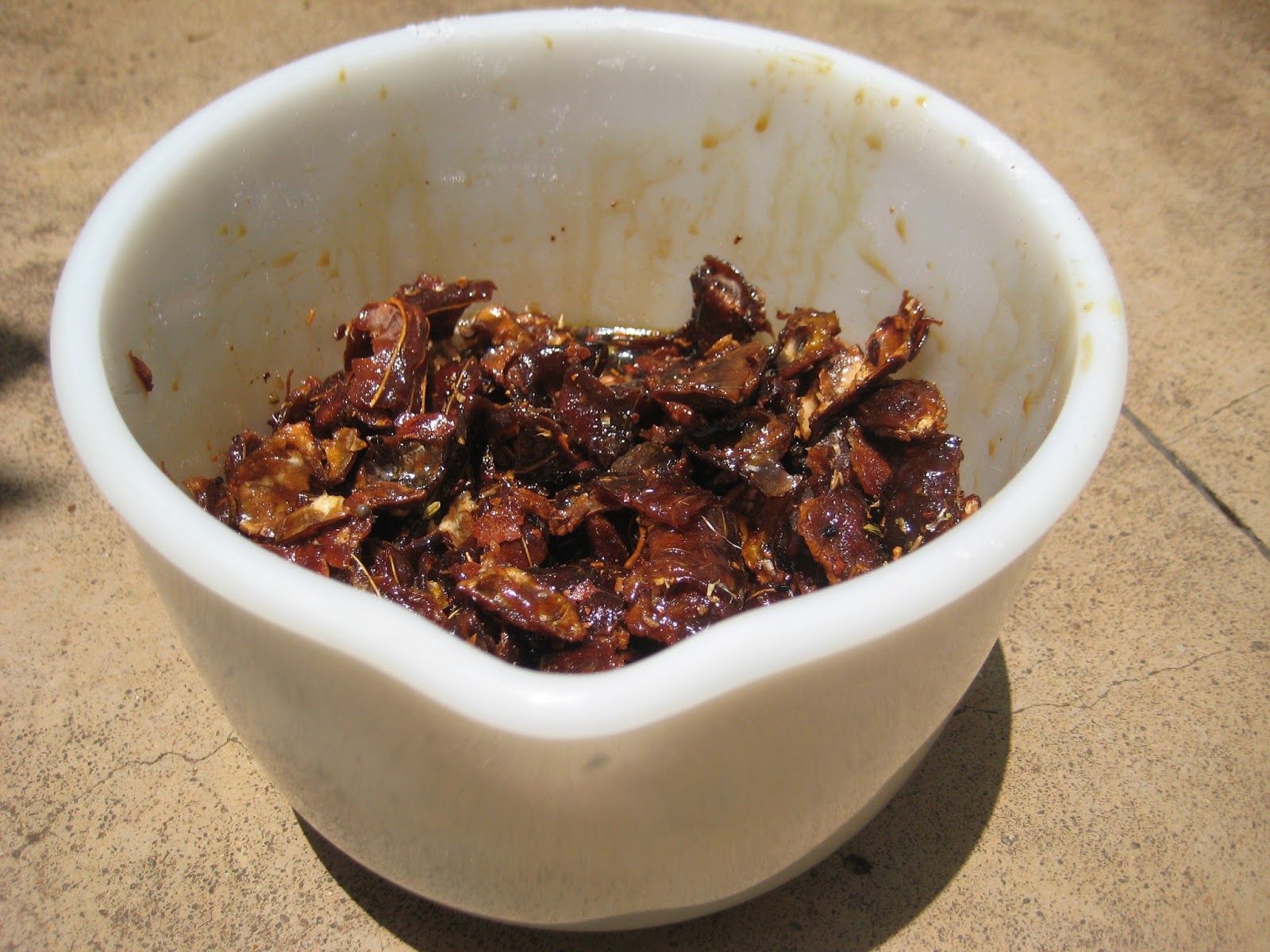
Mix all the ingredients in a clean, dry, non-reactive bowl (I used glass).  Place in the sun for 2-3 days (bring it in each night and cover it tightly with a muslin cloth).  You get a gooey mix, that turns more solid as days go by.  Transfer this to one or more clean glass jars that have been sterilized with boiling water and thoroughly dried.  The flavour of the pickle will mature over time (it tastes sweet, sour and spicy).  The pickle can be stored at room temperature.

A gooey mess!
Footnotes:

The recipe called for raw turmeric powder and mustard oil, a great Bengali favourite that is dabbed on this and that, 'just to be sure'.  While I omitted the turmeric, I fell for the mustard oil, thinking that it might have been included as a preservative or to provide a distinctive Bengali flavour.  As soon as I tasted the raw pickle, I felt the oil was a mistake; it just doesn't go with the rest of the flavours.  I console myself with the thought that its sharpness will be beaten down by the sun and the other ingredients over time, and this seems to be the case (perhaps it will also repel the ants).  The one omission in the original recipe was - salt!  Needless to say, this is essential, for various reasons.  I put in a little extra for good measure but one can tone it down.

Coming to panch phoron - the Bengali five spice mix - this is sold in markets commonly in the east and is now available in Bengali markets in various parts of the country.  Last year, over a family dinner, we were discussing where one could buy the best panch phoron.  Each woman had her own special source and when it was my turn, there was just silence.  On prodding, I revealed that I always made my own, which was the best possible - and got pained looks from all and sundry!  But, it's true!  No one makes panch phoron at home now though it is trivial to do - you end up with good quality spices mixed in the ratio you desire and not some arbitrary packet of condiments.  Opinions about the constituents of panch phoron vary.  The basic ingredients are fenugreek (methi) seeds, cumin (jeera) seeds, nigella (kalonji or kala jeera) seeds, fennel (saunf) seeds and either black mustard (sarson) seeds  or radhuni (no clear English translation for this, the closest seems to be wild celery) seeds, in equal amounts.  I vary the ratio a little, to suit my taste.

My panch phoron
Well, that's it!  I left the pickle in the sun, praying for the absence of clouds, monkeys and ants!  No joke, these fervent entreaties of mine.  During the day, a part of my time is spent monitoring the sky and changes in bird call (that imply the advent of monkeys or rain), evening are spent anxiously scouring the surroundings for ants, which appear silently, swiftly multiply to form an army and march into anything they see, including drinking water (this being summer).  The elements play an important role in the making of a good pickle.

Pickle, innocuously sunning 'midst the lilies

Monday, May 13, 2013

Summer Rain


Cyclones in the east bring to Bangalore an unusual spell of heavy rain.  The first shower is always welcome, sounding a thundery beat, releasing wisps of heat from the ground and bringing a burst of coolness.  However, it is the subsequent showers that create the intense shades of colour (splashes of red, pink, green and cream), the early misty mornings and the tiny rivulets that reflect the sky and trees on the surfaces of roads.


I like to take early morning walks after particularly heavy nocturnal downpours - to watch the birds drying themselves, dogs snoozling in dry spots, to inhale delicious smells of wet earth, trees and grass and to feel the ultra-cool morning breeze.  To listen to the incredibly loud and compelling bird calls, gather the fallen flowers (and in this season - baby mangoes, giant elephant apples and tender tamarind as well) and feel the occasional water droplet run off a branch and plop down on my head.  These pictures, taken midst the breeze, varying light and slow but definite movements all round, adopt a haziness of their own:


 I have a set of old favourite friends that I like to visit - gnarled and wise looking trees - tamarind, banyan, gulmohar, aakash mallige (sky jasmine) and the incredibly elegant jacaranda.  Then I walk down a path lined by fragrant eucalyptus and rustling bamboo.  And finally - back home, to deal with the clogged drains, disrupted phone lines and power failure.  Nothing like a good spell of summer rain!


Friday, February 22, 2013

Signs of Spring


Spring arrived gently a few weeks ago.  I heard it in the air, felt it in my bones and smelt it in the pollen that flew everywhere!  But I paid no heed to it until I began to see the first lilies of my garden emerge.  It was only then that I realized that winter had finally left.


My garden was also changing - the lime tree was straggling back to life and the sweet lime bending under the weight of slowly ripening fruit.


As I began paying attention to the trees, I realized they were alive with birds and birdsong - loaded with incredibly coloured creatures trilling, chirping and flying from branch to branch.  The kites began swooping down more often - to collect twigs for nests.  It is an amazing sight to watch these powerful birds whooshing down to collect a tiny little stick and soaring back up into the sky.


A few days ago, I saw a gardenful of butterflies, all fluttering about at the same time.  (It's really not possible to capture the sight of a bevy of butterflies or a tree bursting with birds.)


As the days get warmer, there are signs of things stirring everywhere - from within the earth and beyond, in the wide blue sky.  Signs of spring, now leading to the usual Bangalore early summer.  In fact, the rapidly spreading Tabebuia yellow in the last few days indicates that summer may already be here!


Wednesday, October 3, 2012

Unexpected Rains


Unexpected rains for a few days have brought out all the birds and insects once more.  The trees are full of huge butterflies and tiny birds, flitting or hopping about.  They come in search of water, and probably, other juicy little insects or flowers.


Orchids have opened and the sweet lime is in flower.


The air is thick with flying ants which head to the nearest light source, falling easy prey to spiders, crows and frogs who patiently at at these spots.  It's a pity these ethereal looking insects are so tasty!


A couple of days ago, a huge rat snake frightened all our downstairs neighbours away.  Probably its home was filled with water and it had briefly stepped out.  I was just grateful and relieved that a few snakes have survived the tremendous concrete-ization of the campus and hope that it manages to survive.

Sunday, August 26, 2012

Stray Garden Visitors

This has been a strange year for rains, half the country is flooded and the other half drought ridden.  In Bangalore we have had small showers periodically that have helped keep the heat away but there has been less rain than usual.  Now, towards the end of the season, the skies are suddenly filled with clouds and there are bursts and torrents of rain.  In between, the sun peeps out and there are moments of bright sunshine, leaving us all confused.  Do we keep the clothes out to dry or bring them in?  Do we need our sweaters or will it be too warm?  Can we step out without an umbrella or will we be caught in a passing shower?


The birds and insects seem all confused too.  Perhaps this is why they have been making short visits to our garden, to look around, forage or just to dry themselves and get their bearings.  Each time I step out I see something crawling or flying or sitting in the garden or on the trees around.  It is impossible to capture these moments in any way, especially as I end up startling the birds and causing the butterflies to gracefully drift away.  But I have captured perhaps a little of the mood of this season - the gentle millipede trundling around, the unusual insects - some that pay a solitary visit and some that come in swarms almost like flocks of birds.  The squirrels that are going crazy chasing each other up and down trees.


The orange aloe vera flowers that don't seem to mind the weather or swarms of insects.  The splash of white in the red ginger lily.  


I missed the koels, the parrots and the barbettes, which flew away as soon as I sighted them, but the bulbul was more placid and allowed me to take a picture as it sat looking around from its perch on the sandalwood tree.


Water droplets run off all the creepers and trees, some go down my neck as well, it's quite refreshing!  And then the sun comes out, suddenly all the colours change and it's a different world.


#Header1_headerimg { margin: 0px auto }