Showing posts with label Food. Show all posts

Tuesday, July 25, 2017

Delights Of British Food

British food is not very highly rated back home (perhaps elsewhere as well).  I will never know why.  My nephew (who spent a couple of years in England before going to America) always makes a face and says he much prefers his current options - and so do many others apparently.  Perhaps many people look for vegetarian options and don't find much, or don't take kindly to the boiled and bland options available.  I disagree.

Perhaps it is because much of my vacation time in England has been centred around London, which is a melting pot of cuisines.  Perhaps it is because I have had the good fortune of being invited to home cooked meals with British friends who serve wholesome and tasty food.  Looking back, I find that while in America I would eat largely the food of immigrant origin, in England I look forward to sampling British food.

In India we grew up on a hearty diet of traditional and western (Anglo Indian) fare.  In the pre-oven days, my grandmother would turn out delicious steamed puddings served hot with custard and would roast chickens in a large pressure cooker.  We could smell the fragrance of the ginger, garlic, black cardamom and bay leaves long before the chicken appeared at the table.  Roast mutton, fried fish and a variety of soups and stews periodically made an appearance, along with rajma, chicken curry, kulfi and other favourites.

My mother acquired a Baby Belling, a reliable and sturdy little oven, on a visit to England.  This tiny, accurate device works still but is not used by anyone at home any more.  In this oven, we made our hot puddings, baked potatoes and it was with this that I learnt to make my first cakes and tarts.  I would pore over the Women's Weekly recipes (and I still love to flip through this British magazine, if I find issues of the sixties and seventies, which were utterly charming) or the Reader's Digest gigantic tome of recipes arranged month wise, and decide what I wanted to try.

My family and I visited London this month and ended up eating meals that we could easily assemble in the apartment where we stayed, buying not very exotic fare from shops close by.  We were lucky to be in a 'good food zone' (I think certain areas of cities just have a higher concentration of better food options than others- not just restaurants but also shops, big and small, that make and source fresh food).

Just down the road from us stood a little Nordic bakery with unusual and delicious seafood and dill sandwiches,  pastries strewn with berries with a hint of sugar and more (the question of Brexit raises its unpleasant head, and one wonders what one will see a couple of years down the line).  Further down the road was a fruit seller who stocked fruit from England and parts of Europe.  Opposite this there was an organic food shop which had delicious soups, stews, fruit, vegetable and meat.  Waitrose - the excellently stocked store, our sustenance really - was where we bought oatcakes, smoked salmon, cheese, cold meat, olives, cider and fresh bread in copious amounts.  My little son was often content with his summer berries and a plate of bread and butter, Cornish Yarg (a cheese) and Scottish smoked salmon!

One Sunday we visited the local farmers' market just outside Paddington Street Park (a short walk away) and (bought and) sampled an excellent array of local food- potted shellfish (freshly caught), savoury British pies (which I like immensely - steak and ale, chicken and leek and my son (who wanted to have Stilton) ate a delicious meat and Stilton pie).  We also tried the handmade fresh sausages - freshly fried with onions and served in a soft roll of bread (we could only manage one between the three of us), and these were very flavourful.  Along with all this, we had fresh summer greens, eaten raw, with just a dash of dressing.  We rarely made it to desserts, but the summer fruit in all its forms (particularly delicious by itself or served in puddings and sweets with whipped cream) was the perfect way to end a large and satisfying meal.

Not for me the chicken tikka masala or balti chicken (ridiculous names in my opinion though these dishes are immensely popular).  A glass of cider, fresh bread with smoked salmon or a crisp, hot pie, a handful of watercress and dark sweet summer cherries would be my perfect summer meal.

Friday, July 8, 2016

Three Favourite Party Recipes

A houseful of hungry students is a great way to test recipes.  After all the crumbs were cleared, I was asked how to make some of the dishes, so I am putting down three recipes which work well for large and small gatherings (they can be scaled up or down with ease).  They can be made in advance or partially made and assembled without too much trouble.  They are adapted from original recipes, which I mention along with each recipe.

Khaukswe (Burmese Noodles)

The original recipe, from 'Cook And Entertain The Burmese Way', by Mi Mi Khaing, has chicken in it.  I prefer this version of the broth, which is vegetarian and lighter.  Various cooked meats and vegetables can be used for the topping.  I also prefer this original Burmese recipe to the variants that are generally found in Indian cookbooks.

Ingredients (for 20 cups of soup):

2 coconuts, extract 3 cups coconut milk from each (to extract coconut milk, mix one and a half cups of warm water mixed with one shredded coconut, leave for a few minutes and strain the milk to get the first extract.  Repeat with another one and a half cups of warm water for the second extract.  Keep the first and second extracts separate) OR 6 cups canned unsweetened coconut milk

2/3 cup gram flour (besan) mixed into a smooth paste with 1 cup of water

13 to 14 cups water

1 cup ground or finely grated onion

1/4 cup finely chopped garlic

oil as required (1/4 - 1/3 cup)

1/2 teaspoon turmeric (haldi) powder

salt to taste

Method:

Heat the oil in a large pan (25 cup capacity).  When it is hot, add the onions and garlic.  Lightly fry them until the raw smell goes away, but do not let them brown.  Gradually, add the water, gram flour paste and turmeric.  Let it come to boil, stirring well periodically so it does not get lumpy.  Add the thin coconut milk (second extract) and simmer for a few minutes.  Add the thick coconut milk (first extract) and salt to taste.  Bring it to a boil, then remove from heat.

Toppings:

Any of the following (one or more can be kept in little bowls)

a) Finely chopped boiled eggs, prawns, boiled chicken, lightly fried mushrooms.

Finely chopped spring onions, coriander (dhania) leaves, basil leaves, thinly sliced and fried onions, fried chopped garlic, fried and pounded red chillies.

b) Boiled rice noodles or wheat noodles

c) Slivers of lime

To assemble:

Place a helping of noodles in a bowl, ladle the hot soup over them.  Let people choose their toppings.

Note: For the chicken version, use a rich chicken stock instead of water and add 2 tablespoons fish sauce along with the thick coconut milk at the end.


Yakhni (A Kashmiri recipe - mutton cooked in milk)

This is adapted from the book Zaika, by Sonya Atal Sapru

Ingredients:

1 kg. mutton (cut in small pieces, I usually use a shoulder along with a part of the back or along with some boneless meat)

Oil as required (I used about 2 tablespoons in a crock pot or slow cooker, but in a regular pan or pressure cooker, you may need more, the original recipes calls for 6 tablespoons)

1 litre of milk

1 and 1/2 teaspoons dry ginger powder

8-10 small green cardamoms

3 teaspoons fennel seeds, powdered

4 bay leaves

8 dry red chillies (I omitted these)

a pinch of saffron

salt to taste

Method:

Heat the oil in a large pan.  When it begins to smoke, add the meat and all ingredients except the last three (do not add the chillies, saffron and salt at this stage).  Cook slowly on low heat, stirring periodically, until the meat is tender and there is a thin milk gravy.  (If using a pressure cooker, I would add half the milk, cook until the meat is tender, then add the remaining half of the milk and slowly let it reduce in a regular pan).  The crock pot is ideal for this recipe and I just let the ingredients simmer overnight.  Once the meat is done, add the chillies, saffron and salt.  Cook for another ten minutes.  Serve hot with rice.

Note: I think the quality of milk makes a difference, use whole (preferably full cream) milk in this recipe.


Mango Tart:

An adaptation from 'The Art Of Viennese Pastry', by Marcia Colman Morton

To make the short pastry dough (murbteig), this makes enough for 2 large (9-10 inch) tart shells-

Ingredients:

100 grams powdered sugar (I use icing sugar)

200 grams cold butter (traditionally unsalted is used, but we don't get good unsalted butter in India for baking, I just use the regular salted butter)

300 grams flour (maida)

1 egg yolk

grated rind of half a lemon (I never bother with this but it does add a nice flavour!)

3-4 tablespoons ice cold water

(I make this in a food processor as it stays colder but one can do it by hand, as was traditionally done.  Keep your hands and all working equipment as cool as possible).

Method:

Combine the flour and sugar in a bowl.  Cut the butter into small pieces and drop them into the bowl along with the egg yolk, lemon rind.  Pulse in a food processor or mix quickly and lightly with cool fingertips until a dough is formed.  I generally have to add water to get a firm smooth dough - add water 1 tablespoon at a time, and when the dough comes together, half a tablespoon at a time.  When you have a smooth ball, flatten it with the heel of your hand to make a thick pancake (I find it better to divide it into two balls and flatten each.  This makes it easier to roll each pastry shell out rather than cutting them later).  Wrap them in plastic wrap and refrigerate for at least one hour (overnight is better).  The dough can be frozen for weeks, to re-use, thaw in a refrigerator and then use.

To bake:

Preheat the oven to 450 degrees F (about 230 degrees C).  Remove the dough from the refrigerator and as soon as it is a little pliable, roll it out, about 1/4 inch thick (I make it just a little thinner).  You will need to sprinkle a little flour on the top and bottom of the dough to prevent it from sticking.  Gently transfer it to the tart pan (you can also make multiple small tartlets).  Press down lightly and prick the bottom and sides gently with a fork.  Place in the hot oven for about 15 minutes or until lightly golden.  (The recipe original states that one should keep the oven door open very slightly during this process but I find it very hard to do, so I just keep it closed).  Remove the tart and cool.

Note: If the weather is cool and dry, the pastry can be stored at room temperature for a few days but not when it is hot or rainy.  This pastry can also be used to make a variety of biscuits, the cooking time is less for those.

To assemble the mango tarts, for two tarts:

About 10 (2 kg.) ripe mangoes, peeled and diced

Spoon the mango filling into the tarts just before serving.  Serve with fresh cream and/or ice cream.

Note: Stewed fruit can be substituted for the mangoes.  I like this version because there is no pastry cream or any other ingredients to detract from the taste of good pastry and good fruit!

(The pictures shown have been taken by Ujjwal Rathore.)

Friday, May 6, 2016

Mangoes!


One of the few bonuses of unremitting summers, like this one.  Mangoes - tiny green windfall ones, almost ripe, sweet and sour ones and the perfectly ripe, incredibly flavourful ones.  We savour them all.

We have had just a couple of showers this summer, hence have picked only a couple of handfuls of freshly fallen green mangoes.  Just enough for several rounds of salad - the other ingredients do not really matter - it's the mango, sugar and salt which does the trick.  One can add lettuce, mint, cilantro (fresh coriander) leaves, spring onion, chillies, pounded mustard seeds and more - and eat it with rice or even with pasta.  We usually soak the ripe ones in a tub of cool water in the early morning and slice them for breakfast.  In previous years we would eat mangoes through the day, but now a couple of perfect mangoes once a day are quite enough for us!


My son likes to play mango games - we pick up a mango that has fallen on the ground and then take turns to throw it along a path, following and retrieving it each time it falls.  Naturally, my throws land on perfectly smooth roads while his seem to go into ditches, piles of leaves and stretches of mud...

Today I have made a mango dessert for a large party.  A Viennese-Indian dessert.  Huge amounts of murbteig (a short pastry) have been made, despite the soaring temperatures.  Never mind the butter visibly softening in minutes, never mind the hot kitchen surface and the laboured cooling of the refrigerator.  Three large tart shells have been rolled out and quickly shoved into the little oven, one after the other, fingers crossed in the hope that there will be no power cuts.  Over a dozen Alphonso mangoes have been peeled and cut - they stand out against the pastry, vividly orange and deliciously sweet.

Everything has been stored in my crockery cupboard (there's no place anywhere else) for this evening, and I am hoping that my little son does not play any cupboard games for the next few hours!

Saturday, April 23, 2016

Turkish Treats

Turkey is one of my favourite countries to visit.  Fortunately its easy to do from India; it's just a six hour flight from Delhi to Istanbul.  Apart from all else, I really enjoy tasting Turkish food - it is fresh, wholesome, strewn with nuts, fresh fruit, herbs, honey in combinations one doesn't find elsewhere.

I haven't visited Turkey in a while but recently my husband had an eight hour stopover in Istanbul.  Fortunately he braved the long exit queues and went into the city.  He took a tram, crossed the Golden Horn via the Galata bridge, got off at the Karaköy tram station (about a 45-50 minute journey, with the metro service available about every 5 minutes) and went in search of - some food!

He brought back with him assorted boxes of delicacies - black olives, peynir (delicious, stringy Turkish cheese typically eaten with freshly made bread), from a gourmet store called Namli Gurme.  From an adjacent store,  Köşkeroğlu, he bought baklava stuffed to the brim with nuts and lokum (Turkish delight).

We are eating all of this (in small rationed doses) for breakfast each morning.  And we feel we are truly basking in Turkish delight!

Just for information, here are some pictures.  Everything that was bought came perfectly packed in his hand baggage, and kept very well (for a week or ten days, as its being so rapidly consumed!) in the refrigerator.  We have actually kept Turkish olives refrigerated for years and they still taste very good.  And the baklava, with all its thin layers of pastry and very thick layers of pistachio or walnut still remains crisp despite the generous drizzles of honey (the power of filo pastry)!

Assorted Baklava and Turkish Delight (lokum)

A good shop for baklava and lokum

Baklava and lokum, overflowing with nuts

A good source for peynir, olives and more

A packet of peynir


Monday, March 14, 2016

Thinking of Tamarind

As always, Bangalore has bypassed spring and stepped straight into summer.  There is nothing more reminiscent of summer than ripe tamarind, hanging temptingly from tall trees, just out of reach.  Of course, if the monkeys (and passers by) don't pick them, the pods fall with little thuds onto the carpet of yellowing tamarind leaves laid out below, and one can race with the squirrels to get to them.

It's hard nowadays to see tamarind trees in public areas; earlier they would abound because they are hardy and well suited to this region.  Providing shade, shelter to birds and animals and deliciously sour fruit, one would think people would like more of them around.  Instead we now have exotic foreign varieties of trees and shrubs which have no place for a bird to sit upon and no shade for a person to rest under.

I also love tamarind trees because they are so incredibly beautiful - large but dainty in detail.  The leaves are made of tiny leaflets, dark green initially, which turn lighter over time.  The flowers are also tiny, almost inconspicuous - yellow and red.  From these emerge long dark pods with tender fruit and the most wonderful looking seeds within - a very dark and shiny brown.

Tamarind is used for cooking and in traditional medicine.  (It is also used in parts of Asia to polish brass!)  My favourite way of eating it is just by itself, fresh off the tree, but one can't eat too much of it like that.  I like to make a chutney by boiling and straining it and adding jaggery and salt, to taste.  Much of the time in our house, the chutney is used to make chaat - the wonderful north Indian savoury concoction, made originally when the weather was very hot and the palate was jaded and the stomach needed something cool and refreshing.  Nowadays, it is found everywhere, but with so much fried stuff and chilly powder thrown in that it does my stomach no good.

No, my homemade chaat is made to my specifications - with freshly boiled and diced potato, tiny boiled chickpeas, tamarind chutney, fresh coriander (cilantro) and mint chutney, pomegranate seeds, whipped curd and a hint of fresh ginger and powdered roasted cumin.  In this I add a few crushed papries (small fried savouries) which give it a nice crunch.

Now that summer has begun, although I no longer can pick and use tamarind off the trees, I have made some bottles of chutney and kept them in the refrigerator (where they stay for months).  Bowls of chaat are being served at home in the afternoons, and they are very welcome!

Saturday, March 12, 2016

The Wisdom Of Traditional Eating

While everything traditional is not really the best option for a changing world, there is much wisdom stored in old ways, that we disregard or choose to forget.

Japanese scientists recently performed a very interesting experiment (that could have been done anywhere in the world, and probably should) - they took several groups of mice and fed each group with dishes recreated from menus of typical Japanese households in 1960, 1975, 1990 and 2005.  This comprised, for example, of mixed rice with dried whitebait and green seaweed flakes, bean and miso soup with taro and mustard spinach for breakfast as opposed to bacon and eggs, toast and fluffy boiled potatoes.

Not surprisingly, the animals that were fed with traditional diets lived longer and better than the ones fed on modern diets.  (K. Yamamoto et al. Nutrition 32, 122-128; 2016).

Diet induced diseases are on the rise everywhere but India with its large population and changing rural and urban dynamics, sees a huge amount of ill health in a relatively young population.  White rice, sugar, processed foods are common culprits (when consumed on a regular basis in large quantities).  The Harvard School of Public Health recently published a paper showing that people who eat one cup of white rice a day have a high risk of developing type 2 diabetes.  White rice consumption is possibly the single largest factor driving this kind of diabetes in India today.

Recently we got a medical check up done for our driver, who is in his early fifties.  His blood sugar levels were surprisingly high, and, to our consternation, the doctor did not even ask him about his diet!  He just prescribed a standard drug to control the sugar levels.  This is just one illustration of the thoughtlessness that goes behind treating diet and lifestyle induced illnesses and the importance of awareness in preventing and controlling such situations.

Should rice eaters switch to brown rice?  Brown rice does not necessarily have a lower glycemic index (i.e. the amount it increases the blood sugar level by); the glycemic index of rice is species-dependent.  But brown rice is heavier to eat (thus one eats less); it also contains vitamins, minerals, oil and fibre which are nourishing and are absent in white rice.  Indian scientists have now developed a new variety of rice that looks white but is unpolished and are trying to introduce this into people's diets (the rationale being that many people don't like the look of unpolished rice).

Appearances do rule the world!  There is a story about a Thai princess who once saw some workers eating unpolished rice that was coarse and ugly looking.  Out of kindness, she declared that these workers must be given white rice to eat, and thereby began their health problems!

India is blessed with a huge variety of traditional foods - many kinds of rice, lentils, millets, wheat, corn and vegetables.  A little thought in choosing what one eats would go a long way.  Of course, what we eat is very important, but almost as important, I think, is how and when we eat.  Eating with awareness (and, if possible, appreciation) of one's food, and at regular and proper times, helps tremendously.

I quote below from two very different books about some traditional forms of food and eating, that charmingly remind us of things forgotten-

"Viennese children were brought up to a rumbling accompaniment of admonitions... But the hardest to understand and to obey, "Don't spoil your appetite - Du sollst deinen Appetit nicht verderben!" was thundered so often and so sternly that it sounded like a latter-day commandment.
   It was doubly difficult for children to learn not to spoil their appetites, because their parents condemned as extremely harmful all the sweets which they really wanted to eat, while all the things they didn't want to eat anyway, such as Spinat (an even less popular word than spinach) and farina pudding, were the rewards for which their parents expected them to keep their appetites intact.  But when they had grown up and had made the happy discovery that they were keeping their appetites unspoiled for better things than farina and spinach, they appreciated the wisdom of the admonition; and they, in turn, drummed the same old lesson into their own children.  as  a result, all Viennese sat up straight at the table and kept unspoilt that most precious possession- their guten Appetit.
   The fine point at which the Viennese were no longer spoiling their appetites and were, in fact, correctly gratifying them was established geographically and horologically.  Anything eaten anywhere except in the dining room, no matter how tempting or nourishing, was frowned upon.  Anything eaten before the appointed dinner hour was considered a definite spoiling of the appetite.  Everything that was eaten in the dining room, after one sat down at the table- with clocklike punctuality and very straight, of course, was smiled upon as legitimate and proper dining, the very thing for which the appetite had been so carefully protected and preserved.  Under these circumstances, the announcement of dinner was always greeted with the greatest pleasure, unless for some unthinkable reason it was late, in which case their were frowns and an audible "Endlich- at last!" when the dining room doors were opened.  No one lingered; they leapt to their feet and began a light and elegant stampede to the dining room and to the long awaited Vorspeise...

 ...What's more the guests no longer sit quite so straight at table, and, to the horror of the cook, they are not nearly so punctual in reaching the dining room as once was the reliable custom when dinner was announced with the striking of the clock."
 (Gourmet's Old Vienna Cookbook, A Viennese Memoir, by Lillian Langseth-Christensen and Leo R. Summers)

"Burmese food is for eating mainly just before morning's pleasantness is lost to the heat of the noon, and again as the cool of evening falls, and eating together is a buttress against dusk's approach.
   Ideally, you should have, minutes before eating, a quick-pouring bath, put on clean loose clothes, and go straight to table.
   Traditionally no wines or spirits, and certainly no tidbits of food, should come between your palate and that table, simultaneously laid with the full meal.  However, present eating shows that foreign wines or Mandalay beer accompanies Burmese food agreeably.
   No flowers or other inedible decoration should be on the table, least of all for guests to whom most hospitality is due.  Eating is the pleasure, and when you in turn are a guest, do not discount the food by an undue amount of conversation.
   A meal's importance is such that, as no one should interrupt yours, so no one who walks in to find you at one should pass by without an invitation to eat.  The carpenter, masseur, bill collector, or postman will recognize the form of your invitation and reply, "I've eaten, please carry on."  A friendly  acquaintance, whom you must press till he sits at the table with a filled plate may sit long and leave the food untouched.  Your close friends who say, "All right then, just a bit of that one," will go on eating till they've shown your family how good your cooking is.
   Burmese food, therefore, must be cooked in quantity and be stretchable by nature.  Today's priorities in your budget might make this difficult.  However customs still enable you to enjoy this traditional gregarious eating.  Tell a sister or friend that tonight your family will bring its dinner over..."
  (Cook And Entertain the Burmese Way, by Mi Mi Khaing)

Wednesday, September 16, 2015

Food, Music And More - Some Memories

Yesterday we said goodbye to Chef Prashant, at Windsor Manor.  Low key and efficient in a very quiet way, he produced memorable meals for us and churned out buffets and banquet meals with ease.  We will miss him!

This got me thinking today of all the years we have been frequenting the buffets at the Windsor coffee shop and all the chefs with their diverse styles that we have met there.  How long has it been?  It's hard to say, for time slips by unnoticed.  A decade perhaps?  Certainly a long, long time but it seems like just a few years.

It began when I got a call asking if I was interested in a card offering discounts on the ITC hotels.  I unhesitatingly said, "No."  Why would I want such a card?
"Well, it's a very good deal," said the very persistent lady at the other end.  I said I would think about it, and my husband and I did.  Finally we decided to try it out for a year as the hotel is very close to where we stay.

That's how it began.  For people interested in trying different kinds of food, it was a good deal, especially the buffet, which we stuck to.

The hotel business in those days was booming.  Tourism was still doing well.  The buffet was large and lavish.  It's been cut down now but it still meets all our requirements and more.  There was an accordion player who would play wonderful European folk and dance music.  (Thus began our friendship with Prakash - a talented musician, one of the few accordion players left in the country, who plays just because he likes to.)

The chef in charge of the buffet at the time was Chef Mazdiyar, a genial, sociable Parsi, who would flit around, chatting with whoever caught his fancy.  We would get tons of Khow Suey and a clear soup with lots of vegetables, in those buffets.  Also prawns in some kind of sweet orange sauce, which he seemed to like.  I got a recipe for vegetable stock from him, which was very handy (as it's tricky to make a flavourful stock with just vegetables).  When he left he organized a week long Parsi food festival, using old family recipes - including everything down to pickles and chutneys.  It was an interesting and new array of food for us.

The next chef, Gaurav, specialized in Indian food, and so we saw a change in the menu style.  A lot of new and different curries, pullaos and biryanis were made.  One that I remember vividly was a prawn biryani from Odisha.  The orange sauce had been replaced by  a spicy tomato one, for the prawns.  A particularly memorable meal we had at this time was on the eve of the Bangalore marathon.  We sat surrounded by Kenyan and Ethiopian runners, who stuffed themselves with carbs (mostly noodles and white bread) while we were eating a very delicate Awadhi chicken curry made with almonds along with traditional breads.

Gaurav was a very spontaneous and enthusiastic chef.  I remember calling him once to request for a birthday cake (part of the 'card package'!) and instead of giving what I believe chefs are instructed to for these occasions, he suddenly launched into a description of a cake with nougat and cream and what not - and proudly produced it!  I was a bit embarrassed but very happy to receive this quite different and delicious cake.

The next chef we met was Prashant.  He specialized in Western food, I think with a generally European slant.  I remember the first time we had the buffet at this stage, there was a white gazpacho soup, which I had never tasted or heard of.  The spicy tomato sauce was now changed to a cocktail sauce, which was terrific.  A new chicken and green papaya soup showed up, which was also very nice.  What I like most about Prashant's cooking was the simplicity of style combined with the high quality of ingredients.  He also reintroduced many of the classic combinations.

In this day of innovation where creativity is greatly rated, I think people forget that classics are classics for a reason.  There is a timelessness about great recipes that must be respected.  Pastry may be painted in different hues and food may be garnished fancily but ultimately, the proof of a pudding is in the eating.  Commercial food establishments (and perhaps buffets) are particularly susceptible to these changing styles, but through many of the years that Prashant was around, I'm glad he didn't yield to this view and served many basic, delicious things like home grown sprouts (mustard sprouts in a green salad, which was tossed with lemon juice and olive oil was one of his simple and delicious dishes).  His stint at the coffee shop was the longest of all chefs when we were around, hence my descriptions also contain more about this style of food.

After this, budget cuts increased.  The hotel embarked on a green policy, wherein they said buffets were wasteful and a fixed buffet like menu would be offered but people could select what they liked and it would be freshly made and sent from the kitchen.  This was the time that we had several nice stir fries (especially with pork and lamb), prawn fried rice and so on.  We were also thankful for Prashant's unabashed joy in cooking with pork, which is one of our favourite meats and is not easy to cook just right. In fact it rarely appears on most menus.

This phase did not last long and we were back to the regular buffet and some nice grills.  A hot stone sizzler option appeared, which was also a terrific new addition.

Then one day, my husband found himself in charge of organizing a banquet to celebrate a special event - the golden jubilee of the Ramachandran plot (a path breaking calculation conceived by Professor GN Ramachandran that was worthy of a Nobel prize, which it never received).  A host of notable scientists from around the world had been invited.  Our thoughts turned to the Windsor poolside, with its charming ambience, and to Prashant, who was still around, and in charge of banquets.

The Windsor managers were too busy to meet us in our personal capacity.  "You are just footfalls in this hotel," they said, with a (charming) smile.  We shrugged and let it be.  Perhaps it was not destined.  A little enquiry from Prakash set the ball rolling again.  And this time, we managed to negotiate and book and meet with Prashant, who offered (and produced) an outstanding and truly elegant buffet at the poolside.

Many people remember this with happiness and satisfaction.  Everything was wonderfully presented and served.  The final flourish came from Prakash, who began playing some Russian tunes when an elderly Russian scientist came up.  The scientist was so moved that he spontaneously broke out into song; his joyful notes reverberated down to the lobby, making people smile.

So, here's to all the people I have known in Windsor, who have worked behind the scenes, handing out happiness through food, music and more.

Wednesday, August 13, 2014

Quick, Satisfying Meals

With very little time on my hands these days, I have simplified my meals considerably.  At the same time, they need to be nutritious, energizing - and (importantly for me!) - tasty!  So I'm using a lot of nuts and fruit, rice and noodles and seafood.  Combinations of these are easy to whip up in half hour periods.  They can also be prepared in stages and actual cooking time is small.  These are some nice combinations:


Cherry tomatoes (always delicious, by themselves or with spring onions or basil and an olive oil dressing, a sprinkling of good feta cheese is a bonus).

Traditional Indian snacks like poha (beaten rice) - instead of just cooking this with chopped potatoes, I add a handful of sprouts and some cashewnuts, a sprinkling of coriander leaves and lime juice.  Similarly with upama (a dry snack or 'tiffin' with roasted semolina - to this I add finely diced carrots and beans or peas, and lightly fried cashewnuts).


Stir fried prawns: in olive oil and garlic or with loads of chopped onion and garlic or just with olive oil and a sprinkling of herbs.  Also small whole fish, marinated and rolled in rice flour and then fried, for the crispiest, lightest coating possible.


Avocadoes with lime, tomato salsa - as we had in Mexico - these go well with almost anything.


Pizza, Pasta, Noodles : I buy some freshly made, half cooked pizzas and add extra vegetables - garlicky spinach or crunchy baby corn or green, red, yellow peppers...
Amongst the sweet quick breads, banana, walnut and cranberry is a delicious combination that takes just about fifteen minutes to put together (before baking).


Wholewheat pasta with a fresh tomato or mushroom sauce is filling and wholesome but what I like even more are rice noodles made the Thai way (Pad Thai), with prawns or chicken (I often use mushrooms and baby corn), spring onions, bean sprouts (when available) and egg and sprinkled with roasted, coarsely pounded peanuts and fresh lime juice.


Mango sticky rice : A traditional Thai dessert.  Sticky rice is drenched in coconut milk and eaten with fresh mango.  Instead of roasted mung beans on the side (which I find too hard when I try and make them at home), I use pine nuts.  This is one of my favourite desserts.  Nothing can beat a good mango, but this would also be nice with caramelized bananas or pineapple, I think.

Friday, January 24, 2014

A Time For Eating

Delhi's grey damp days do not deter me from walking - the air is fresh and icy and the damp gets into every crevice it can find.  But at the end of long walks I come home and help myself to a little bit (or more!) of the wonderful food that winter brings.  Everything is so plentiful right now that I can't imagine that it will all be gone in just another month, when spring brings its own special things.

Right now we are eating carrots in all forms - deep red, sweet winter carrots in salads as we bask in the occasional sunshine (along with this we have white or red radishes, which are particularly mild at this time).  Carrots with peas, carrots with methi (fenugreek greens), carrot juice and delicious carrot halwa (which is never the same when made with regular orange carrots - in fact it is never really made at any other time of the year except in restaurants).  Black carrots, fermented to make a unique winter drink - kanji- which gets its zing from the fermentation and a heady flavour from the carrots to which rock salt and pounded mustard have been added.  It begins as a deep blue liquid and gradually turns deep pink as the acid builds up.  Beetroots, which are also plentiful now, are sometimes used when black carrots are not available.

Winter is always good for greens - an endless variety that can be stir fried (on their own or with potatoes or paneer), kneaded into a dough and used to make rotis.  They can also be made into pullaos with rice, added to lentils and more.  Spinach, fenugreek greens and others which have no English names that I know of.  The mustard greens are now losing their sweetness as they mature and flower; the seeds will later be crushed for oil.  We have the last of them this week, cooked thick and served with thin flat corn bread (makki ki roti), lots of chopped ginger and butter on the side.  A hearty meal.

Peas are especially sweet and tender and are thrown into almost any conceivable dish -  pullaos, curries, dry vegetables. stuffings for breads that are pan fried or deep fried.  My favourite is mattar paneer - peas and cubes of paneer (a kind of homemade lemony cheese) in a light curry.  They also go well with mushrooms, which are plentiful in the winter.

This is also the season for palm jaggery (an eastern Indian specialty) that is freshly tapped and concentrated by boiling the juices.  This imparts a distinct dark colour and delicious flavour to sweets.  I just like to scrape off a little bit and add it to homemade curd.  Apart from this, many other sweets are made, ostensibly to keep off the winter cold - piping hot halwas oozing with ghee (clarified butter) and nuts, thick milky concoctions with saffron, pista or almonds sprinkled in, sheets of peanuts or sesame seeds bound together with sugar or jaggery syrup - crisp and crackly or soft and flaky depending on the consistency.  And when one is tired of all the sweetness, there are always the savouries - roasted nuts, vegetables dipped in gram flour and fried, little salted and spiced snacks made with different kinds of flour and fried till they are crisp and samosas stuffed with potatoes and peas - to be consumed with hot milky tea and much gossip on the side!  Perfect for those dark winter evenings.

Thursday, October 24, 2013

Rain, Apples and Cinnamon


Just a few days after the cyclone, the north-eastern monsoons have stepped in, or rather gusted in, bringing thick clouds and rain at all hours.  We barely got a fortnight of sunshine squeezed in between two heavy monsoons.

I am grateful for the apple season - there's a bumper harvest this year and apple growers in the north are concerned about crashing prices.  No trace of this is evident down south, in Bangalore, where we are still subsisting on pomegranates and oranges.  These fruits are refreshing, but there's not much in terms of wholesome baking that can be done with them.

And these days, steeped in misty mornings and wet evenings, hot apple with a scent of spice is what I long for.  Fortunately, several visitors from Delhi have brought an unending supply of fresh apples for me - tangy golden ones and sweet red ones from the hills of Himachal and Kashmir.

I have spent the last few weeks trying out a range of apple recipes with the bruised, left overs (the best way to eat them of course is as they are) and here are some of my observations:

For sheer elegance, nothing can beat a classic French apple tart - a layer of crisp pastry topped with soft apple filling and covered with thin, lightly caramelized apple slices and perhaps a bit of glaze.  A variety of taste and texture in every mouthful.

One of the tastiest apple desserts, in my view, is Tarte Tartin - the French recipe where apples are bathed in caramel and topped with a crisp, buttery pastry.  I don't throw the tart on the floor (as the legendary Tartin sisters supposedly did) or even turn it over on a plate (the more conventional way) because I feel the pastry stays crisper when it remains on top.  No tartin pans or special skillets are required to make this here, for we have our own stainless steel dabbas, which make very good containers.

However, this comes more in the 'indulgence' category of desserts and it inevitably requires a side serving of cream, which adds to the calories.  I like crumbles too, but I face the same problem - if they're hot and crisp, they beg for a scoop of ice cream or a dollop of cream on the side.  So, instead, for everyday wholesome snacking, I make a plain spiced apple pie.  This uses a very basic crust and a delicious filling of a little bit (but not too much) of all the things that go well with apples - lemon, orange, brown sugar, butter and cinnamon.  Nutmeg and cloves are good too but apple and cinnamon have always been a classic pair.


When the stomach refuses fresh apples, apple stew is a marvel.  Apples, sliced and stewed with just a little sugar, clove and cinnamon are light and satisfying.

And if you like apple in your salad, apples, avocados and walnuts make for a nice combination.  But when they are fresh, I just like to eat them plain!


Sunday, May 26, 2013

Foods (And Food Writers) Of The World

My attempt to learn more geography and history (subjects which never interested me in school) has somehow got entangled with my culinary interests.  The result is a growing collection of books on food from different parts of the world!  Not mere cookbooks, for I initially selected them because they served as guides to various countries' geography, history, political past and culture.

I began with some of 'The Beautiful' series quite by chance - Mexico The Beautiful was the first, a gift from an old Mexican friend.  These books are a cross between a small encyclopedia and a large coffee table book, with lots of recipes thrown in.  An interesting and informative combination.  What got me thinking a little more about them was when I read 'China The Beautiful' by Kevin Sinclair.  This was so well written that I wondered if the author was not merely a cook or gourmet traveller in the country.  After a little search, I discovered that he had been a veteran and irrepressible journalist, who  spent forty years reporting on Hong Kong.  This led me to thinking about the universal appeal of thoughtful and well written books.

The next step in my search came when I looked at some Time Life volumes which were part of the 'Foods of the World' series.  These were lying at the very bottom of a large bookshelf, almost concealed, in a second hand bookstore.  They had been lying there for some time and I had seen them earlier but had never bothered to give them a second glance.  I was usually searching for more modern and relevant cookbooks.  This time, I thought of Kevin Sinclair and Time Life's reputation for serious, high quality writing and opened these books.  They seemed filled with quaint pictures, interesting-sounding recipes and very personal interpretations of food.  The Time Life teams appeared unusual - some were writers, some journalists, editors and professional photographers.  I bought the few books that were stocked in the bookstore and am slowly going through them.

I find them quite fascinating, not just because of what I learn about the country they deal with but because of their intrinsic subjectivity.  The mind of the author comes through distinctly, lending a particular style to each volume that sets it apart from the others (though I sense that some volumes have been over-zealously edited).  Equally interesting are the reasons given for creating these books; these shed light on the authors and their regions of interest.

I quote below, from various authors, their reasons for writing about food.  (My main reason for writing about food is that it satisfies me from within.  But others have put it far more eloquently and movingly than I can ever hope to):

One of the nicest descriptions that I have come across in general is that by M.F. K. Fisher, (one of America's earliest food writers), when asked why she chose to write about food and hunger :  

'When I write about hunger, I am really writing about love and the hunger for it, and warmth, and the love of it . . . and then the warmth and richness and fine reality of hunger satisfied.'

Certainly the last century was filled with horrors of war and its aftermath in many parts of the West, where most of these food writers lived.  Elizabeth David, in the preface to the second edition of her book 'Mediterranean Food' writes:

'This book first appeared in 1950, when almost every essential ingredient of good cooking was either rationed or unobtainable.  To produce the simplest meal consisting of even two or three genuine dishes required the utmost ingenuity and devotion.  But even if people could not very often make the dishes here described, it was stimulating to think about them; to escape from the deadly boredom of queueing and the frustration of buying weekly rations; to read about real food cooked with wine and olive oil, eggs and butter and cream, and dishes richly flavoured with onions, garlic, herbs and brightly coloured Southern vegetables.'

For many authors of the Time Life series, the assignment began as a personal quest that shaped the style and manner of presentation of each volume.  The quest varied in nature depending on the person and their circumstances.  Dale Brown, writer of 'American Cooking' travelled within America at a time when there was no scarcity or rationing and these were his main concerns :

'New York, New England, the middle Atlantic States and the Mid-West - have long been familiar to me.  But until recently I had not had an opportunity to acquaint myself with the food in other parts of the country and to study the influences that have affected it.  And so, my wife and I, with our two year old daughter, embarked on an extended gastronomic tour of the country.  Before our journey was over, we would have tasted everything from Florida's Key lime pie and South Carolina's wild orange marmalade (a real rarity) to Louisiana's mirliton, or vegetable pear, stuffed with Gulf shrimp, and Oregon's kippered salmon.  I welcomed so unique an opportunity to show my Dutch wife this beautiful country and to introduce her to its regional cooking - but I was also, to tell the truth, a little worried.  I felt that mass communication and mass travel might have succeeded in throwing a net of conformity over many formerly colorful areas.  How wrong I was, only the trip could tell.'

For some, moving to a new country (especially from the West to the East) was a eye-opener of sort.  Emily Hahn began 'The Cooking of China' with her description of the first meal in a Shanghai restaurant, where she was a guest of some Chinese friends:

'For one thing I was exasperated by the behavior of my host, who made what seemed to me a ridiculous fuss about giving the order.  After all, I said to myself, we weren't celebrating anything, but simply going to eat.  Yet the host went into a long, incomprehensible (to me) discussion about the menu with the proprieter.  With every minute that passed I grew more bored and hungry, wondering how people could possibly find so much to say about food.  Long after the proprieter had gone away with the order, I continued to feel indignant.
   Then the first dish arrived - soup with sliced pork and Chinese vegetables - I tasted it.  I looked up in amazement, waiting for someone else to comment on its excellence, but nobody did.  They spooned it up busily, and after a moment I followed their example.  I was considering a second bowl when the waiter brought in a number of dishes that he put on the table in a haphazard way, all together.  One was steamed fish in black bean sauce, tender and juicy, full of different tastes of spice, and enriched by the sauce.  There were spareribs of just the right crispness, and a dish of vegetables that I did not recognize, crunchy and as fresh-colored as if they had not been cooked.  I asked how this effect was attained, and was told that they had been "stir-fried", or cooked quickly in very hot oil.  There was also chicken cooked in soya sauce, and that completed what my host called a plain, simple little meal.  It certainly showed me how much I did not know about Chinese food.  I had come late to the realization, but I determined to make up for lost time.'

Her determination resulted in a book explaining the food and cooking of different parts of China!

Rafael Steinberg, a correspondent during the Korean war and later Tokyo's bureau chief, was married to a Japanese and was introduced in some detail to Japanese food through her and her family.  (This book is also filled with beautiful photographs taken by Eliot Eliofson, a painter and photographer.)

In the prelude to his book 'The Cooking of Japan' Rafael Steinberg quotes from the writings of Faubion Bowers, author, world traveller and aide-de-camp to General Douglas Mac Arthur during the early years of the post-war occupation of Japan:

'The time finally came for me to visit my dream of Japan, and as soon as I set foot on the good ship Hikawa-maru in Seattle - oh yes, aircrafts were invented but they weren't flying the Pacific - I was confronted with what the passengers called "The Choice".  You could have either a full Western meal or a full Japanese one.  I asked for Japanese food, got it three times a day and stuck to it for the whole 21 days of the voyage to Yokohama.  My motives were mostly brummagem, but partly too, I like to imagine, good sense.  I was determined to learn Japanese for, as I now tell the story, I knew war was coming.  I have never believed that "you are what you eat" (in Japanese they drink snake's blood for longevity), however I am convinced that you can't learn a language without enjoying the food of the nation.  Just think of the loss of idiom an English-speaking Japanese might feel if he didn't understand things like a lover being the "cream in his coffee", or something being "as English as roast beef".
   Now, in retrospect, I must admit I explored Japan's gustatory and culinary arts the hard way.  I tortured myself with umeboshi, ultra-sour plums, on deck while watching the sun rise.  I snacked on odorous, fermented soya beans, called natto, at night before retiring .  I even tried again and again those little cakes printed in the shapes of flat flowers, which taste dry as chalk and crumble into sandy powder with every bite.  But along the way I encountered myriads of delight and miracles of surprising pleasures.  Sukiyaki and tempura, as it goes without saying, and noodles too, and tonkatsu, which loses totally in translation if you say "pork cutlet".  The warmth of bean soup, the dew-like freshness of thin soup, the brilliant clarity of good, first-quality soya sauce, and thousands of other sauces, each bound, as in a marriage, to its own particular mate.  Where else in the cooking world can you have so light, so greaseless, so sparkling a set of flavours and textures that turn into aromas or melt as soon as they reach your mouth?
   The day soon came when raw fish was on the ship's table d'hote, and I discovered that it didn't taste raw, or even like fish.  And with this conclusion I joined the ranks of astonished foreigners whose numbers increase, like school children and textbooks, year by year.  By now the last threshold was crossed, and I was enslaved to Japanese cooking...
   ...Today I often find myself "hungry" for Japan, and once it got so bad I cooked up an excuse for a quick trip back just because I was hungry.  So, there are dangers in becoming habituated to this great cuisine.  However, a book such as this one at last makes possible the impossible: You can now do it yourself in your own home.  Here, too, be careful.  My own son said to me recently, "Please, Dad.  Not tofu again!"  But just wait until he grows up.'

And finally, a book on African food by a very interesting author, Laurens van der Post.  I couldn't believe that such a book might actually exist!  I was curious about the food of Africa - a whole mysterious continent that one knows little of, and that too seen through the eyes of one who was born there and had extensively explored and written about it.  He drifted between Africa and England and finally settled in England; his biographical claims and descriptions were mired in controversy after he died, but some of his words remain haunting and evocative.

In his book 'African Cooking', he says:

'My earliest memories of Africa, and of my life there, center around the large dining table in the home of my Boer grandfather, in the Orange Free State, deep in the interior of south Africa.  And almost invariably the scene in this theater of my past is the evening meal.  I used to wait for this meal, six decades ago, with the same kind of excitement that I was to experience much later as a drama critic in London, before the curtains rose on the first night of a new work by a friend from whom I expected much.  As in a darkened playhouse, the excitement would start when the maids began to light the heavy oil lamps in the long passage that led from the front door on the veranda surrounding the house.  At last they came to the dining room, and the biggest lamp of all.  In the center of that room was a great table made of an African wood so hard and dense that a piece of it would sink like iron if it was thrown into water; and over the center of the table, suspended in massive chains, hung an immense oil lamp made of brass  that glowed and shone like gold...
   The sense of smell is surely the most evocative of all our senses.  It goes deeper than conscious thought or organized memory and has a will of its own that the mind is compelled to heed.  Since the scent of cinnamon is the first to present itself to my memory of the moment when the great lamp was lit and the great table set and ready, I must accept the fact that my first coherent recollection of the drama of our evening meal begins with the serving of a typical milk soup of the South African interior...
   The fragrance of cinnamon would still be adrift in the room when the more acute sense of cloves announced that the main course was on its way.  This would be a superbly pot-roasted leg of lamb, a standard dish of the interior.  Studded with cloves from Zanzibar, less than 2,000 miles from us as the crow flies, the lamb - itself a product of our farm- was so tender that it seemed to flake rather than cut at the touch of my grandfather's carving knife.
   Mixed with the smell of cloves was that of saffron rice and raisins - a dish that was not typical of the interior, but one that had been introduced to my family by my French grandmother.  My grandfather served it more as apart of a ritual remembrance of all she had meant in his life than as mere gratification of his own liking for it.
   With these varied scents, there came the sharp fragrance of quince jelly, which was always served with our roasts, burning like a maharaja's ruby in its own crystal bowl, and tasting as brilliant as it looked.  Then, since this was winter, came a dish of dried spotted beans, which we know as governor's beans; centuries ago , presumably, some forgotten governor had first planted them in the vast kitchen garden that his masters, the Dutch East India Company, had made of the Cape of Good Hope.  (Their purpose was to provide fresh foods to forestall scurvy among Dutch sailors in the spice trade.)  At grandfather's house the beans were cooked in mutton stock and pureed tomatoes and were accompanied by baked pumpkin flavoured with nutmeg.
   Last of all came a bowl piled high with yellow peaches, turned to burnished gold by the alchemy of the great lamp overhead.  These peaches still glow in my memory like an offering of fruit from some sheltered grove of Hesperides.  Like everything else we ate they were the product of our completely self-sufficient farm.  They were preserved whole in glass jars in the summer, so skillfully that much of their original savor remained.  I have yet to discover, in this technological age of ours, any preserved fruit that could rival those peaches.  They brought into the winter night the fullness of the summer gone by and the promise of its return...

...Some months ago I badly injured my right arm and was told by doctors that, if I ever meant to use it for writing again, it would have to be rested for many months.  This enforced ease seemed a wonderful opportunity to revisit the whole of Africa.  I would see again the lands I had explored for 40 years of my life; I would see what Africa was achieving now that so many influences of European colonialism were vanishing.  I intended, once I could write again, to set down my appraisal of this new emergent Africa.  But everywhere I went I found myself too profoundly depressed by what I saw to write dispassionately about it.  In an Africa that is so much at one in its deepest nature, millions of human beings are involved in divisive conflicts, killing one another from Mali to Zanzibar and The Congo on a scale that even the reviled former imperialists would never have permitted.  The political and social scene in Africa seemed to me eroded and bankrupt, and I instinctively rebelled against joining in any form of activity so negative and destructive.
   All this may be part of the price Africa must pay before it can enjoy ultimate unity.  But I was certain that I could not further this unity by entering into the ideological conflicts and rivalries that are tearing the continent apart.  I came to believe that embattled Africa could best be regenerated by a profoundly nonpolitical reassessment of common aims and ideals - a rediscovery of the overriding values of the dignity of man and the reverence for life.
   Then I wondered, often in desperation, what in the world all the warring systems, countries, tribes and races still had indisputably in common.  Oversimple and childlike as it may seem, one answer that popped up from my imagination was food.  If I did what has never been done before - if I wrote about the food of Africa as a whole, about African man and his ways of eating and cooking from the Stone Age Bushman to the sophisticated gourmet in Addis Ababa or Capetown - perhaps I could render some service and at least pay homage to my troubled continent.  In a way, I would be doing what my grandfather did at those meals at his homestead, when he assembled all the races around his table every night.  In a small way, too, I could recall for my readers the fact that all men are one in their needs and searchings, that whatever set them apart is evil and whatever brings them peacefully together is good.  This is what I have tried to do in the chapters that follow.'

The down side of so much subjectivity is that one depends heavily on the writer for accuracy of reporting, but these books (mostly published in the early seventies) are an incredible read.  So here  begins a culinary adventure of a different kind for me - one that starts in the mind and that can be converted into things one can smell and taste (the books come with recipes) - more exciting than reading mere geography or history!

Friday, May 17, 2013

Make Tamarind Pickle While The Sun Shines

A ripe pod of tamarind 
Tamarind or Tamrhind (Indian date, as Arab traders named this dark, fleshy pod) has filled every nook and corner of my house.  It peeps out from myriad plastic packets that have been stuffed in cupboards, boxes, buckets and even reclines gracefully at the entrance, catching my eye and reminding me to do something about it.

Neatly packed, ready to go!
I like many things about tamarind - the beautiful trees that flourish in tropical weather, overflowing with tiny green leaves, the creamy yellow-red flowers and most of all the fruit, with its tongue puckering sourness.  I can never resist picking up fallen pods, breaking them open and popping a piece into my mouth and cringing as the sourness makes its presence felt.  It's not often one comes across old venerable tamarind trees any more; for some unknown reason  people have stopped planting them (perhaps they take up too much space) but I always get a burst of nostalgia on seeing a large tamarind tree.  I have spent many happy hours under these ancient trees (beginning with a wonderful tree near the West End Hotel swimming pool in Bangalore in days when one could happily wander around such places, gathering fallen pods under the indulgent eye of a waiter with large moustaches, who had nothing much to do other than serve the evening diners).

A tree of many seasons
Tamarind tree in bloom
To return to the present, the reason tamarind pods are flooding my house is that this is the harvest season.  Some weeks ago, I received a gift from a friend - tamarind that had just come off his tree.  It had barely been cleaned and retained  its 'fresh from the tree' appearance.  It was undoubtedly delicious just as it was, however there is a limit to the amount of fresh tamarind one can consume daily (unfortunately, this figure is inversely proportional to one's age).  The tamarind was too good to be used for cooking, hence I decided to make a pickle.  There is a Bengali pickle made with tamarind and, after some probing, I was fortunate to be sent an old family recipe from Kolkata.  Tetul is the Bengali word for tamarind; it sounds quite poetic, especially when compared to the mundane Hindi 'imli'.  Tamrhind, of course, has a more dashing ring to it, though I can't say that this fruit reminds me much of dates (and the tree is actually a native of tropical Africa though its scientific name is Tamarindus indica).

The second reason I am flooded with tamarind is because a couple of weeks ago, another friend called to say that she had harvested some tamarind from her farm and could I find out if anyone might want some?  Since then, I have become a sort of sales agent, commissioning and selling packets of farm fresh, organic, sun dried tamarind.  This has been a pleasant exercise, helping me renew contact with several acquaintances and friends.  Some people have reserved many kilos and are yet to come and collect it and as my friend only visits the city once in a while, the bags repose in my house, awaiting their new owners.  I am pleased to mention that I successfully sold all the tamarind but at the end of it we realized she had barely broken even!  Next year, the prices will be fixed more wisely (but we have generated a lot of goodwill this season)!

Now, to the pickle.  I'm sure better recipes exist and I will need to optimize this one.  I have modified it a little, for as many old family recipes go, the original recipe was a mere outline.  After hearing  horrific tales of my husband's grandmother, who purposely left out one key ingredient each time someone asked her for a recipe, I requested members of the current generation to verify this recipe before sending it.  It turns out that no one makes tamarind pickle any more.  So I cannot guarantee that this method produces a 'genuine' Bangali pickle, but it tastes fine and is as good a way as any, to eat tamarind without blowing out your taste buds.  Here goes:

250 g tamarind, fresh off the tree (with outer pod and seeds removed - you can use store bought stuff too!)
250 g jaggery dissolved in a cup of water, boiled and strained
1 Tablespoon panch phoron (a mix of spices, see footnote) (I roasted and lightly pounded this)
2-4 whole red chillies (or to taste), powdered (I de-seeded and roasted them first)
2 Tablespoons mustard oil (see footnote)
50 g salt (I mixed regular and rock salt to make it less salty, I think 30 g regular salt should probably do)

Use as many (or as few) chillies as you like
Jaggery - a key ingredient
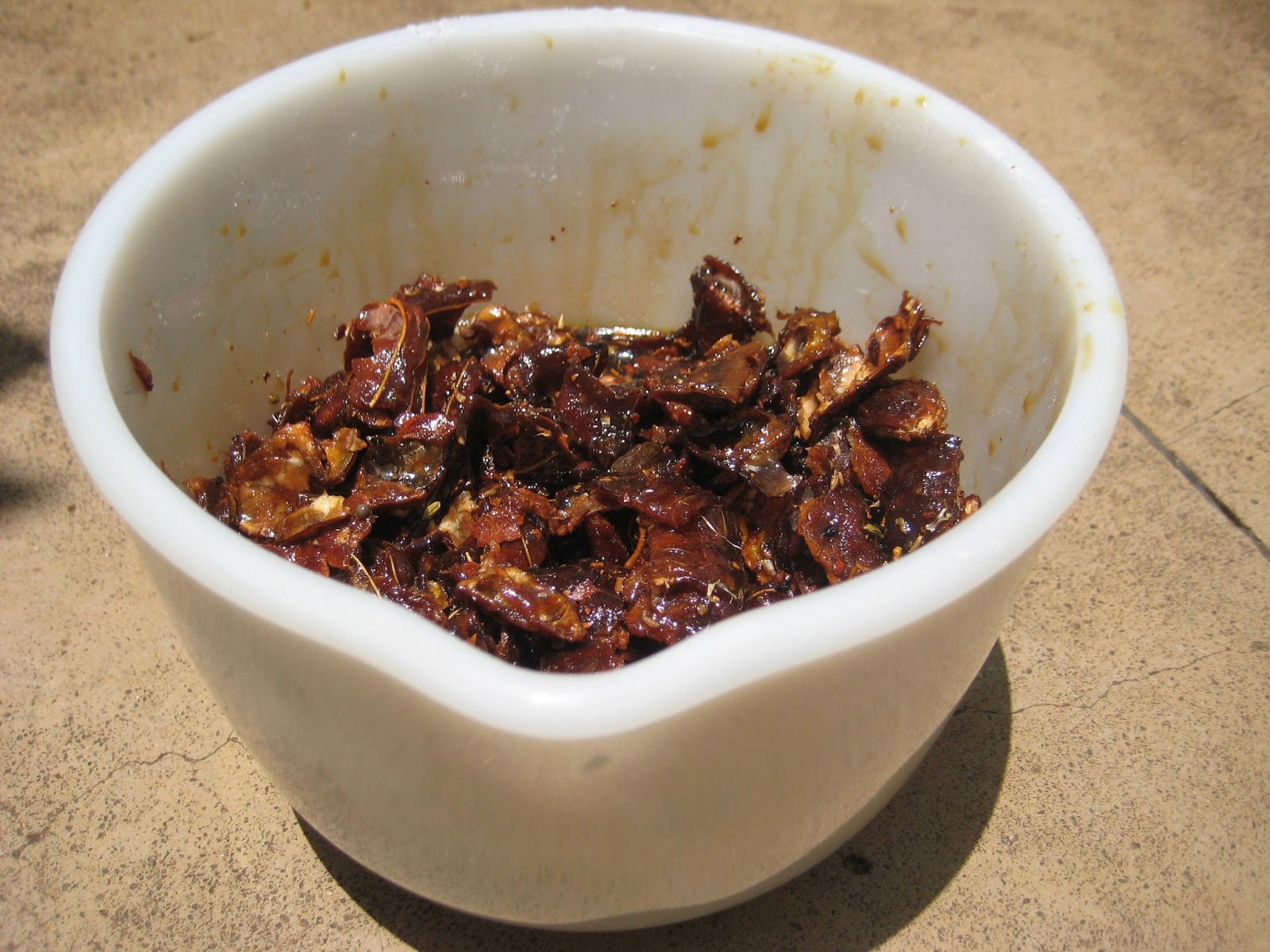
Mix all the ingredients in a clean, dry, non-reactive bowl (I used glass).  Place in the sun for 2-3 days (bring it in each night and cover it tightly with a muslin cloth).  You get a gooey mix, that turns more solid as days go by.  Transfer this to one or more clean glass jars that have been sterilized with boiling water and thoroughly dried.  The flavour of the pickle will mature over time (it tastes sweet, sour and spicy).  The pickle can be stored at room temperature.

A gooey mess!
Footnotes:

The recipe called for raw turmeric powder and mustard oil, a great Bengali favourite that is dabbed on this and that, 'just to be sure'.  While I omitted the turmeric, I fell for the mustard oil, thinking that it might have been included as a preservative or to provide a distinctive Bengali flavour.  As soon as I tasted the raw pickle, I felt the oil was a mistake; it just doesn't go with the rest of the flavours.  I console myself with the thought that its sharpness will be beaten down by the sun and the other ingredients over time, and this seems to be the case (perhaps it will also repel the ants).  The one omission in the original recipe was - salt!  Needless to say, this is essential, for various reasons.  I put in a little extra for good measure but one can tone it down.

Coming to panch phoron - the Bengali five spice mix - this is sold in markets commonly in the east and is now available in Bengali markets in various parts of the country.  Last year, over a family dinner, we were discussing where one could buy the best panch phoron.  Each woman had her own special source and when it was my turn, there was just silence.  On prodding, I revealed that I always made my own, which was the best possible - and got pained looks from all and sundry!  But, it's true!  No one makes panch phoron at home now though it is trivial to do - you end up with good quality spices mixed in the ratio you desire and not some arbitrary packet of condiments.  Opinions about the constituents of panch phoron vary.  The basic ingredients are fenugreek (methi) seeds, cumin (jeera) seeds, nigella (kalonji or kala jeera) seeds, fennel (saunf) seeds and either black mustard (sarson) seeds  or radhuni (no clear English translation for this, the closest seems to be wild celery) seeds, in equal amounts.  I vary the ratio a little, to suit my taste.

My panch phoron
Well, that's it!  I left the pickle in the sun, praying for the absence of clouds, monkeys and ants!  No joke, these fervent entreaties of mine.  During the day, a part of my time is spent monitoring the sky and changes in bird call (that imply the advent of monkeys or rain), evening are spent anxiously scouring the surroundings for ants, which appear silently, swiftly multiply to form an army and march into anything they see, including drinking water (this being summer).  The elements play an important role in the making of a good pickle.

Pickle, innocuously sunning 'midst the lilies

Wednesday, May 1, 2013

Summer Foods


As I sit and write of summer foods in India, I think of two English women who have, in part, made it possible.  Nora, who has served as a constant source of support for my blogging and who has encouraged me to unabashedly write about food (which I thought this blog was perhaps getting an overdose of).  Elizabeth David, whose classic and timeless cookbooks brought 'sunshine and elegance' to post war greyness and continue to do so in modern times.

As the sun sears everything in sight and I long to sit in an air conditioned car, drive to an air conditioned supermarket and buy whatever is available, I am severely admonished by Elizabeth David.  She writes in the introduction to her book "Summer Cooking'' (first published in 1955) :

"A couple of years ago an advocate of the tin and the deep freeze wrote to a Sunday newspaper explaining that  frozen or tinned vegetables were better than fresh ones, as the "pick of the crop" goes straight to the factories to be frozen or tinned.  Can this be a matter for congratulation?  I am not unappreciative of modern marvels, and in its way the deep freeze is an admirable invention, particularly for the United States, where fresh produce has to be transported great distances.  Some foods, game, for example, stand up remarkably well to the freezing process, but let us not pretend that frozen green peas, raspberries, and blackberries are "as good as fresh".  They may indeed be quite adequate, and are an incontestable blessing to people pressed for time or space, or having to provide meals at very short notice, but is it necessary for those not in such circumstances to eat all the food out of season?  Frozen peas seem to have become the almost obligatory accompaniment to every meal, whether in private houses or restaurants; yet how often do we get a dish of those really delicate, fresh, sugary green  peas?  Is it because the "pick of the crop" has gone to the factory instead of to the market and we are therefore unable to buy them, or is it because people no longer know how to shell them and cook them and have forgotten what they taste like?
   The deep freeze appears to have gained over the minds of the English housewife and restaurant keeper a hypnotic power such as never was exercised by the canning factories.  Even leaving out of consideration the fact that the pleasure of discovering each season's vegetables and fruits at the appropriate time is thereby quite blunted, this method of marketing seems to me an extravagant one.  As I write, there are lovely little South African pineapples in the greengrocer's down the road for 1s. 6d. each, sweet, juicy oranges at seven for a shilling, yet people are crowding round the deep freeze in the same shop paying four times as much for a few strawberries in a cardboard packet.  As soon as strawberries and raspberries are in season they will be clamouring for frozen pineapple and cartons of orange juice..."

I read this, sigh, put on my most summery clothes and head out to Russell Market.  The market is surprisingly clean - garbage has been cleared and wonder of wonders, they actually have electricity!  "What's happening?" I ask.  "Elections," people answer with a broad grin.  "The candidates are all terrible but until the elections, we have been given power."  The pun is unintended (appears only in translation; everyone in Russell Market speaks in Hindi).  State elections are round the corner and everyone's being generous with resources.  The market is also cool within, being housed in an old colonial building with high ceilings and plenty of air.  This is a natural coolness; it feels much nicer than air conditioned stores where one is chilled to the bone.

The market is not overflowing with food; summer is a difficult period for storage and transportation.  But much of what is available is fresh and there's quite enough for many good meals.  I buy the usual summer staples - onions, tomatoes, squashes, okra (lady's fingers), aubergine (brinjal).  In addition, real coriander (not the hybrid kind) - the one with a delicate fragrance, green mangoes and mint.  Then, as I am planning a party, I look for something different.  And I find - heaps of basil, celery and parsley (the flat leafed kind, which we rarely see), piles of baby corn and red peppers.  And tiny cucumbers, each displaying a flower at one end.  I can scarcely believe these are cucumbers, fresh off the vine!  I have never seen a cucumber flower in my life!  The shopkeeper is amused.  He throws in several extra pieces for good measure.


From the fruit shops, I select the very last of the strawberries, early mangoes and a couple of different kinds of melons.  I plan to serve some of the fruit with tiny sweet tarts and meringues that I have baked and thick, chilled cream on the side.

Earlier I used to refer to British recipes (which we have a family collection of, since my grandmother's time) for 'Western' cooking but these days I find the Mediterranean ones more useful.  This is partly because we are eating less meat and partly because the weather and availability of ingredients favours Mediterranean (and Asian) cooking.  Of course, often times, I just modify or concoct recipes based on classic compositions.

For the party, we had a thickened curd dip, with hints of fresh coriander and mint.  I served this with a collection of crackers (my experiments with different kinds of flours, nuts and seeds) and with slices of radish and baby cucumbers and crisp celery stalks.  Just for information, the tiny yellow thing in the centre is a cucumber flower!


I made two kinds of pasta - a carbonara (bacon, eggs and cream) for the meat eaters and one with fresh tomato and basil for everyone.  In addition we had a platter of thinly sliced aubergine (brinjal), coated with breadcrumbs and fried crisp.  Also, large dishes of baby corn, red and yellow peppers, onions and basil, that were marinated in wine and olive oil and grilled.


Finally, the dessert - a medley of fruit, pastry, meringue and cream.  People could choose their own combinations.  It all went down smoothly (and cost just a fraction of what it might at a restaurant).
This, of course, is just the beginning of a long summer and my experiments with summer foods.


#Header1_headerimg { margin: 0px auto }