Friday, May 17, 2013

Make Tamarind Pickle While The Sun Shines

A ripe pod of tamarind 
Tamarind or Tamrhind (Indian date, as Arab traders named this dark, fleshy pod) has filled every nook and corner of my house.  It peeps out from myriad plastic packets that have been stuffed in cupboards, boxes, buckets and even reclines gracefully at the entrance, catching my eye and reminding me to do something about it.

Neatly packed, ready to go!
I like many things about tamarind - the beautiful trees that flourish in tropical weather, overflowing with tiny green leaves, the creamy yellow-red flowers and most of all the fruit, with its tongue puckering sourness.  I can never resist picking up fallen pods, breaking them open and popping a piece into my mouth and cringing as the sourness makes its presence felt.  It's not often one comes across old venerable tamarind trees any more; for some unknown reason  people have stopped planting them (perhaps they take up too much space) but I always get a burst of nostalgia on seeing a large tamarind tree.  I have spent many happy hours under these ancient trees (beginning with a wonderful tree near the West End Hotel swimming pool in Bangalore in days when one could happily wander around such places, gathering fallen pods under the indulgent eye of a waiter with large moustaches, who had nothing much to do other than serve the evening diners).

A tree of many seasons
Tamarind tree in bloom
To return to the present, the reason tamarind pods are flooding my house is that this is the harvest season.  Some weeks ago, I received a gift from a friend - tamarind that had just come off his tree.  It had barely been cleaned and retained  its 'fresh from the tree' appearance.  It was undoubtedly delicious just as it was, however there is a limit to the amount of fresh tamarind one can consume daily (unfortunately, this figure is inversely proportional to one's age).  The tamarind was too good to be used for cooking, hence I decided to make a pickle.  There is a Bengali pickle made with tamarind and, after some probing, I was fortunate to be sent an old family recipe from Kolkata.  Tetul is the Bengali word for tamarind; it sounds quite poetic, especially when compared to the mundane Hindi 'imli'.  Tamrhind, of course, has a more dashing ring to it, though I can't say that this fruit reminds me much of dates (and the tree is actually a native of tropical Africa though its scientific name is Tamarindus indica).

The second reason I am flooded with tamarind is because a couple of weeks ago, another friend called to say that she had harvested some tamarind from her farm and could I find out if anyone might want some?  Since then, I have become a sort of sales agent, commissioning and selling packets of farm fresh, organic, sun dried tamarind.  This has been a pleasant exercise, helping me renew contact with several acquaintances and friends.  Some people have reserved many kilos and are yet to come and collect it and as my friend only visits the city once in a while, the bags repose in my house, awaiting their new owners.  I am pleased to mention that I successfully sold all the tamarind but at the end of it we realized she had barely broken even!  Next year, the prices will be fixed more wisely (but we have generated a lot of goodwill this season)!

Now, to the pickle.  I'm sure better recipes exist and I will need to optimize this one.  I have modified it a little, for as many old family recipes go, the original recipe was a mere outline.  After hearing  horrific tales of my husband's grandmother, who purposely left out one key ingredient each time someone asked her for a recipe, I requested members of the current generation to verify this recipe before sending it.  It turns out that no one makes tamarind pickle any more.  So I cannot guarantee that this method produces a 'genuine' Bangali pickle, but it tastes fine and is as good a way as any, to eat tamarind without blowing out your taste buds.  Here goes:

250 g tamarind, fresh off the tree (with outer pod and seeds removed - you can use store bought stuff too!)
250 g jaggery dissolved in a cup of water, boiled and strained
1 Tablespoon panch phoron (a mix of spices, see footnote) (I roasted and lightly pounded this)
2-4 whole red chillies (or to taste), powdered (I de-seeded and roasted them first)
2 Tablespoons mustard oil (see footnote)
50 g salt (I mixed regular and rock salt to make it less salty, I think 30 g regular salt should probably do)

Use as many (or as few) chillies as you like
Jaggery - a key ingredient
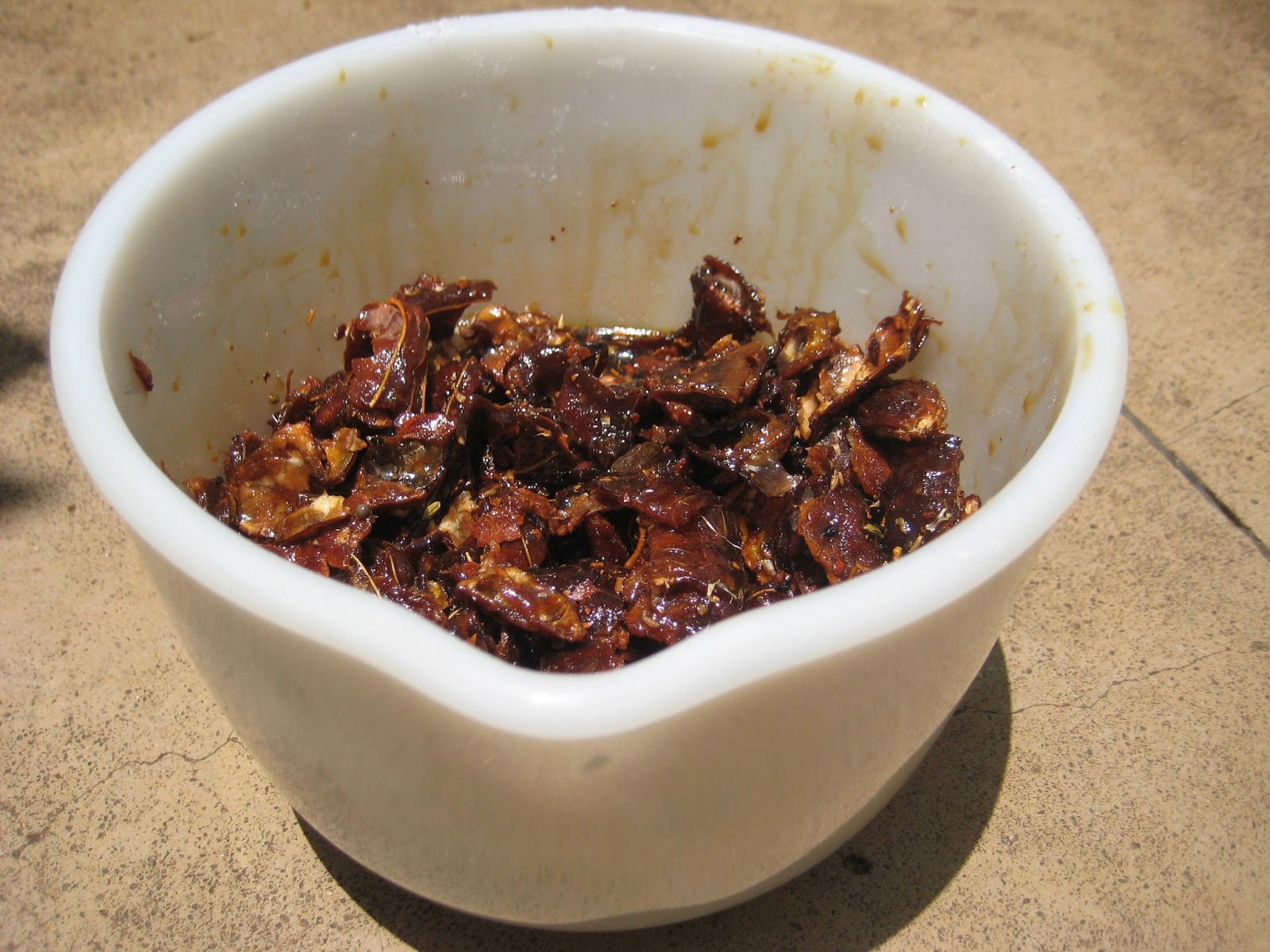
Mix all the ingredients in a clean, dry, non-reactive bowl (I used glass).  Place in the sun for 2-3 days (bring it in each night and cover it tightly with a muslin cloth).  You get a gooey mix, that turns more solid as days go by.  Transfer this to one or more clean glass jars that have been sterilized with boiling water and thoroughly dried.  The flavour of the pickle will mature over time (it tastes sweet, sour and spicy).  The pickle can be stored at room temperature.

A gooey mess!
Footnotes:

The recipe called for raw turmeric powder and mustard oil, a great Bengali favourite that is dabbed on this and that, 'just to be sure'.  While I omitted the turmeric, I fell for the mustard oil, thinking that it might have been included as a preservative or to provide a distinctive Bengali flavour.  As soon as I tasted the raw pickle, I felt the oil was a mistake; it just doesn't go with the rest of the flavours.  I console myself with the thought that its sharpness will be beaten down by the sun and the other ingredients over time, and this seems to be the case (perhaps it will also repel the ants).  The one omission in the original recipe was - salt!  Needless to say, this is essential, for various reasons.  I put in a little extra for good measure but one can tone it down.

Coming to panch phoron - the Bengali five spice mix - this is sold in markets commonly in the east and is now available in Bengali markets in various parts of the country.  Last year, over a family dinner, we were discussing where one could buy the best panch phoron.  Each woman had her own special source and when it was my turn, there was just silence.  On prodding, I revealed that I always made my own, which was the best possible - and got pained looks from all and sundry!  But, it's true!  No one makes panch phoron at home now though it is trivial to do - you end up with good quality spices mixed in the ratio you desire and not some arbitrary packet of condiments.  Opinions about the constituents of panch phoron vary.  The basic ingredients are fenugreek (methi) seeds, cumin (jeera) seeds, nigella (kalonji or kala jeera) seeds, fennel (saunf) seeds and either black mustard (sarson) seeds  or radhuni (no clear English translation for this, the closest seems to be wild celery) seeds, in equal amounts.  I vary the ratio a little, to suit my taste.

My panch phoron
Well, that's it!  I left the pickle in the sun, praying for the absence of clouds, monkeys and ants!  No joke, these fervent entreaties of mine.  During the day, a part of my time is spent monitoring the sky and changes in bird call (that imply the advent of monkeys or rain), evening are spent anxiously scouring the surroundings for ants, which appear silently, swiftly multiply to form an army and march into anything they see, including drinking water (this being summer).  The elements play an important role in the making of a good pickle.

Pickle, innocuously sunning 'midst the lilies

Monday, May 13, 2013

Summer Rain


Cyclones in the east bring to Bangalore an unusual spell of heavy rain.  The first shower is always welcome, sounding a thundery beat, releasing wisps of heat from the ground and bringing a burst of coolness.  However, it is the subsequent showers that create the intense shades of colour (splashes of red, pink, green and cream), the early misty mornings and the tiny rivulets that reflect the sky and trees on the surfaces of roads.


I like to take early morning walks after particularly heavy nocturnal downpours - to watch the birds drying themselves, dogs snoozling in dry spots, to inhale delicious smells of wet earth, trees and grass and to feel the ultra-cool morning breeze.  To listen to the incredibly loud and compelling bird calls, gather the fallen flowers (and in this season - baby mangoes, giant elephant apples and tender tamarind as well) and feel the occasional water droplet run off a branch and plop down on my head.  These pictures, taken midst the breeze, varying light and slow but definite movements all round, adopt a haziness of their own:


 I have a set of old favourite friends that I like to visit - gnarled and wise looking trees - tamarind, banyan, gulmohar, aakash mallige (sky jasmine) and the incredibly elegant jacaranda.  Then I walk down a path lined by fragrant eucalyptus and rustling bamboo.  And finally - back home, to deal with the clogged drains, disrupted phone lines and power failure.  Nothing like a good spell of summer rain!


Saturday, May 4, 2013

Talkin' bout my generation

Yesterday Osibisa performed in Bangalore.  Osibisa needs no introduction to people of my generation.  This Ghanian Afro pop band made waves in the seventies and eighties with their spirited music and their 1983 India tour was even shown on Doordarshan (the one and only national T.V. channel that existed at the time), which was my introduction to this band.

'Afro pop' doesn't do them justice.  Perhaps their own name is more telling.  Band members explain Osibisa as meaning 'criss cross rhythms that explode with happiness'.  Wikipedia says that this is derived from 'osibisaba', the Fante word for highlife.  (Highlife is a genre of music that originated in Ghana about a century ago and spread to the English speaking countries of Western Africa).  Osibisa's music is full of small explosions - mainly of happiness but also of sounds and beats - chants, jazz, rock, hip hop and lots of percussion.  I had never seen them live before and it was a spirited, fun performance despite the fact that the original remaining members are getting on in years (the founder, Teddy Osei, suffered from a stroke some time ago and seems paralysed waist down; but he can still talk and sing and beat the drums with gusto).  The new members are talented, full of life and deeply involved in their music.  As with most African bands, this one generates music and rhythm effortlessly, making everything look deceptively simple.  In fact, it's very hard to produce such peppy stuff that has a happy, lingering quality.

We were lucky enough to make it to the show despite having read about it just that morning.  I visited the venue after seeing a small, uninformative announcement in the papers and reached to find the place buzzing with activity.  The band was up on stage, dealing with lights and sound.  The local staff couldn't help me with tickets so I finally collared the first person in sight, who was a very pleasant young man from the sound section.  (In fact everyone there except the band and me seemed to be awfully young!  I wondered how it would all work out).  As a matter of fact, it worked out fairly easily, with help from the young generation's favourite instrument - the cell phone.  The girl in charge of tickets called someone, who confirmed that she could not give me any real tickets.   Instead she took my cell number and reserved a couple of seats for me.  She told me to call her when I reached the venue in the evening and reassured me that hard copies were not required until the last mo, that everything would be fine; in a nutshell - that it was cool and I could chill.  So I did.

The concert was fun, with a mix of old and new compositions.  For me a lot of it was new, as I had heard only songs which Doordarshan had condescended to show.  Many others tripped down memory lane (physically tripping as well because they were no longer as young and agile as their minds led them to believe).  Basically everyone had a good time including a large bunch of school kids from an international school who left their seats and began dancing at the base of the stage, in front of the performers (and slightly blocking our view).  Not done in my time (we were meant to be seen not heard and in fact, not even be seen on some occasions).  But then, this is a new world altogether..

I give here a few links to Osibisa's music.  One of their most fun songs is 'Who's got the paper' which (like some of their songs) consists of four lines, most unprofound and quite addictive.  There is no live recording on youtube of this song; I provide a 'down the memory lane' kind of link, with pictures of the group etc.

http://www.youtube.com/watch?v=CmLJLuo-wW8

Another link to the same song that reminds me of my most fun, early twirly dances with Rags is

http://www.youtube.com/watch?v=aau3DKVVbSI
Watch it only for a few minutes (at the danger of getting dizzy) and don't resist the temptation to try out a few steps.

The next link shows Osibisa's skill in percussion, followed by their song Kelele (a song of togetherness) and some funk (a rhythmic kind of music).  This recording is not of very high quality but is a good illustration of their live performances and how energetically they reach out to their audience.
http://www.youtube.com/watch?v=wcup5JKTpOc

And finally, their take on the Indian prayer 'Raghupati Raghava Raja Ram' - a bhajan (devotional song), one of Mahatma Gandhi's favourites.  This is something Osibisa has been playing in India on most of their visits, a kind of tribute and a prayer to a common god, sung in their own style.  And, being an upbeat African style, they have zoomed into the intrinsic rhythm (and brought out the beat!) of this old Indian bhajan.  To me, it sounds good but purists may not agree.  The audience yesterday, comprising largely of people of my generation, who had seen many gentle, liberal days, was thrilled with the song.  The other component of the audience (the schoolkids) had likely never heard this bhajan before and were happy with the beat.  So, we all stood and clapped for this group that has succeeded in reaching out to people of many generations, over many decades through their music.

http://www.youtube.com/watch?v=xzT_vvA8Igk

Wednesday, May 1, 2013

Summer Foods


As I sit and write of summer foods in India, I think of two English women who have, in part, made it possible.  Nora, who has served as a constant source of support for my blogging and who has encouraged me to unabashedly write about food (which I thought this blog was perhaps getting an overdose of).  Elizabeth David, whose classic and timeless cookbooks brought 'sunshine and elegance' to post war greyness and continue to do so in modern times.

As the sun sears everything in sight and I long to sit in an air conditioned car, drive to an air conditioned supermarket and buy whatever is available, I am severely admonished by Elizabeth David.  She writes in the introduction to her book "Summer Cooking'' (first published in 1955) :

"A couple of years ago an advocate of the tin and the deep freeze wrote to a Sunday newspaper explaining that  frozen or tinned vegetables were better than fresh ones, as the "pick of the crop" goes straight to the factories to be frozen or tinned.  Can this be a matter for congratulation?  I am not unappreciative of modern marvels, and in its way the deep freeze is an admirable invention, particularly for the United States, where fresh produce has to be transported great distances.  Some foods, game, for example, stand up remarkably well to the freezing process, but let us not pretend that frozen green peas, raspberries, and blackberries are "as good as fresh".  They may indeed be quite adequate, and are an incontestable blessing to people pressed for time or space, or having to provide meals at very short notice, but is it necessary for those not in such circumstances to eat all the food out of season?  Frozen peas seem to have become the almost obligatory accompaniment to every meal, whether in private houses or restaurants; yet how often do we get a dish of those really delicate, fresh, sugary green  peas?  Is it because the "pick of the crop" has gone to the factory instead of to the market and we are therefore unable to buy them, or is it because people no longer know how to shell them and cook them and have forgotten what they taste like?
   The deep freeze appears to have gained over the minds of the English housewife and restaurant keeper a hypnotic power such as never was exercised by the canning factories.  Even leaving out of consideration the fact that the pleasure of discovering each season's vegetables and fruits at the appropriate time is thereby quite blunted, this method of marketing seems to me an extravagant one.  As I write, there are lovely little South African pineapples in the greengrocer's down the road for 1s. 6d. each, sweet, juicy oranges at seven for a shilling, yet people are crowding round the deep freeze in the same shop paying four times as much for a few strawberries in a cardboard packet.  As soon as strawberries and raspberries are in season they will be clamouring for frozen pineapple and cartons of orange juice..."

I read this, sigh, put on my most summery clothes and head out to Russell Market.  The market is surprisingly clean - garbage has been cleared and wonder of wonders, they actually have electricity!  "What's happening?" I ask.  "Elections," people answer with a broad grin.  "The candidates are all terrible but until the elections, we have been given power."  The pun is unintended (appears only in translation; everyone in Russell Market speaks in Hindi).  State elections are round the corner and everyone's being generous with resources.  The market is also cool within, being housed in an old colonial building with high ceilings and plenty of air.  This is a natural coolness; it feels much nicer than air conditioned stores where one is chilled to the bone.

The market is not overflowing with food; summer is a difficult period for storage and transportation.  But much of what is available is fresh and there's quite enough for many good meals.  I buy the usual summer staples - onions, tomatoes, squashes, okra (lady's fingers), aubergine (brinjal).  In addition, real coriander (not the hybrid kind) - the one with a delicate fragrance, green mangoes and mint.  Then, as I am planning a party, I look for something different.  And I find - heaps of basil, celery and parsley (the flat leafed kind, which we rarely see), piles of baby corn and red peppers.  And tiny cucumbers, each displaying a flower at one end.  I can scarcely believe these are cucumbers, fresh off the vine!  I have never seen a cucumber flower in my life!  The shopkeeper is amused.  He throws in several extra pieces for good measure.


From the fruit shops, I select the very last of the strawberries, early mangoes and a couple of different kinds of melons.  I plan to serve some of the fruit with tiny sweet tarts and meringues that I have baked and thick, chilled cream on the side.

Earlier I used to refer to British recipes (which we have a family collection of, since my grandmother's time) for 'Western' cooking but these days I find the Mediterranean ones more useful.  This is partly because we are eating less meat and partly because the weather and availability of ingredients favours Mediterranean (and Asian) cooking.  Of course, often times, I just modify or concoct recipes based on classic compositions.

For the party, we had a thickened curd dip, with hints of fresh coriander and mint.  I served this with a collection of crackers (my experiments with different kinds of flours, nuts and seeds) and with slices of radish and baby cucumbers and crisp celery stalks.  Just for information, the tiny yellow thing in the centre is a cucumber flower!


I made two kinds of pasta - a carbonara (bacon, eggs and cream) for the meat eaters and one with fresh tomato and basil for everyone.  In addition we had a platter of thinly sliced aubergine (brinjal), coated with breadcrumbs and fried crisp.  Also, large dishes of baby corn, red and yellow peppers, onions and basil, that were marinated in wine and olive oil and grilled.


Finally, the dessert - a medley of fruit, pastry, meringue and cream.  People could choose their own combinations.  It all went down smoothly (and cost just a fraction of what it might at a restaurant).
This, of course, is just the beginning of a long summer and my experiments with summer foods.


Saturday, April 27, 2013

Tales Of Kangra Fort

Kangra fort, from a distance
The highlight of our trip to Kangra was our visit to the Kangra fort; something we had left for the very end as we knew nothing much about it and could barely see it atop a hill, somewhere on the outskirts of Kangra town.  Everyone had mentioned various temples and tea estates and Tibetan colonies but no one had really spoken of this monument.

On the last day of our trip, we drove up a winding road, stopped a couple of times to get directions (there is a sign along the way but it points in the wrong direction) and finally reached our destination.  This fort belongs to the Katoch family, the oldest surviving royal dynasty in the world ('Katoch' means 'one who is skillful with the sword').

No fort in India is really dead; its life is embedded in the very stones and earth from where it rose and in tales about how its inhabitants lived (and died).  Kangra was a fort unknown to me and though I had read that it was a flourishing kingdom, I knew nothing of its history.  Fortunately the recent descendants of this family have put together a remarkable audio guide on the history and structure of the fort (evocatively narrated by Roshan Seth, the actor).  This is the first Indian fort I have visited that offers such a tour.  Walking into the Kangra fort, with a headset clamped over my ears playing ancient sounds - the drumbeats of war, old hymns and prayers, anecdotes narrated by the royal family overlaid by descriptions of each part of the fort, was an uncanny experience.  It was like whizzing back thousands of years ago and gradually moving forward again, step by step through centuries.


"Whoever holds the fort holds the hills," was an old Kangra saying - and many attempts were made to attack and defend this fort.  It is a long, sad tale of vicious war, ruthless plundering and treachery repeated endlessly.  Many have attacked this fort but none has been able to hold it and it belongs still to the Katoch family.

The fort encompasses 463 acres
The Kangra fort is India's oldest dated fort, said to be built around 3,500 years ago by Raja Susarma Chandra, a descendant of the Katoch family.  This royal Rajput family was founded by Rajanaka Bhumi Chand in 4300 B.C.  According to the Puranas (Vedic texts), there was a time when the goddess Ambika (a form of Parvati) was fighting a ferocious demon.  It was a long and hard battle and at some stage, a drop of the goddess's sweat fell on the earth.  From this emerged Bhumi Chand of the Chandravansh (the moon clan), who helped the goddess fight the demon.  As a blessing, Ambika granted him the kingdom of Trigarta that is located between three rivers - Sutlej, Beas and Ravi.  Kangra is a part of this region.


Goddess Ambika, a form of Parvati

The earliest references to these kings are found in the Ramayana and Mahabharata, where the kings apparently fought Lord Rama and the Pandavas.  The earliest historical reference to the Katoch clan is a report by Alexander's scribe, describing the valour of the king Paramanand Chandra (also called Porus or Phageus).  Porus was defeated by Alexander on the banks of the Jhelum river in 326 B.C.  So impressed by this Rajput warrior was Alexander that he asked him to become a satrap in Macedonia.

There are subsequent reports on a series of battles involving the Katoch clan, beginning with a battle against King Ashoka (where the Katoch kings lost their lands in Multan) followed by several centuries of fighting against neighbouring Indian rulers.

Stories set in stone

The next mention of these Kangra kings comes in the 11th century A.D., when they were invaded by Mahmud of Ghazni.  Taking advantage of the absence of the Katoch ruler from the area, Mahmud of Ghazni attacked and robbed the fort of its immense stores of wealth - there was so much loot that his scribes had no words to describe it and his army was unable to carry it all.  Muhammad bin Tughlaq and his successor Firuz Shah Tughlaq captured the fort in the 14th century but could not subdue it - eventually they signed a treaty with the Katoch kings.  The Katoch kings also fended off several other attacks including one by Taimur during this period.

In the 16th century, the fort caught the eye of the Mughal emperor Akbar who forged friendship with the Katoch family.  This was just a strategic deal for Akbar; he soon betrayed the kings and confiscated their lands.  In the words of Todar Mal (Akbar's minister), Akbar 'cut off the meat and left the bones', leaving the Katoch kings to fend for themselves in jungles.  Even under these circumstances they made numerous small but ferocious attacks; the Mughals were unable to settle into the fort and eventually the Katoch kings reclaimed their kingdom.

The Mughals tried hard to recapture the fort - they made 52 further (unsuccessful) attempts!  Finally, in the 17th century, Jehangir (Akbar's son) fought a 14 month personal jehad (as he described it) - and won.  After this victory, as Jehangir approached, reading Islamic prayers, slaughtering a cow and destroying temples to make a certain point, the queens of the fort killed themselves by jumping into a well located within the fort.  The well still stands.

Gate near the entrance
The 18th century saw the Katoch family (with the aid of the Sikhs) regain the fort and subsequently, much of the surrounding land.  Trouble began once more in the 19th century, with a series of attacks by the Gorkha army of Gadhwal, who took over the fort after much carnage in 1806. A counter attack was planned by Sansar Chand (the Katoch king) with help from the Sikh ruler Ranjit Singh in 1809.  In return for his help, Ranjit Singh demanded Kangra fort and 66 villages, which Sansar Chand handed over.  However, over a period of time, Ranjit Singh did not keep his end of the pact and began encroaching further into Kangra territory.  Finally, when Ranjit Singh demanded that Sansar Chand's daughter be given in marriage to the son of a Sikh minister, the then Katoch king Anrudh Chand (Sansar Chand's son) fled to Hardwar.  The Sikh rulers ruled for a few years, then ceded this fort to the British in 1846, after the first Anglo Sikh war.  In 1947, after independence, it became a part of Indian territory and has now been returned to the Katoch dynasty.

Sculptures of deities and a deer carved on a gate


The fort stands atop a hill, surrounded on three sides by steep slopes; the only way in is through a narrow winding road (the road we took).  The entrance is through a small courtyard between two gates.  The audio tour at this stage plays the voice of the Katoch descendant telling us how his grandfather taught him never to enter the gates head first, in case there was an enemy within who might behead you.  I look up at the gates - tall, unyielding and almost sinister.  It is impossible to know what lurks behind.  There are 11 gates (several added over a period of time by successive conquerors) and 23 bastions.  Outside the temple gate lies the Andheri Darwaza (the gate of darkness), the first line of defence (before people could reach the temple courtyard).  This is 7 metres in length and wide enough only for two men or a horse to pass through, the intention being to slow down an attacking army at this point.

We cross the gates, one by one, climbing steep stone steps and walking past defaced sculptures of Hindu river goddesses Ganga and Yamuna, broken pedestals and stones bearing old carvings and inscriptions in ancient scripts.  The original, broken temple stands with a huge peepul tree in front of it.  Newer smaller temples have now been built for the deities Lakshmi Narayana, Ambika and also to house one of the earliest known statues of Mahavira.  The Katoch family still visits this temple to offer prayers to their family deity, goddess Ambika.

Temple ruins

Carvings on the old temple 

Further on, towards the highest part of the fort, lie more courtyards and small enclosures that display a breath taking view of the countryside below.  It is a sharp, steep drop on all sides.  The Ban Ganga river flows on one side.  The other sides show vertical walls of sheer rock.  Apparently men were lowered down the cliffs to remove all undergrowth and polish the cliff surface till is was smooth and slippery, ensuring that no one could approach by climbing these mountains.  It remains as forbidding today as it must have been through all those centuries.


The fort emanates tremendous strength and energy; physically it has withstood an earthquake that damaged many surrounding regions in 1905.  The Dhauladhar mountains shimmer in the distance.  The land below looks fertile and green, the river flows swiftly and contentedly.  The sky is filled with eagles that swoop down suddenly onto the highest parts of the fort and then take flight again.  These are magnificent birds but I am a little wary of their swoops.


The air is clear and soundless.  The only permanent residents here seem to be the eagles.

Tuesday, April 23, 2013

What The Ground Says


The last few days have been filled with reports of violence of unnatural and perverted kinds.  Man made and man engendered.  It is at times like this that I look out towards nature and ask, "Is everything all wrong?"  The answer, as some tell us, is blowin' in the wind.  What might it be?  Certainly, the wind, the sky and the earth say different things to each of us, and some of us cannot hear them at all.

This, more than any other, is a time to close our minds, if only for a moment.  To allow ourselves a small respite from the cacophony of cities, discussions of and men and their petty affairs and to look to the spirit for answers.  I quote some Native American voices ( which were recorded as their tribes were dwindling and dying):


"The Great Spirit is our father but the Earth is our mother.  She nourishes us; that which we put into the ground she returns to us and healing plants she gives us likewise.  If we are wounded, we go to our mother and seek to lay the wounded part against her, to be healed."                           (Big Thunder)


"The Lakota was a true naturist - a lover of nature.  He loved the earth and all things of the earth, the attachment growing with age.  The old people came literally to love the soil and they sat or reclined on the ground with a feeling of being close to a mothering power.  It was good for the skin to touch the earth and old people liked to remove their moccasins and walk with bare feet on the sacred earth.  Their tipis were built upon the earth and their altars were made of earth.  The birds that flew in the air came to rest upon the earth and it was the final abiding place of all things that lived and grew.  The soil was soothing, strengthening, cleansing and healing.
   Kinship with all creatures of the earth, sky and water was a real and active principle.  For the animal and bird world there existed a brotherly feeling that kept the Lakota safe among them and so close did some of the Lakotas come to their feathered and furred friends that in true brotherhood they spoke a common tongue.
   The old Lakota was wise.  He knew that man's heart away from nature becomes hard; he knew that lack of respect for growing, living things soon led to a lack of respect for humans too.  So he kept his youth close to its softening influence."                                          (Chief Luther Standing Bear)


"I wonder if the ground has anything to say?  I wonder if the ground is listening to what is said?  I wonder if the ground would come alive and what is on it?  Though I hear what the ground says.  The ground says, It is the Great Spirit that placed me here.  The Great Spirit tells me to take care of the Indians, to feed them aright.  The Great Spirit appointed the roots to feed the Indians on.  The water says the same thing.  The Great Spirit directs me, Feed the Indians well.  The grass says the same thing, Feed the Indians well.  The ground, water and grass say, The Great Spirit has given us our names.  We have these names and hold these names.  The ground says, The Great Spirit has placed me here to produce all that grows on me, trees and fruit.  The same way the ground says, It was from me man was made.  The Great Spirit, in placing men on the earth, desired them to take good care of the ground and to do each other no harm..."                              (Young Chief)
                                                                           

"Oh, yes, I went to the white man's schools.  I learned to read from school books, newspapers, and the Bible.  But in time I found that these were not enough.  Civilized people depend too much on man-made printed pages.  I turn to the Great Spirit's book which is the whole of his creation.  You can read a big part of that book if you study nature..."                                                   (Tatanga Mani)

"I had learned many English words and could recite part of the Ten Commandments.  I knew how to sleep on a bed, pray to Jesus, comb my hair, eat with a knife and fork, and use a toilet....  I had also learned that a person thinks with his head instead of his heart."                         (Sun Chief)

"The man who sat on the ground in his tipi meditating on life and its meaning, accepting the kinship of all creatures and acknowledging unity with the universe of things was infusing into his being the true essence of civilization.  And when native man left off this form of development, his humanization was retarded in growth."                                                                        (Chief Luther Standing Bear)


"What is life?  It is the flash of a firefly in the night.  It is the breath of a buffalo in the winter time.  It is  the little shadow which runs across the grass and loses itself in the Sunset."          (Crowfoot)

(Quotes from 'Touch The Earth', compiled by T.C. McLuhan)

Friday, April 12, 2013

Mangoes Arrive!


Here they are - slowly ripening on trees, piled high on pavements, stacked attractively in fruit shops - the first mangoes of the year.  A few weeks ago, green mangoes made their appearance.  These are sold for pickles and chutneys which seem almost essential with every meal given our jaded summer appetites.  The early windfall mangoes - tiny little things without any seeds have a very different flavour from the big green ones.  They are earthy and smoky, more like berries than fruit.  They are mixed with a few spices (largely chilly and salt) and made into a fresh pickle eaten with rice or rotis.

This year, so far, we have tasted three different kinds of mango pickles already - one with whole baby mangoes from north Karnataka, another with freshly sliced raw mangoes from an orchard in Maharashtra (lots of some unidentifiable Maharashtrian masala and the taste of fresh, raw mango), a third golden yellow (laced with ground mustard and chilly) from Uttar Pradesh.  Also, my own strange experiments, of mangoes cooked with jaggery and whole spices (not very successful but not dreadful either)!  Very soon will begin my next phase of cooking with unripe mangoes - green mango rice with hints of fresh coriander and coconut, sweet and sour green mango chutney and shredded mango salad with peanuts.

Tiny, flattened dried mangoes
As for the ripe mangoes, early varieties from Andhra Pradesh and Maharashtra and our own state of Karnataka are slowly trickling in.  Apart from buying at regular shops or pavements, each year I visit Maharashtra Mandal, where a lady rents some rooms to store and sell Ratnagiri mangoes.  This year was no different and last week I trundled up to this inconspicuous building in the middle of the crowded lanes of Gandhinagar.

Maharashtra Mandal stands at a corner, apparently quiet but buzzing with frenetic activity deep inside the 'mango rooms'.  Rows of crates are stacked from floor to ceiling in the inner rooms; these are periodically dragged out when customers arrive.  The crates are expertly flipped open, the contents revealed to customers (each of whom has a precise set of requirements).

The customers here are invariably aggressive and extremely particular about each piece of mango being the very best - as if they were buying bullions and not fruit.  The quality of a mango is determined by the size and external appearance and the fact that it must be blemishless, much like models in fashion parades.  This is quite amusing to watch.  Customers are also invariably in a hurry.  These various requirements, somewhat contradictory in nature, means that one person rapidly empties out a crate; mangoes are selected or rejected, prices are discussed and some bargaining attempted.  Other crates are opened up, the selected mangoes are counted and repacked.  Other customers must wait their turn to follow the same procedure.  I of course dispense with the haggling and the close scans of each piece.  I have been visiting this place for years and the lady knows the kind of price range and mangoes I ask for (I generally prefer small and ripe ones whereas most people like large and semi-ripe mangoes).  I also don't mind blemishes for most of them seem to be skin deep.  This considerably speeds up my mango buying and makes place for the next customer.

This is not to say that mango buying occurs one person at a time.  There are two or three parallel processes occurring, the main constraints being floor space and man power.  We all tread carefully around the mango piles, minimize out footprints, prefer to ram into each other rather than bump into any of the precious the mangoes (we would probably have to buy the squashed ones).  It is all rather fun as long as one is not impatient.  Voices yell "450 - 400"  "No, this is 600," much like a stock market and they refer to bulk prices based on the mango sizes (nothing is weighed here, it is sold by the dozen).

Mango selection
What is so special about these mangoes?  It's not the price, which initially tends to be higher than market rates and slowly drops as the season proceeds.  It is the fact that these mangoes are plucked from orchards, immediately packed in crates and sent to this building.  Here they lie ripening slowly and naturally in straw; their flavour and aroma intensifying gradually as days go by (they may take a few days to a few weeks to completely ripen).  These naturally ripened mangoes taste much better than the chemically ripened ones.  Their flavour is more intense, there are no unripe, sour or over-ripe patches.

Mangoes ripening in straw
This particular variety crinkles and turns a deep, orangey-yellow when ripe.  The mangoes fill my house with an enticing smell and part of the joy is to pick them out of the crate and select the ripest of the lot.  They are uniformly exceedingly delicious - sweet and flavourful with very little fibre; the only danger is the tendency to over-indulge!  


#Header1_headerimg { margin: 0px auto }