Saturday, November 23, 2013

The Lunchbox - An Unusual Indian Film

I saw this movie a couple of months ago but didn’t post a review because I felt the original trailer (without subtitles) did not do justice to the film.  Now I see that a new trailer (with English subtitles) has been put up, which is considerably better. 

Not that trailers are required to recommend a film, in fact, if you want to keep everything a surprise for yourself, don’t watch the trailer!  You could watch the second link (to a song) that I have given at the end, to get an idea of the characters and photography.

This film has done well in mainstream cinema even though it does not pander to Bollywood stereotypes and deals with serious issues (in a slightly romanticized fashion).  Perhaps it has done well simply because people are tired of watching continuous and excess glamour and endless song and dance sequences, perhaps it is because there is so much food in the story (food is stated to be the spine of the film, but I don’t think that is correct, however, food does seem to envelope or affect almost all the characters in one way or the other) or perhaps because it is an unusual love story.

I like the film for several reasons – the main one being its intelligent and sensitive approach to showing lives of different kinds of people or communities that still exist in India but that media generally doesn’t want to depict (they are so unglamorous and so not India shining!  Nor are they awfully depraved or violent!!).  It does so without crossing the fine line that would take it to realms of being clichéd, didactic or even dark.  It is about quirks of fate that transform people’s decisions and in turn, their lives.

The main actress, Nimrat Kaur, stated in an interview that the hardest thing for her to do in the film was to de-glamourize herself.  Indeed she looks remarkably unlike her off screen chic self, but this is the face of thousands of Indian women, quietly tucked away, working to keep their families together.  Nimrat has given a superb performance, especially as this is her first major role in a mainstream film.  The other two main actors, Irrfan Khan and Nawazuddin Siddiqui are veterans and are a joy to watch anytime.  They convey so much through their body language and style of speech; this is why it’s not worth watching a dubbed version of the film.  The official DVD with subtitles has not been released yet but I’m sure it will appear in the market soon.  The unseen and often heard ‘Auntie’ upstairs is done by Bharati Achrekar , a renowned Marathi actress.  All the other actors are very competent in their respective roles.

The Lunchbox was originally meant to be a documentary on dabbawallahs (the large army of people who unerringly deliver tiffin boxes from place to place in Mumbai) but eventually took the shape of a romantic feature film.  (It is hard to believe that it is the first feature film made by the director, Ritesh Batra.)  As mentioned earlier, this film has no real songs.  It has one borrowed song though, which adds a bit of charm and makes those unpalatable truths much easier to bear.  How does one deal with a life of ‘quiet desperation’?  Is life really as bad as one makes it out to be?  And finally – as the movie posters and trailers ask – can you fall in love with someone you have never met?  The film lets you find answers for yourself as it unfolds.

Apart from the romance and the philosophy, the well edited script and the skillful photography (showing the city of Mumbai), there are some tongue in cheek moments that are wonderfully done.  One in particular is when Ila (Nimrat) asks a dabbawallah whether her carefully packed tiffin box is reaching the right destination and he replies, “We have been commended by Prince Charles and Harvard; we never make mistakes!”  But as Shaikh  (Nawazuddin) says, “Sometimes the wrong train can take you to the right station.”  Watch this heartwarming and thought provoking film to get a glimpse of India that is rarely shown on screen.  I am attaching two links: the first is the trailer with English subtitles and the second is the small song sequence from the film.


Thursday, November 21, 2013

Masters Of The Sarod

I have never paid much attention to the sarod, I don't know why.  This is a musical string instrument which probably originated from the Afghan 'rubab' and has been modified considerably since. The last time I heard the sarod in a concert, some years ago, it sounded a bit laguorous and didn't capture my attention.

Last week, when we were invited to a concert featuring Amjad Ali Khan and his sons, Amaan and Ayaan, I was not sure what to expect.  There is so much publicity surrounding these artists (and the queue that we had to stand in, even though it was a concert by invitation, was so long) that I began to feel fretful and wonder why I had come.

But it was wonderful - a beautifully explained and presented set of tunes and ragas by Amjad Ali Khan and an inspired performance by his sons and the accompanying percussionist on the tabla.  It opened my mind to the incredible range and depth of this string instrument and the very different style of playing (strings were plucked using only the finger nails).  Amjad Ali Khan's expertise lies in understanding and expressing the mood or emotion of a composition; he displays a certain gentleness and involvement in the process that emanates to the audience.  I attach a link below showing an excerpt of his concert with Zakir Hussain (which he dedicates to great musicians and the memory of those musicians who are no longer with us).

http://www.youtube.com/watch?v=mAlEsGPOpB0

Amaan and Ayaan are very skilled and intense players, each with his own style.  Speed is one of their strengths and they went back and forth, effortlessly, with increasing tempo, the tabla player adding his bit, keeping the audience mesmerized.  However, I personally preferred Amjad Ali Khan's music and the way he could express all kinds of things with his instrument.  The link below (showing all three in a concert) gives an indication of this.

http://www.youtube.com/watch?v=rQ9xzPYE4c8

This family (the Bangash gharana) is only one of several families of music (gharanas) of the sarod.  Amjad Ali Khan's ancestors migrated from Central Asia to India.  Amjad Ali Khan's father, Haafiz Ali Khan, an iconic musician, settled in Gwalior, under the patronage of the royal family.

Ali Akbar Khan, another incredible sarod player (no longer alive), of the Maihar gharana, has left behind wonderful recordings.  His father, Allaudin Khan, left home and moved from Bangladesh to India when he was a child, to learn music.  He eventually became also a royal court musician, an eminent teacher - and could play 200 instruments!  Of these, he selected to teach his son the sarod (which he had structurally modified considerably) - an instrument that he felt could produce the sound of many instruments put together.

I had unwittingly heard Ali Akbar Khan many times over while listening to 'Concert For Bangladesh' - a recording of two incredible benefit concerts held for Bangladesh, by George Harrison and Ravi Shankar in 1971.  The Indian section features Ali Akbar Khan along with Ravi Shankar, but somehow, much of the attention is focussed on Ravi Shankar, perhaps as he was co-organizer.  However if you listen to this folk song (a tune called Bangla Dhun), it begins with Ravi Shankar on the sitar and subsequently Ali Akbar Khan joins in on the sarod, adding a depth and richness that the sitar alone would not provide.  Unfortunately, I could not find a video recording of this and am attaching an audio link.

http://www.youtube.com/watch?v=Vo7lxXW6tO0

A couple of these recordings are over ten minutes, but you need only to listen to a few minutes of each, if you wish, to get an idea of the sounds.  Steeped though I am in musical ignorance, I feel I have learnt much by attending the last concert and I am glad I impatiently stood in line to do so!

Sunday, November 10, 2013

The Changing Shape Of Yoga

Some stray thoughts on the changing 'yoga scene' within and outside the country -

As with many ancient Indian systems of study, yoga was not formally put down in writing until thousands of years after it began.  Information was passed on from teacher to student and the system diversified as multiple schools arose.  This imparted a certain flexibility to the system; each school emphasized specific aspects and developed them over time.

In the last few years, however, the changes have been more drastic and driven by market forces rather than real reasons for change.  I have been thinking about this for some time now as each time I drive out to the main road, I see large hoardings proclaiming how you can lose 3 kgs. in 15 days by attending a certain yoga class.  These classes are apparently packed, mostly with younger people.  These, and other classes, now offer yoga that is practiced in tune to different kinds of music, somewhat akin to aerobic workouts.  To me, the postures demonstrated don't look perfect, but apparently that's not what people are looking for.  Stretching in silence is boring.

There have always been some teachers who have taught while continuously giving directions and verbally correcting students.  One aim of this exercise is to try and keep the students' minds "on the job".  I feel fortunate to have attended a class where the practice was carried out mostly in silence.  My yoga teacher often corrected me, initially by physical adjustments, and subsequently just by signs indicating which part I had to readjust.  The emphasis was on focussing inwards.  When one attempts this, the mind settles down and you attain a certain peace and inner equilibrium.  This internal focussing brings a kind of transformation that nothing from the outside can ever achieve.  But often I suppose people don't trust themselves (or their students) to this silence and to listening to oneself from within.

My yoga classes are long over as my teacher moved to another town, to teach.  I was glad to be able to meet him over Diwali, when he was visiting Bangalore.  Some of our conversation revolved around the numerous classes and advertisments for yoga that are flooding the cities.  He told me that his current classes were very poorly attended.  I was amazed, for I believe he is a very good teacher - compassionate and experienced with knowledge of some old, classical styles.  I asked what the reason was, as many other yoga centres seem to be doing very well.  He shrugged and said that people found the class too intense and wanted it simplified.  This sounded strange because one important aspect of his class has always been that each person goes at his or her own pace.  He claimed that people didn't want to put in the effort on a regular basis.

Of course, many other factors might also play a role.  His traditional (and fixed) hours may not be convenient for all; many yoga studios offer walk in classes through the day with different teachers and different styles of yoga.  It's hard to compete with that but all these are led-classes (where everyone in the group follows one format); very little personal attention can be given especially if the numbers are large.

There are also apparently certain times of the year when yoga classes are more frequented.  In the 'yoga hotspots' which have emerged in different parts of India, teaching yoga is often a '6 month business' that coincides with the travel and holiday season.  The rest of the time, the schools shut down or slow down and the better teachers go elsewhere to teach.  This makes it difficult to sustain a serious school in one of these areas.

Over-secularisation is another hazard to the teaching of yoga.  Several people have asked me about the religious overtones of yoga.  The answer is, of course, that there are none.  Well, not absolutely, because, as with most ancient systems of philosophy, yoga is based on certain assumptions about what comprises an individual and how a person is linked to a higher source of energy.  This is what the philosophy of yoga has in common with several other Indian systems of philosophy and spirituality.  The religion and rituals of Hinduism have also developed in this milieu and there is naturally a social and cultural overlap in the way some of the thoughts are expressed.  But that is a very tiny aspect and is not relevant when it comes to the practice of yoga.  The aim (rather definition) of yoga (as mentioned in the earliest known text, the Yoga Sutras of Patanjali) is to alleviate fluctuations in the mind, intellect and conscious self.  Nothing more (and nothing less)!

Many schools outside India have stopped reciting the prayers that are typically chanted at the beginning of the class so as to make people of various (or no) leanings comfortable.  I have no cause to complain about this all-inclusive approach.  The prayers were always in Sanskrit (for obvious reasons), a language not everyone is comfortable with and one that most people are not familiar with.  However I continue to say the prayer I have been taught; I find the sound very soothing and helpful in focussing my mind.  This is a prayer to the teachers of yoga, beginning with Patanjali, asking them to help us remember the objectives of yoga in our practice.  I always find it a good reminder and a nice way to express my gratitude to those who have helped me learn.

Certain semantic aspects of new approaches to yoga have taken me completely by surprise.  Recently a friend told me that in some Indian Universities, teaching of Surya Namaskar (the Sun Salutation) has been banned because of its religious connotation.  She attended a class where the instructor refused to teach this set of movements.  Surya Namaskar is the beginning (the warm up exercise) of yogasanas (yogic postures).  It is traditionally done facing the east.  In some schools of yoga, a prayer to the sun is chanted first.  We don't say any prayers because we follow a style where the movements are uninterrupted and repeated at least for five or ten rounds (about half an hour), leaving no extra breath for anything!  This is a particularly beautiful set of movements that warms each part of the body without causing any pulls or strains (by 'warm' I mean that in summer one is dripping with sweat at the end of this practice!) and expels mucous that may be blocking the nose or throat, clearing the respiratory passage.  These are a small subset of the regular yoga postures that have been linked together in a dynamic fashion.  Often when one has no time for a complete practice, one just does Surya Namaskar to get the circulation going.  To eliminate them without understanding anything about their purpose, just because they happen to be called Sun Salutations, seems to me a tremendous pity.

These, of course, are some of the stranger trends I have come across.  I'm sure there are successful schools which rise above populist sentiments and focus on the depth and vast range of possibilities that yoga offers.  But they are few and getting harder to find.

Thursday, October 24, 2013

Rain, Apples and Cinnamon


Just a few days after the cyclone, the north-eastern monsoons have stepped in, or rather gusted in, bringing thick clouds and rain at all hours.  We barely got a fortnight of sunshine squeezed in between two heavy monsoons.

I am grateful for the apple season - there's a bumper harvest this year and apple growers in the north are concerned about crashing prices.  No trace of this is evident down south, in Bangalore, where we are still subsisting on pomegranates and oranges.  These fruits are refreshing, but there's not much in terms of wholesome baking that can be done with them.

And these days, steeped in misty mornings and wet evenings, hot apple with a scent of spice is what I long for.  Fortunately, several visitors from Delhi have brought an unending supply of fresh apples for me - tangy golden ones and sweet red ones from the hills of Himachal and Kashmir.

I have spent the last few weeks trying out a range of apple recipes with the bruised, left overs (the best way to eat them of course is as they are) and here are some of my observations:

For sheer elegance, nothing can beat a classic French apple tart - a layer of crisp pastry topped with soft apple filling and covered with thin, lightly caramelized apple slices and perhaps a bit of glaze.  A variety of taste and texture in every mouthful.

One of the tastiest apple desserts, in my view, is Tarte Tartin - the French recipe where apples are bathed in caramel and topped with a crisp, buttery pastry.  I don't throw the tart on the floor (as the legendary Tartin sisters supposedly did) or even turn it over on a plate (the more conventional way) because I feel the pastry stays crisper when it remains on top.  No tartin pans or special skillets are required to make this here, for we have our own stainless steel dabbas, which make very good containers.

However, this comes more in the 'indulgence' category of desserts and it inevitably requires a side serving of cream, which adds to the calories.  I like crumbles too, but I face the same problem - if they're hot and crisp, they beg for a scoop of ice cream or a dollop of cream on the side.  So, instead, for everyday wholesome snacking, I make a plain spiced apple pie.  This uses a very basic crust and a delicious filling of a little bit (but not too much) of all the things that go well with apples - lemon, orange, brown sugar, butter and cinnamon.  Nutmeg and cloves are good too but apple and cinnamon have always been a classic pair.


When the stomach refuses fresh apples, apple stew is a marvel.  Apples, sliced and stewed with just a little sugar, clove and cinnamon are light and satisfying.

And if you like apple in your salad, apples, avocados and walnuts make for a nice combination.  But when they are fresh, I just like to eat them plain!


Sunday, October 13, 2013

Vastrabharana - the Annual Saree Exhibition


Come October and Bangalore saree shoppers are on the look out for signs of Vastrabharana.  This is an annual saree exhibition and sale organized by the Crafts Council of Karnataka; weavers and saree sellers from around the country (typically one from each region) are invited to participate.  Unlike many other cloth exhibitions, the emphasis here is on sarees, generally those obtained directly from craftsmen.  This year however, I found that about one third of the sellers were designers or individuals running their own shops.  Not that I have anything against this, but it leaves less room for weavers from smaller places (whose sarees I inevitably end up buying).

However, it's always nice to visit the stalls, to see sarees everywhere - on walls, on shelves, draped alongside mirrors and held in the hands of prospective buyers or sellers.  Yards of beautifully woven material - silk, cotton or a mix of the two as many modern weavers are now using.


This year I bought two sarees, both from traditional weavers - a soft pale green Maheshwari with colours of spring and autumn mixed together in a beautiful way.


The weaver, of course, came from Maheshwar (Madhya Pradesh) and had brought with him a range of these typically light sarees in silk or cotton, woven generally in one main colour with a similar or contrasting pallu (part that is draped over the shoulder).  These are easy to wear for most of the year.


The second saree I selected was quite different - a rich green-gold shot silk with a yellow-orange border and a pallu that was vividly woven with peacocks in orange, blue, green and purple.


Yes!  A typical Paithani saree from Maharashtra.  Colours are bright and thrown together in unimaginable combinations but they look splendid when worn on special occasions.  And with the festival season round the corner, there's no dearth of special occasions!

Thursday, September 26, 2013

Here Comes The Sun!


After more than three months of continuous rain and cloudy skies, we have the sun back again.  Not just peering through and sending a few weak rays, but gloriously beaming down on us.  What a tremendous sense of relief - and such delight to see blue skies once more.


The plants look up cheerily and my pots of sprouts perk up (I had begun planting them because it became impossible to buy good greens due to so much rain).


I open my cupboards, shake out my cotton sarees. These can now be worn, washed, starched and sun dried without a second thought.


I too have been hibernating in the grey gloom of cyclonic weather.  I celebrate these warm golden days (I don't know how many there will be before the winter rains begin!) by writing this little blog and beginning on a round of baking - crusty bread, crisp crackers and more..


Tuesday, September 10, 2013

The Kingdom of 'Sun Shield' and 'Serpent Jaguar'


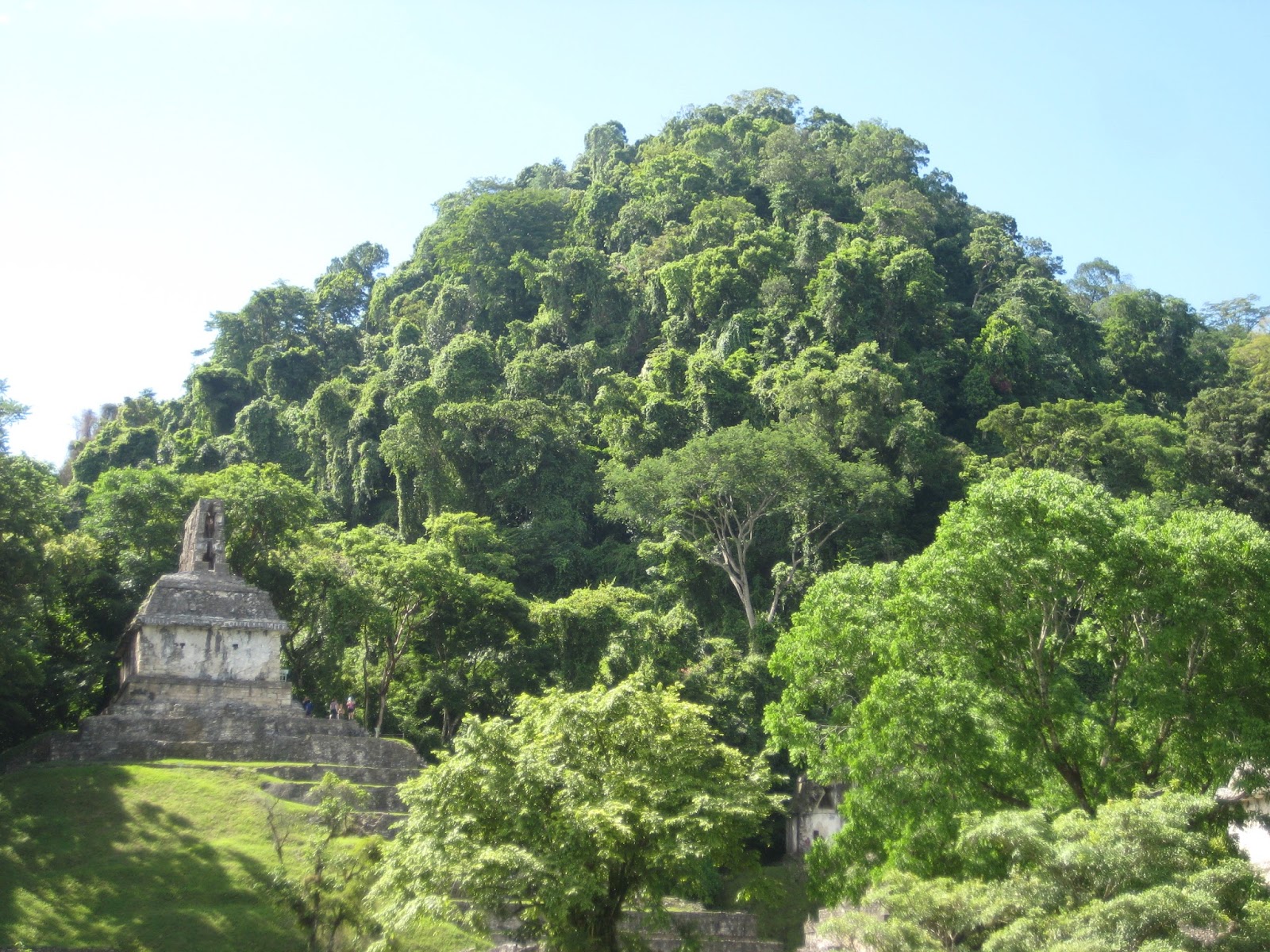
Palenque - a modern name for an ancient city in the Chiapas area, is one of the best preserved Mayan sites.  Much of it is still believed to be buried within the forest for the trees spread far and wide, covering everything if they get a chance.  This empire began around 100 B.C., flourished under the rule of the king Pacal (Sun Shield) and his son Chan Bahlum (Serpent Jaguar) in the 7th and 8th centuries A.D.  Its decline began in the 9th century A.D.

This was also one of the first cities to be re-discovered after many centuries.  In 1746, a Spanish priest, Padre Solis, was sent by his bishop on an exploratory trip to Santo Domingo de Palenque.  He had heard of a buried city and came across impressive remains that lay deep in the forest.  After his reports, several explorers visited the area and each contributed and added to the information that is now available about this site.


Pacal ruled Palenque from 615 A.D. to 683 A.D. and constructed a huge 'Palace' complex.  This may have served as the home for the royal family (there are buildings with naturally air cooled 'bedrooms' - laid out with a stone bed and ventilation channels, systems for sewage management and also water canals) but the complex may also have served as an area for religious and cultural ceremonies.  A large tower rises above the Palace.  This is believed to be a watch tower or, more likely, an astronomical observatory.


Near the palace stands the Temple of Inscriptions - a splendidly built structure, tapering in pyramid style, with a flattened top and a central room filled with intricate, carved symbols.  For a long time, people had been trying to study this central room, however, in 1952, the Mexican archaeologist Alberto Ruz found that this building contained much more than was apparent to the eye.  Hidden by slabs in the floor of the temple lay an entrance to a long staircase.  This led to a high ceilinged crypt - a Funerary Crypt that contained a monolithic, highly inscribed and decorated sarcophagus.  The inscriptions indicated that this was the tomb of King Pacal.


The Temple of Inscriptions was closed for renovation when we went and I was greatly disappointed, for this is one of the highlights of the archaeological site.  I had foolishly avoided visiting a life size model of the tomb at the museum at Mexico City, thinking that I would shortly be seeing the original!  Apparently all the contents of the tomb have also been moved to Mexico City - and there were several treasures that it originally contained.  An amazingly carved funerary mask of jade with eyes of shell and obsidian had been placed over the face of the king.  Two realistic stucco heads, possibly portraits of the king, were placed close by.  The lid of the sarcophagus is a complex relief with astronomical symbols, interpreted by scholars to depict the Cosmic Tree (a symbol of the Milky Way) or the 'White Road' along which the spirit of the dead king travelled before it was reborn into a new life.  The inscriptions mention that Pacal was succeeded by his son Chan Bahlum, who constructed three great temples in this complex in specific cosmological orientations.

The three temples are the Temple of the Sun, the Temple of the Cross and the Temple of the Foliated Cross.  These are also pyramid like structures with flattened tops with roofcombs.  The dedicatory ceremony for the Temple of the Cross was celebrated at a time of the year when three planets were in conjunction with the sun.


Most of the inscriptions and several of the reliefs on the temples have been deciphered and copies are seen in the small but well designed site museum.


We spent the better part of the day walking around, exploring these and many other smaller structures that are clustered around this site.  While each building is partly worn out and sometimes broken, the feel of the entire area - a whole incredibly designed (now ruined) city is intriguing.  One wishes one knew more about the lives and beliefs of those who lived here.


We also took a short walk in the adjoining forest.  Howler monkeys shrieked in the distance and invisible birds called out periodically.  Other than that it was quite still.  Tree roots clambered over small ancient buildings and temple-like structures.  Our guide pointed out trees and plants that were used locally for food, as natural dyes, as medicine.  He broke off a large termite mound and rubbed some termites on his skin - this serves as a mosquito repellent.  Then he popped some in his mouth.  "Delicious!  Minty!  Try them!" he said and we did.  To our surprise they did taste of mint and were rather refreshing.


At the end of a long day we trudged back, negotiated (rather fought over) our return fare and took long, hot baths to wash off all the grime and sweat.  We had dinner at El Huachinango Feliz (which roughly translates to 'The Happy Snapper').  This place is packed every evening, with locals and tourists.  Prices are reasonable and service is efficient.  They serve all kinds of Mexican food but are known for their seafood.  Along with our drinks they served a large plate of avocado and small, delicious shrimps witha sprinkling of lemon juice and salt.  This was on the house and a perfect beginning to our large meal.  It was followed by fish and shellfish, cooked in Mexican sauces and served fresh and piping hot!  Then, we somehow managed to walk back to our hotel (a few metres away), climb into bed - and were soon fast asleep.


#Header1_headerimg { margin: 0px auto }