Monday, July 29, 2013

Glimpses Of Mexico City

Traditional Mexican kitchen, painting in El Cardenal
As we landed, blurry eyed from our early morning DC flight to Mexico City, we could catch only a few glimpses of the city from the air.  It was covered with clouds and a light rain pattered incessantly.  We could not see the mountains and volcanoes that surround Mexico city from up above.  As we left the plane, the height and coolness of the place suddenly hit us (Mexico city is about 7200 feet above sea level) and I wondered if we should have brought more woolens.  Fortunately, a light sweater and jacket sufficed.

We were met by our old friend and her incredibly pleasant and steady driver at the airport.  Battling the chaotic traffic (very reminiscent of Delhi) requires steady nerves and a ton of patience.  Mexico city is densely populated (about 57 people per sq. km., so the statistics say) - and the roads are groaning with vehicles (despite the fact that there is a very efficient metro system in the city).  There were cars, buses, two wheelers, real taxis and fake ones (discernible only by the order of alphabets on the number plates) - the only thing we missed here were the cows!

We stayed with our friends, in Coyoacan - the place of the coyotes - a beautiful area where once a river flowed.  Now it has picturesque old houses, narrow, winding lanes and bird-filled trees.

After a delicious lunch of tortillas and chicken with mole and glasses of hibiscus juice and tamarind water, our friends took us around.  It was a whirlwind tour of the city covered in the short time we had - to show the diversity of the region : the large green spaces and cramped roads, the famous murals and architecture, the local bazaars and the world renowned museums.  During most of my stay, I shunned my camera, just wanting to soak in the atmosphere and sights.  I do this sometimes (and generally regret it later, when I am unable to describe all that I have seen and experienced, to others!).  Fortunately others were not so lackadaisical.

On the first evening we visited UNAM, the second oldest university of the Americas.  It has a sprawling, green campus dotted with architectural wonders including beautiful mosaics and sculpted murals.  We walked around to get a feel for this venerable University; it seemed like a wonderful place for students.

Mural atop a University building
We returned home for tea and then visited a nearby marketplace.  An old church stood at the entrance and much to our delight, a wedding procession had just begun to enter.  "Weddings are lucky," we were told, and this one certainly lit up the entire area.  A few feet away, a stage was being set for live music.  Further down there were rows of stalls selling the most interesting looking food - an incredible variety of chopped fruit, vegetables, tortillas, steamed and roasted corn, all kinds of fried snacks, juices and more.  We stopped to try some hot guava juice - thick, soup-like, laced with cinnamon and very slightly sweetened - it was delicious in the cool, rainy weather.  Our friends bought all kinds of things for us to try- pumpkin seeds and more held together with a kind of caramel, paper-thin wafers of different colours sprinkled with seeds and nuts, fried snacks served with a thin sauce.  We then entered the actual market, which was filled with art, craft, textiles, jewellery and hand made products of a high quality.  Very similar and yet very different from India.  Our friends bought us a painted wooden box made of a local citrus-scented wood and I bought myself a jaguar T-shirt, which made me feel very powerful when I put it on!

The next day was Sunday and we rose early in anticipation of our Sunday breakfast at 'the best breakfast place in town' (as our friends said).  It truly was.  El Cardenal (named after the bird) - located close by, in a huge traditional house with gleaming wood, beautiful stained glass, white linen and large vases overflowing with fresh flowers.  Everyone was impeccably courteous and no one was rushed us (even though a long queue built up as we sat down for breakfast).  I was quite amazed at the unhurried atmosphere - families large and small, sat together and ate their food with relish amidst much chatter.  "It is the Mexican way," I was told.

It was a memorable meal, that began with a plateful of hot, freshly baked rich breads and a cup of steaming chocolate that was made at our table.  The Mexican chocolate is lighter (and I think, tastier) than the Spanish variety.  It is generally made with milk but one can also request for a version made with water than is still lighter and has a more intense chocolate flavour.

Then, to my great joy, we were able to taste two specialties that I had read about and had been wanting to try in Mexico (and it was very fortunate that we ordered them because I did not see them anywhere else subsequently).  Huitlacoche - a corn fungus (that was served in tortillas).  This is a fungus that grows on the ears of the corn, transforming them into dark coloured, earthy tasting nuggets.  The second was an omelette (Mexicans are experts at cooking eggs) stuffed with nopal (a cactus) and a kind of ant larva - a surprisingly tasty combination.  This was one of the most memorable meals that we had in Mexico.  We were also offered lots of fresh fruit but could only manage a slice of Mexican pineapple (a different variety from the American kind).

Tortillas with corn fungus
Omelette with cactus and ant larvae
Tortillas with a baked tomato sauce dish
After this, we staggered out and managed to head towards the Museo Nacional de Antropologia (Museum of Anthropology) - a world famous museum and the best anthropological museum I have seen so far.  On Sundays, there is no entrance charge and we trooped in along with many other families.  The museum is far too large to be covered in a day, it requires almost a week to do justice to all its exhibits.  It has some visiting foreign exhibitions that change periodically (at the time we visited there was an exhibition on Indian miniatures) and a large number of galleries showcasing Mexican civilization through the centuries.  Some of the permanent highlights include the colossal Olmec heads (there seem to be no bodies, just large, incredibly carved, ancient heads) from sites in Tabasco and Veracruz, sacred objects from the cenote near Chichen Itza, a replica of Pacal's tomb from Palenque, a model and layout of the Aztec capital Tenochtitlan (currently central Mexico city) and the original gigantic Aztec 'Stone of the Sun'.

Stone of the Sun
We spent half a day at the museum and then stepped out, into the Chapultpec park - vast, green and filled with picnicking families.  Suddenly we saw some people in brightly coloured clothes, wrapping vast amounts of rope round themselves.  Traditional acrobatic dancers!  Another wondrous surprise for us.  We sat and watched them climbing up a tall metal pillar and securing themselves to the top.  A single musician remained below, the others (some carrying small musical instruments) were high up above.  All of a sudden, the music started and they launched themselves, upside down, off the post and descended slowly, in wide graceful circles, almost flying through the air, until they reached the ground.  It was a spectacular performance.  Then they nonchalantly untied themselves and drifted away.  We clapped and dropped some money into the can that was being passed around.


After this we went for a drive through the most amazing and varied sections of town - tiny lanes, broad boulevards (some of the roads are closed to traffic on Sundays, leaving a clear path for cyclists - this was a heart warming sight, and we wished that the same could be done in India).

Finally, we drove past the Gandhi bookstore (one of the best in the city), past the sculpted coyotes, to reach home - in time for a Sunday nap and a good Sunday evening gossip session followed by a small piano concert.  Later at night we met my husband's college friend, who had driven miles in the pouring rain to come and see us.  We sat in a little cafe and watched him eat his dinner (we were too full to eat anything except a bit of rice pudding that was thick, creamy and liberally sprinkled with cinnamon).  Caught up on news.  He has recently opened a hotel in Baja California and invited us to stay.  Alas, we had no time, but I did secure a job as a Yoga teacher in his hotel!  An offer to be seriously considered at some other time, in the future.  As we parted he handed us a bagful of guavas- they were small, ripe and delicious.

Thus ended our last night in Mexico city.  We left (after another excellent breakfast and a bagful of gifts) the following morning, carrying with us sunny memories of Mexico city and all our friends.

(Note on photographs: All pictures were expertly taken by Gossi Soto but Blogger has somehow changed the dimensions in the process of uploading.  Some of the pictures have been slightly distorted in this process.)  

Tuesday, July 16, 2013

Travels in Mexico : Impressions

I learnt many things on my recent trip to Mexico.  First and foremost that x in 'Mexico' is actually pronounced h.  I was terribly ashamed that a large part of the world (first and foremost - me!) blatantly mispronounces the name of this country.

Our hosts - family friends of yore (a remarkable Indian-Mexican relationship that has spanned decades and generations) were overwhelmingly kind and affectionate.  "My home is yours," a Mexican (and also Indian) saying seemed really to be put into practice.  They were delighted to hear my first Spanish word : salsa - a fiery little word that encompasses so much that is quintessentially Mexican.

Mexico is a country of extremes and diversity, of violence and tolerance, harsh living and incredible hospitality - somewhat like India.  Several Mexicans that we met on the streets or in shops were convinced that there was a strong bond that linked Mexico and India through the centre of the earth.

Our journey was filled with road trips - passing through vast expanses where no one lived, halting at ancient Mayan ruins - trying to understand the immense body of knowledge and beliefs that were contained within these.  Also, inevitably, stopping at small local places to try traditional favourites.  It was enjoyable and soul satisfying.

We travelled a fair bit in the few days that we had - beginning with Mexico city, moving on to Chiapas (close to Guatemala) and ending in the Yucatan penninsula (not far from Cuba).  We were on the move, everyday, and my mind is so full of impressions that it will take a little time to disentangle them and write them down, neatly and systematically!  Meanwhile, here are some visual impressions of the places we visited.  More will follow!

Home made tacos, fresh off the griddle

Home made tacos with many layers of topping - our breakfast

Heading towards Guatemala

Palenque - ancient site of tombs and temples

We try some live forest termites - they taste like mint!

Sign outside one of the many temples in Palenque

Hieroglyphics (museum reproduction, Palenque)

Hot and flavourful!

Tamales - corn with a pork stuffing, steamed in corn leaves

A succulent iguana

Music everywhere! - Merida

Elegant Spanish dancing, Merida

Eating human hearts (and other gory stories), Chichen Itza

Pyramid yoga - a north American recipe for sunstroke! Chichen Itza

Street food festival, Merida

On Sunday the streets are for cycling, Merida (and many other Mexican cities)

Wednesday, June 19, 2013

Strolling The Streets Of DC


Washington DC, a grid-like city, is simple enough to navigate.  But I am focussing on the sky, the little green patches overflowing with lilies and lavender, the magnolia lined pavements - and I get lost - once in a while.  I'm here for a few days; the weather is pleasant with a few fierce storms thrown in.  Somehow, each time I try to walk through the rain as the weather channels predict the beginning of a storm, I end up reaching  home just as skies begin to clear.  Oh well, nothing like a nice hot cup of tea and hazelnut chocolate after a wet walk.

I visit the zoo with my nephew (a tall, strapping youth who accompanies me to show me his favourite animal sections) - and we promptly get lost.  Blame it on the lack of GPS, says he, for he uses only his cell phone to find his way.  I blame it on all the wonderful distractions along the way and my overriding desire to see the komodo dragon (which is ensconsed in the invertebrate section for some unknown reason).  The bonus of going in circles is seeing all kinds of amazing monkey action - gorillas thumping their chests, orangutans ambling on overhead bridges, tamarins - tiny, rust-gold in colour, leaping about excitedly.


On Saturday we visit Eastern Market, a semi-covered market, with some permanent stalls and some temporary ones.  Saturday is when farmers come to sell their local produce.  I am amazed by the colourful vans standing outside and delighted by the rows of fresh fruit, vegetables and flowers that I see.  Inside the market, my nephew incurs the wrath of a German cheese seller as he looks at the cheeses while talking to her.  "Look at me when you are talking to me!" she yells and I intervene, to pour oil over very troubled waters.  Outside, I incur the wrath of a large black woman as I bend down to click two tiny dogs resting under a table.  "My property!" she yells.  My nephew swiftly propels me away.  I am amazed at the number and variety of dogs in this place and how placid they are despite being miles from home, immersed in a sea of new faces and scents.


Fiddlehead ferns, freshly harvested

Cacti!
Different kinds of basil


On Sunday we do a typical 'DC brunch'.  It is asparagus, mushroom and goat cheese quiche with a green salad for me, omelet (as the Americans call it) with rock shrimp and mozzarella for my nephew and eggs, grits and home made bacon for his wife.  And a plate of doughnuts, without which no true American breakfast is complete.  Everything is delicious but equal to two Indian sized servings.  I plan to starve the rest of the day, but of course, succumb to the delights of dinner (a hefty pizza)!


DC looks prosperous and glows with purpose.  Despite this, I detect a sense of isolation amongst several people on the streets and in the buses.  How else can one explain sudden unwarranted bursts of temper and rudeness in public places?  Nothing like NY, which surpasses all cities in rudeness and frazzled nerves.  But enough to make one wonder if things are as smooth as they appear on the surface of this capital city.  I suppose everyone needs something nice to come home to.  We come home to a large television - online streaming is swift and efficient and delivers to us new and wondrous BBC shows (which we watch as we tuck into our dinner).  Only on days when the NBA games are not being screened, that is.


Sunday, May 26, 2013

Foods (And Food Writers) Of The World

My attempt to learn more geography and history (subjects which never interested me in school) has somehow got entangled with my culinary interests.  The result is a growing collection of books on food from different parts of the world!  Not mere cookbooks, for I initially selected them because they served as guides to various countries' geography, history, political past and culture.

I began with some of 'The Beautiful' series quite by chance - Mexico The Beautiful was the first, a gift from an old Mexican friend.  These books are a cross between a small encyclopedia and a large coffee table book, with lots of recipes thrown in.  An interesting and informative combination.  What got me thinking a little more about them was when I read 'China The Beautiful' by Kevin Sinclair.  This was so well written that I wondered if the author was not merely a cook or gourmet traveller in the country.  After a little search, I discovered that he had been a veteran and irrepressible journalist, who  spent forty years reporting on Hong Kong.  This led me to thinking about the universal appeal of thoughtful and well written books.

The next step in my search came when I looked at some Time Life volumes which were part of the 'Foods of the World' series.  These were lying at the very bottom of a large bookshelf, almost concealed, in a second hand bookstore.  They had been lying there for some time and I had seen them earlier but had never bothered to give them a second glance.  I was usually searching for more modern and relevant cookbooks.  This time, I thought of Kevin Sinclair and Time Life's reputation for serious, high quality writing and opened these books.  They seemed filled with quaint pictures, interesting-sounding recipes and very personal interpretations of food.  The Time Life teams appeared unusual - some were writers, some journalists, editors and professional photographers.  I bought the few books that were stocked in the bookstore and am slowly going through them.

I find them quite fascinating, not just because of what I learn about the country they deal with but because of their intrinsic subjectivity.  The mind of the author comes through distinctly, lending a particular style to each volume that sets it apart from the others (though I sense that some volumes have been over-zealously edited).  Equally interesting are the reasons given for creating these books; these shed light on the authors and their regions of interest.

I quote below, from various authors, their reasons for writing about food.  (My main reason for writing about food is that it satisfies me from within.  But others have put it far more eloquently and movingly than I can ever hope to):

One of the nicest descriptions that I have come across in general is that by M.F. K. Fisher, (one of America's earliest food writers), when asked why she chose to write about food and hunger :  

'When I write about hunger, I am really writing about love and the hunger for it, and warmth, and the love of it . . . and then the warmth and richness and fine reality of hunger satisfied.'

Certainly the last century was filled with horrors of war and its aftermath in many parts of the West, where most of these food writers lived.  Elizabeth David, in the preface to the second edition of her book 'Mediterranean Food' writes:

'This book first appeared in 1950, when almost every essential ingredient of good cooking was either rationed or unobtainable.  To produce the simplest meal consisting of even two or three genuine dishes required the utmost ingenuity and devotion.  But even if people could not very often make the dishes here described, it was stimulating to think about them; to escape from the deadly boredom of queueing and the frustration of buying weekly rations; to read about real food cooked with wine and olive oil, eggs and butter and cream, and dishes richly flavoured with onions, garlic, herbs and brightly coloured Southern vegetables.'

For many authors of the Time Life series, the assignment began as a personal quest that shaped the style and manner of presentation of each volume.  The quest varied in nature depending on the person and their circumstances.  Dale Brown, writer of 'American Cooking' travelled within America at a time when there was no scarcity or rationing and these were his main concerns :

'New York, New England, the middle Atlantic States and the Mid-West - have long been familiar to me.  But until recently I had not had an opportunity to acquaint myself with the food in other parts of the country and to study the influences that have affected it.  And so, my wife and I, with our two year old daughter, embarked on an extended gastronomic tour of the country.  Before our journey was over, we would have tasted everything from Florida's Key lime pie and South Carolina's wild orange marmalade (a real rarity) to Louisiana's mirliton, or vegetable pear, stuffed with Gulf shrimp, and Oregon's kippered salmon.  I welcomed so unique an opportunity to show my Dutch wife this beautiful country and to introduce her to its regional cooking - but I was also, to tell the truth, a little worried.  I felt that mass communication and mass travel might have succeeded in throwing a net of conformity over many formerly colorful areas.  How wrong I was, only the trip could tell.'

For some, moving to a new country (especially from the West to the East) was a eye-opener of sort.  Emily Hahn began 'The Cooking of China' with her description of the first meal in a Shanghai restaurant, where she was a guest of some Chinese friends:

'For one thing I was exasperated by the behavior of my host, who made what seemed to me a ridiculous fuss about giving the order.  After all, I said to myself, we weren't celebrating anything, but simply going to eat.  Yet the host went into a long, incomprehensible (to me) discussion about the menu with the proprieter.  With every minute that passed I grew more bored and hungry, wondering how people could possibly find so much to say about food.  Long after the proprieter had gone away with the order, I continued to feel indignant.
   Then the first dish arrived - soup with sliced pork and Chinese vegetables - I tasted it.  I looked up in amazement, waiting for someone else to comment on its excellence, but nobody did.  They spooned it up busily, and after a moment I followed their example.  I was considering a second bowl when the waiter brought in a number of dishes that he put on the table in a haphazard way, all together.  One was steamed fish in black bean sauce, tender and juicy, full of different tastes of spice, and enriched by the sauce.  There were spareribs of just the right crispness, and a dish of vegetables that I did not recognize, crunchy and as fresh-colored as if they had not been cooked.  I asked how this effect was attained, and was told that they had been "stir-fried", or cooked quickly in very hot oil.  There was also chicken cooked in soya sauce, and that completed what my host called a plain, simple little meal.  It certainly showed me how much I did not know about Chinese food.  I had come late to the realization, but I determined to make up for lost time.'

Her determination resulted in a book explaining the food and cooking of different parts of China!

Rafael Steinberg, a correspondent during the Korean war and later Tokyo's bureau chief, was married to a Japanese and was introduced in some detail to Japanese food through her and her family.  (This book is also filled with beautiful photographs taken by Eliot Eliofson, a painter and photographer.)

In the prelude to his book 'The Cooking of Japan' Rafael Steinberg quotes from the writings of Faubion Bowers, author, world traveller and aide-de-camp to General Douglas Mac Arthur during the early years of the post-war occupation of Japan:

'The time finally came for me to visit my dream of Japan, and as soon as I set foot on the good ship Hikawa-maru in Seattle - oh yes, aircrafts were invented but they weren't flying the Pacific - I was confronted with what the passengers called "The Choice".  You could have either a full Western meal or a full Japanese one.  I asked for Japanese food, got it three times a day and stuck to it for the whole 21 days of the voyage to Yokohama.  My motives were mostly brummagem, but partly too, I like to imagine, good sense.  I was determined to learn Japanese for, as I now tell the story, I knew war was coming.  I have never believed that "you are what you eat" (in Japanese they drink snake's blood for longevity), however I am convinced that you can't learn a language without enjoying the food of the nation.  Just think of the loss of idiom an English-speaking Japanese might feel if he didn't understand things like a lover being the "cream in his coffee", or something being "as English as roast beef".
   Now, in retrospect, I must admit I explored Japan's gustatory and culinary arts the hard way.  I tortured myself with umeboshi, ultra-sour plums, on deck while watching the sun rise.  I snacked on odorous, fermented soya beans, called natto, at night before retiring .  I even tried again and again those little cakes printed in the shapes of flat flowers, which taste dry as chalk and crumble into sandy powder with every bite.  But along the way I encountered myriads of delight and miracles of surprising pleasures.  Sukiyaki and tempura, as it goes without saying, and noodles too, and tonkatsu, which loses totally in translation if you say "pork cutlet".  The warmth of bean soup, the dew-like freshness of thin soup, the brilliant clarity of good, first-quality soya sauce, and thousands of other sauces, each bound, as in a marriage, to its own particular mate.  Where else in the cooking world can you have so light, so greaseless, so sparkling a set of flavours and textures that turn into aromas or melt as soon as they reach your mouth?
   The day soon came when raw fish was on the ship's table d'hote, and I discovered that it didn't taste raw, or even like fish.  And with this conclusion I joined the ranks of astonished foreigners whose numbers increase, like school children and textbooks, year by year.  By now the last threshold was crossed, and I was enslaved to Japanese cooking...
   ...Today I often find myself "hungry" for Japan, and once it got so bad I cooked up an excuse for a quick trip back just because I was hungry.  So, there are dangers in becoming habituated to this great cuisine.  However, a book such as this one at last makes possible the impossible: You can now do it yourself in your own home.  Here, too, be careful.  My own son said to me recently, "Please, Dad.  Not tofu again!"  But just wait until he grows up.'

And finally, a book on African food by a very interesting author, Laurens van der Post.  I couldn't believe that such a book might actually exist!  I was curious about the food of Africa - a whole mysterious continent that one knows little of, and that too seen through the eyes of one who was born there and had extensively explored and written about it.  He drifted between Africa and England and finally settled in England; his biographical claims and descriptions were mired in controversy after he died, but some of his words remain haunting and evocative.

In his book 'African Cooking', he says:

'My earliest memories of Africa, and of my life there, center around the large dining table in the home of my Boer grandfather, in the Orange Free State, deep in the interior of south Africa.  And almost invariably the scene in this theater of my past is the evening meal.  I used to wait for this meal, six decades ago, with the same kind of excitement that I was to experience much later as a drama critic in London, before the curtains rose on the first night of a new work by a friend from whom I expected much.  As in a darkened playhouse, the excitement would start when the maids began to light the heavy oil lamps in the long passage that led from the front door on the veranda surrounding the house.  At last they came to the dining room, and the biggest lamp of all.  In the center of that room was a great table made of an African wood so hard and dense that a piece of it would sink like iron if it was thrown into water; and over the center of the table, suspended in massive chains, hung an immense oil lamp made of brass  that glowed and shone like gold...
   The sense of smell is surely the most evocative of all our senses.  It goes deeper than conscious thought or organized memory and has a will of its own that the mind is compelled to heed.  Since the scent of cinnamon is the first to present itself to my memory of the moment when the great lamp was lit and the great table set and ready, I must accept the fact that my first coherent recollection of the drama of our evening meal begins with the serving of a typical milk soup of the South African interior...
   The fragrance of cinnamon would still be adrift in the room when the more acute sense of cloves announced that the main course was on its way.  This would be a superbly pot-roasted leg of lamb, a standard dish of the interior.  Studded with cloves from Zanzibar, less than 2,000 miles from us as the crow flies, the lamb - itself a product of our farm- was so tender that it seemed to flake rather than cut at the touch of my grandfather's carving knife.
   Mixed with the smell of cloves was that of saffron rice and raisins - a dish that was not typical of the interior, but one that had been introduced to my family by my French grandmother.  My grandfather served it more as apart of a ritual remembrance of all she had meant in his life than as mere gratification of his own liking for it.
   With these varied scents, there came the sharp fragrance of quince jelly, which was always served with our roasts, burning like a maharaja's ruby in its own crystal bowl, and tasting as brilliant as it looked.  Then, since this was winter, came a dish of dried spotted beans, which we know as governor's beans; centuries ago , presumably, some forgotten governor had first planted them in the vast kitchen garden that his masters, the Dutch East India Company, had made of the Cape of Good Hope.  (Their purpose was to provide fresh foods to forestall scurvy among Dutch sailors in the spice trade.)  At grandfather's house the beans were cooked in mutton stock and pureed tomatoes and were accompanied by baked pumpkin flavoured with nutmeg.
   Last of all came a bowl piled high with yellow peaches, turned to burnished gold by the alchemy of the great lamp overhead.  These peaches still glow in my memory like an offering of fruit from some sheltered grove of Hesperides.  Like everything else we ate they were the product of our completely self-sufficient farm.  They were preserved whole in glass jars in the summer, so skillfully that much of their original savor remained.  I have yet to discover, in this technological age of ours, any preserved fruit that could rival those peaches.  They brought into the winter night the fullness of the summer gone by and the promise of its return...

...Some months ago I badly injured my right arm and was told by doctors that, if I ever meant to use it for writing again, it would have to be rested for many months.  This enforced ease seemed a wonderful opportunity to revisit the whole of Africa.  I would see again the lands I had explored for 40 years of my life; I would see what Africa was achieving now that so many influences of European colonialism were vanishing.  I intended, once I could write again, to set down my appraisal of this new emergent Africa.  But everywhere I went I found myself too profoundly depressed by what I saw to write dispassionately about it.  In an Africa that is so much at one in its deepest nature, millions of human beings are involved in divisive conflicts, killing one another from Mali to Zanzibar and The Congo on a scale that even the reviled former imperialists would never have permitted.  The political and social scene in Africa seemed to me eroded and bankrupt, and I instinctively rebelled against joining in any form of activity so negative and destructive.
   All this may be part of the price Africa must pay before it can enjoy ultimate unity.  But I was certain that I could not further this unity by entering into the ideological conflicts and rivalries that are tearing the continent apart.  I came to believe that embattled Africa could best be regenerated by a profoundly nonpolitical reassessment of common aims and ideals - a rediscovery of the overriding values of the dignity of man and the reverence for life.
   Then I wondered, often in desperation, what in the world all the warring systems, countries, tribes and races still had indisputably in common.  Oversimple and childlike as it may seem, one answer that popped up from my imagination was food.  If I did what has never been done before - if I wrote about the food of Africa as a whole, about African man and his ways of eating and cooking from the Stone Age Bushman to the sophisticated gourmet in Addis Ababa or Capetown - perhaps I could render some service and at least pay homage to my troubled continent.  In a way, I would be doing what my grandfather did at those meals at his homestead, when he assembled all the races around his table every night.  In a small way, too, I could recall for my readers the fact that all men are one in their needs and searchings, that whatever set them apart is evil and whatever brings them peacefully together is good.  This is what I have tried to do in the chapters that follow.'

The down side of so much subjectivity is that one depends heavily on the writer for accuracy of reporting, but these books (mostly published in the early seventies) are an incredible read.  So here  begins a culinary adventure of a different kind for me - one that starts in the mind and that can be converted into things one can smell and taste (the books come with recipes) - more exciting than reading mere geography or history!

Wednesday, May 22, 2013

Yoga And Movement

Some weeks ago I read an article in a newspaper encouraging more people to do yoga.  It said that even sitting in your office, massaging your fingers was a very useful kind of yoga.  Undoubtedly the author had noble intentions but a loosely written article serves more to fuel misconceptions than to provide concrete help.

This brought to my mind many thoughts about yoga and it's connection with movement.  Yoga is believed to be derived from the Sanskrit word 'yuj' (to join).  It is the means by which the body, mind and soul can be united to form a whole individual and the individual can also unite with a greater cosmic spirit.  My yoga teacher sometimes questioned this definition.  What does it mean to be united and is this the true root of the word?  I think we will never know the answer to this and to many other aspects of yoga, which had not been written down but just passed on from teacher to student for generations.  This is one reason for the many interpretations of yoga and what it means.

My teacher proposed an alternate plausible root for the meaning of yoga - the word 'ga', which means movement.  He said, yoga is that which helps us move, in different ways, from one level to another.  When he said this, of course, he was not necessarily talking about movement in a physical sense.  However, in the minds of many people (especially as yoga continues to be marketed more aggressively both in the West and in India), yoga is equated with physical movement.  It is seen as a form of activity or exercise that increases flexibility, reduces stress and provides therapeutic benefits.

This is very far from the classical definition of yoga as found in Patanjali's yoga sutras (the earliest known treatise on yoga).   Patanjali, in fact, does not even consider the body while defining 'yoga'.  He describes yoga as "Yogah cittavrtti nirodhah" (sutra 1.2) .  Yoga is that which prevents movement in the consciousness (in practical terms, that which stops an individual's mental flow of thoughts and blocks tendencies driven by intellect and ego).  This can be achieved in a systematic manner, through an eight-fold path called 'Ashtanga yoga' (ashta - eight, anga - parts), of which only one part (asana) deals with physical movement.  The rest deal with other aspects that help one's practice - rules and norms of conduct, self discipline, physical fitness, mental steadiness and finally an attempt to move inwards and to know the truth (after mastering the mind, body and emotions).

Within the realm of physical movements in yoga, repetitive movements do have a role to play.  They are considered important when the person is weak or injured and does not have the energy or ability to adopt and hold specific postures.  But under normal circumstances, these kinds of movements or massages would not fall within the ambit of asanas (or postures).  Certainly I do not know of any classical asana which recommends that one massage one's fingers (or any other part).

Patanjali, in his yoga sutras, fleetingly refers to asanas as "Sthira sukham asanam" (sutra 2.46).  That which provides happiness and stability is an asana (or posture).  Happiness and stability for yogis implies achieving a level of equilibrium such that one is completely at ease and is unmoving in a particular position.  This requires a concerted act between the body, mind and breath.  When one is perfectly at ease in a posture one can relax, attempt to breathe slowly, deeply and uniformly, focus inward and allow the mind to passively observe oneself.  When I approach this state, I feel calm, still and alert - and it's extremely enjoyable holding oneself steady in an asana.

This feeling comes to many who practice yoga, at certain points or moments.  The hard part is to sustain these moments.  These moments of stability, stillness and peace are harder to come by in a led class, especially physically demanding classes.  People invariably tend to look outwards - at other students or at the teacher (or at the clock!).  Mastering physical movements brings an exhilaration of its own (because the mind is compelled to stop thinking and also because one achieves something concrete), but I would not always term this activity a practice of  'asana'.  There is a fine line.

Ultimately technical details are not the most important: what is important is whether the practice makes you feel healthier and more balanced.  However, when everything under the sun is labelled 'yoga' with no lucid explanations as to why it might work, my mind does object!

Friday, May 17, 2013

Make Tamarind Pickle While The Sun Shines

A ripe pod of tamarind 
Tamarind or Tamrhind (Indian date, as Arab traders named this dark, fleshy pod) has filled every nook and corner of my house.  It peeps out from myriad plastic packets that have been stuffed in cupboards, boxes, buckets and even reclines gracefully at the entrance, catching my eye and reminding me to do something about it.

Neatly packed, ready to go!
I like many things about tamarind - the beautiful trees that flourish in tropical weather, overflowing with tiny green leaves, the creamy yellow-red flowers and most of all the fruit, with its tongue puckering sourness.  I can never resist picking up fallen pods, breaking them open and popping a piece into my mouth and cringing as the sourness makes its presence felt.  It's not often one comes across old venerable tamarind trees any more; for some unknown reason  people have stopped planting them (perhaps they take up too much space) but I always get a burst of nostalgia on seeing a large tamarind tree.  I have spent many happy hours under these ancient trees (beginning with a wonderful tree near the West End Hotel swimming pool in Bangalore in days when one could happily wander around such places, gathering fallen pods under the indulgent eye of a waiter with large moustaches, who had nothing much to do other than serve the evening diners).

A tree of many seasons
Tamarind tree in bloom
To return to the present, the reason tamarind pods are flooding my house is that this is the harvest season.  Some weeks ago, I received a gift from a friend - tamarind that had just come off his tree.  It had barely been cleaned and retained  its 'fresh from the tree' appearance.  It was undoubtedly delicious just as it was, however there is a limit to the amount of fresh tamarind one can consume daily (unfortunately, this figure is inversely proportional to one's age).  The tamarind was too good to be used for cooking, hence I decided to make a pickle.  There is a Bengali pickle made with tamarind and, after some probing, I was fortunate to be sent an old family recipe from Kolkata.  Tetul is the Bengali word for tamarind; it sounds quite poetic, especially when compared to the mundane Hindi 'imli'.  Tamrhind, of course, has a more dashing ring to it, though I can't say that this fruit reminds me much of dates (and the tree is actually a native of tropical Africa though its scientific name is Tamarindus indica).

The second reason I am flooded with tamarind is because a couple of weeks ago, another friend called to say that she had harvested some tamarind from her farm and could I find out if anyone might want some?  Since then, I have become a sort of sales agent, commissioning and selling packets of farm fresh, organic, sun dried tamarind.  This has been a pleasant exercise, helping me renew contact with several acquaintances and friends.  Some people have reserved many kilos and are yet to come and collect it and as my friend only visits the city once in a while, the bags repose in my house, awaiting their new owners.  I am pleased to mention that I successfully sold all the tamarind but at the end of it we realized she had barely broken even!  Next year, the prices will be fixed more wisely (but we have generated a lot of goodwill this season)!

Now, to the pickle.  I'm sure better recipes exist and I will need to optimize this one.  I have modified it a little, for as many old family recipes go, the original recipe was a mere outline.  After hearing  horrific tales of my husband's grandmother, who purposely left out one key ingredient each time someone asked her for a recipe, I requested members of the current generation to verify this recipe before sending it.  It turns out that no one makes tamarind pickle any more.  So I cannot guarantee that this method produces a 'genuine' Bangali pickle, but it tastes fine and is as good a way as any, to eat tamarind without blowing out your taste buds.  Here goes:

250 g tamarind, fresh off the tree (with outer pod and seeds removed - you can use store bought stuff too!)
250 g jaggery dissolved in a cup of water, boiled and strained
1 Tablespoon panch phoron (a mix of spices, see footnote) (I roasted and lightly pounded this)
2-4 whole red chillies (or to taste), powdered (I de-seeded and roasted them first)
2 Tablespoons mustard oil (see footnote)
50 g salt (I mixed regular and rock salt to make it less salty, I think 30 g regular salt should probably do)

Use as many (or as few) chillies as you like
Jaggery - a key ingredient
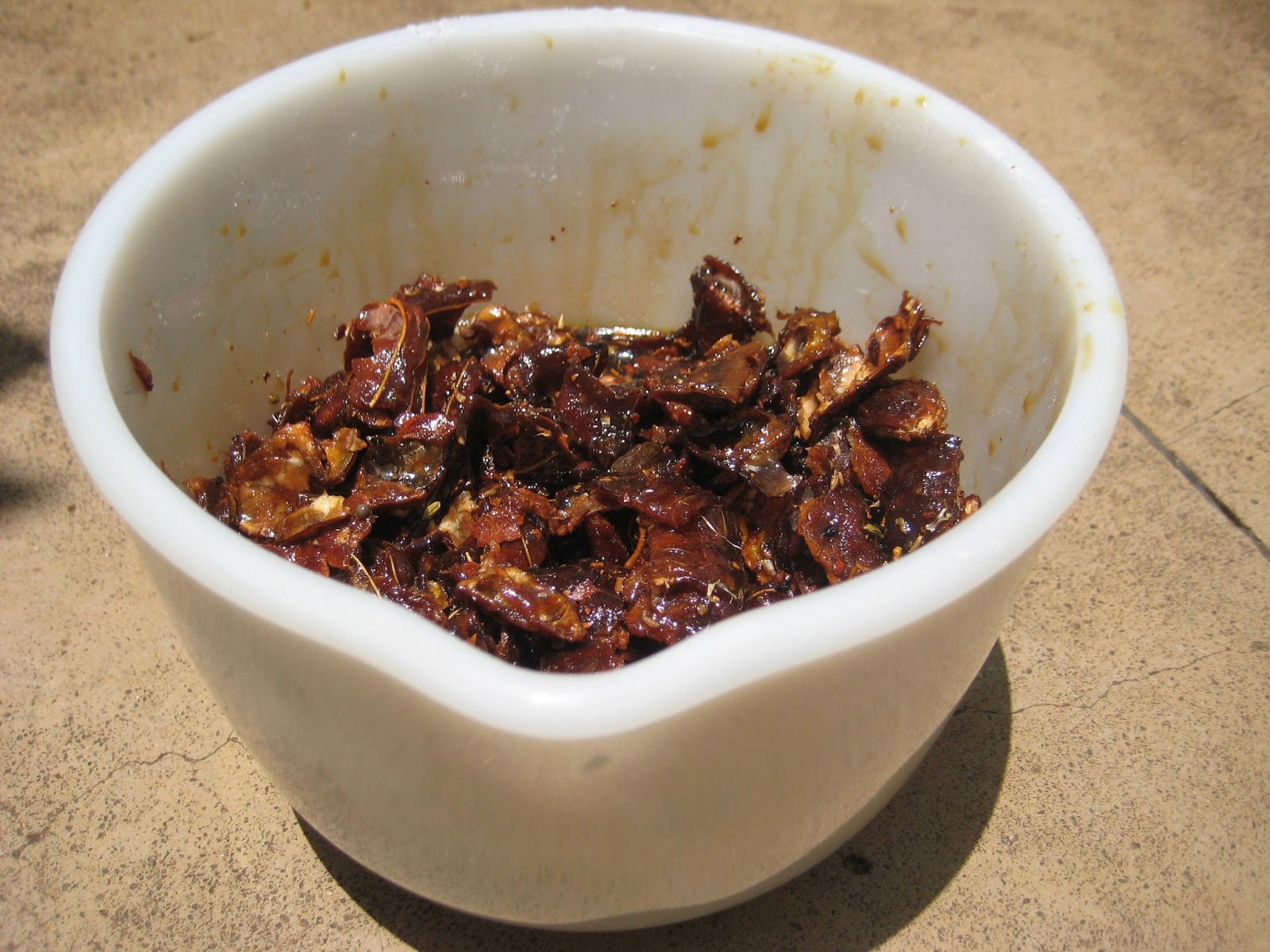
Mix all the ingredients in a clean, dry, non-reactive bowl (I used glass).  Place in the sun for 2-3 days (bring it in each night and cover it tightly with a muslin cloth).  You get a gooey mix, that turns more solid as days go by.  Transfer this to one or more clean glass jars that have been sterilized with boiling water and thoroughly dried.  The flavour of the pickle will mature over time (it tastes sweet, sour and spicy).  The pickle can be stored at room temperature.

A gooey mess!
Footnotes:

The recipe called for raw turmeric powder and mustard oil, a great Bengali favourite that is dabbed on this and that, 'just to be sure'.  While I omitted the turmeric, I fell for the mustard oil, thinking that it might have been included as a preservative or to provide a distinctive Bengali flavour.  As soon as I tasted the raw pickle, I felt the oil was a mistake; it just doesn't go with the rest of the flavours.  I console myself with the thought that its sharpness will be beaten down by the sun and the other ingredients over time, and this seems to be the case (perhaps it will also repel the ants).  The one omission in the original recipe was - salt!  Needless to say, this is essential, for various reasons.  I put in a little extra for good measure but one can tone it down.

Coming to panch phoron - the Bengali five spice mix - this is sold in markets commonly in the east and is now available in Bengali markets in various parts of the country.  Last year, over a family dinner, we were discussing where one could buy the best panch phoron.  Each woman had her own special source and when it was my turn, there was just silence.  On prodding, I revealed that I always made my own, which was the best possible - and got pained looks from all and sundry!  But, it's true!  No one makes panch phoron at home now though it is trivial to do - you end up with good quality spices mixed in the ratio you desire and not some arbitrary packet of condiments.  Opinions about the constituents of panch phoron vary.  The basic ingredients are fenugreek (methi) seeds, cumin (jeera) seeds, nigella (kalonji or kala jeera) seeds, fennel (saunf) seeds and either black mustard (sarson) seeds  or radhuni (no clear English translation for this, the closest seems to be wild celery) seeds, in equal amounts.  I vary the ratio a little, to suit my taste.

My panch phoron
Well, that's it!  I left the pickle in the sun, praying for the absence of clouds, monkeys and ants!  No joke, these fervent entreaties of mine.  During the day, a part of my time is spent monitoring the sky and changes in bird call (that imply the advent of monkeys or rain), evening are spent anxiously scouring the surroundings for ants, which appear silently, swiftly multiply to form an army and march into anything they see, including drinking water (this being summer).  The elements play an important role in the making of a good pickle.

Pickle, innocuously sunning 'midst the lilies
#Header1_headerimg { margin: 0px auto }